
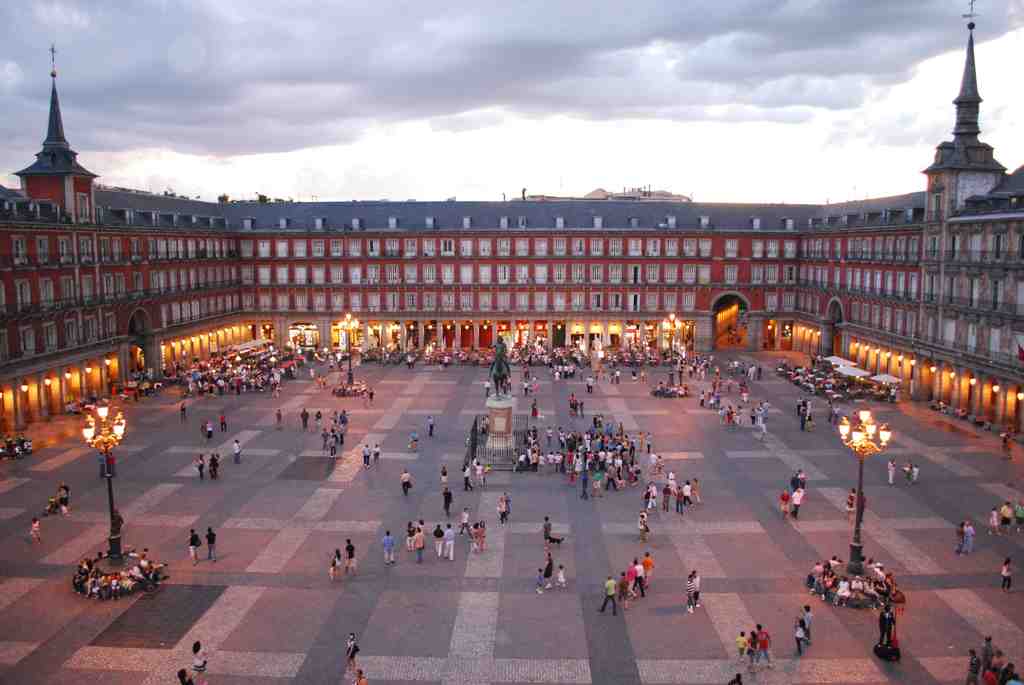
Ahead of you, you’ll spot a wide, open plaza surrounded on all sides by tall red buildings with rows of white windows and elegant arches, and right in its heart stands a bronze statue of a king on horseback-if you see a crowd and hear street music drifting through the air, you’ve found the Plaza Mayor.
Welcome to the grand stage of Madrid, where history didn’t just quietly take notes-it made a ruckus! Close your eyes for a second and imagine the plaza beneath your feet, way back in the 1500s. Instead of an elegant square, you’d be standing in the lively “Plaza del Arrabal,” the city’s main market, where traders shouted over one another selling cheese, cloth, and just about anything that squeaked or sparkled.
As Madrid’s importance grew, King Philip II-never the modest type-decided his city deserved a square fit for royalty. He tapped the architect Juan de Herrera to turn the raucous open-air bazaar into something more regal. Over the next few decades, the square began to take shape, first with Diego Sillero’s Casa de la Panadería, a building so impressive you’d almost expect pastries to rain down from its windows. The final touches? Left to Philip III and architect Gómez de Mora, who finished this giant living room for the entire city by 1619.
But the Plaza Mayor hasn’t always been so peaceful. It has more lives than a cat and has survived three massive fires! The first, in 1631, gave town planners a very literal trial by fire. The next, in 1672, sent the square up in flames once more, only to have another fiery encore in 1790. Each time, master architects like Tomás Román and Juan de Villanueva rebuilt its walls, tweaking the Plaza-like reducing its buildings from five to three stories and giving it those dramatic, wide arches for entry.
Now, as you gaze around, notice those endless balconies-237 in total, perfect for sneaking a peek at all the drama below. Those elegant porticoes along the edges aren’t just for showing off; they’ve held markets, guilds, stamp and coin shops, and nowadays, lively cafés.
Let’s turn your attention to the centerpiece: the statue of King Philip III, crafted by Italian geniuses Giambologna and Pietro Tacca. Picture this: for centuries, birds slipped inside the hollow belly of the bronze horse, never to return-until someone decided to put an explosive in the statue during the 1930s. When it went off, out burst a feathery avalanche of bird bones. Most statues have pigeon problems; this one had a whole poultry crypt.
If you take a closer look at the Casa de la Panadería, you’ll spot the coat of arms of Carlos II looking down upon the square. For a bit of royal gossip: you won’t see Portugal’s arms there, because by the time that was carved, Portugal had broken up with Spain-no love lost, apparently!
And then there’s the plaza’s many names-a true identity crisis. From Plaza del Arrabal, to Plaza de la Constitución, to Plaza Real, to Plaza de la República, and back to Plaza Mayor, this square has had more name changes than a rock star.
It’s not just a pretty place: the Plaza Mayor has seen bullfights, festivals, markets, executions (gulp), royal ceremonies, and now, holiday fairs and open-air concerts. Each December, the plaza transforms into a twinkling Christmas market, and every Sunday, collectors fill it with treasures of Madrid’s past.
So, take in the expanse, listen for echoes of hooves, laughter, and music in the stones beneath you, and imagine the centuries of drama that unfolded right where you stand. Trust me, if these walls could talk, they’d have some seriously juicy stories! Ready to keep exploring?
Intrigued by the the name of the square, characteristics or the uses? Explore further by joining me in the chat section below.




