
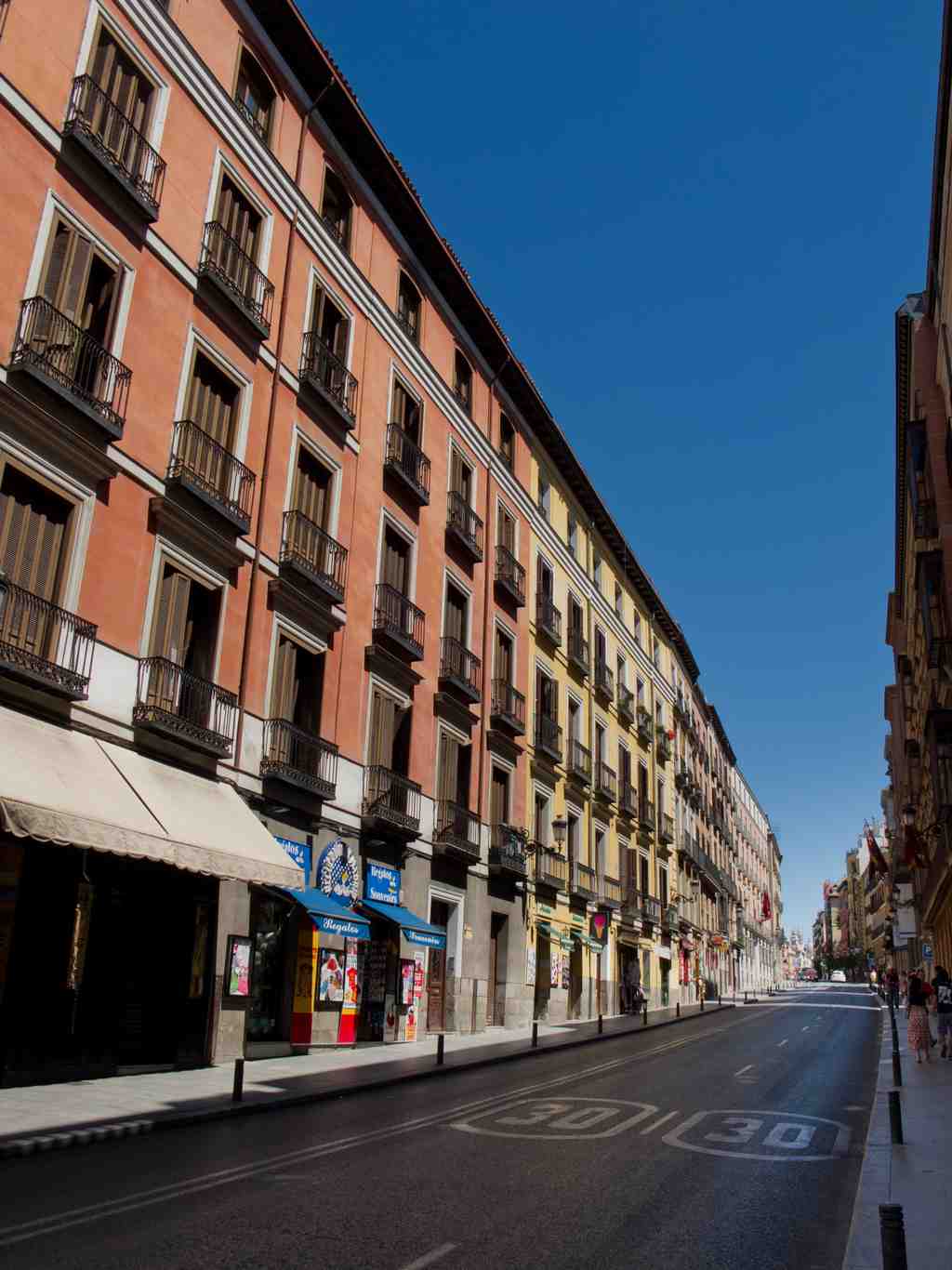
Right ahead, you’ll spot Calle Mayor by its long stretch of elegant, colorful buildings with rows of iron balconies and lively shopfronts running straight ahead under the bright Madrid sky.
So here you are, on the historic Calle Mayor-the lifeline that has been threading together the heart of Madrid for more than six centuries. If these balconies could gossip, oh, they’d have endless stories! Originally, this road wasn’t even a street, but rather a ceremonial path fit for kings. Picture the swagger of the Catholic Monarchs as they paraded here at the end of the 15th century, with velvet, horses, jubilation, and probably some snazzy hats. By the 1600s, this avenue had transformed into Madrid’s grandest catwalk, where aristocrats waltzed out to show off their latest fashions, hoping the neighbors were watching (and a little jealous).
Over the years, Calle Mayor became a patchwork of different names-each stretch telling its own tale. In the old maps, you could see the street labelled as Mayor, Puerta de Guadalajara, and Platerías, with each section buzzing with different trades. Imagine the scent of leather and silks, the clatter of jewelers’ hammers, the laughter from crowds passing by colorful stalls where tailors, perfumers, and basket-weavers all elbowed for the best spot. If you think traffic is bad today, just imagine trying to squeeze a horse-drawn carriage past all that!
But the street has its secrets too. Some of its oldest stones once supported grand structures long gone-like the convent of San Felipe el Real, abandoned with the laws of Mendizabal and swapped out for fancy new flats. Fire claimed the Puerta de Guadalajara in 1582, leaving only smoky memories behind. Each plot, each cornerstone, has witnessed deals being made and houses being sold as far back as the 1500s, as the road was widened and reshaped to fit the growing city.
Look out for buildings like the elegant Casa de Ruiz de Velasco with its early modernist flair, or the pinkish Colonial Company building. Hidden in plain sight are palaces like Cañete, or the Uceda Palace, and the spirited Italian Culture Institute within the palace of Abrantes. If you were a playwright in Spain’s Golden Age, this was the street to call home-Lope de Vega was born just at number 46, and Calderón de la Barca also scribbled his masterpieces here.
It wasn’t all high drama and high society-at number 1, the Casa Cordero played host to Madrid’s first telephone exchange and a string of hospitable inns and legendary cafés. Number 59? That’s where the Farmacia de la Reina Madre served up mysterious remedies. Around the corner, hungry locals and curious visitors have always clamored for treats at La Mallorquina or eyed the hearty fare at Casa Ciriaco.
Calle Mayor doesn’t just connect the Puerta del Sol and Plaza Mayor-it weaves together every flavor, ambition, and twist in Madrid’s story. Even today, as bikes whiz past in the special cycle lane and tourists pause to snap photos, this storied street is still moving, still changing, and full of life. Notice the sunshine glancing off the iron railings, the smell of chocolate from a nearby bakery, the cheerful shouts from shopkeepers, and, if you’re lucky, a bit of the magic that’s danced down this avenue for centuries. Welcome to the beating, ever-changing soul of Madrid!
Want to explore the buildings, historic shops or the coda de répide in more depth? Join me in the chat section for a detailed discussion.




