
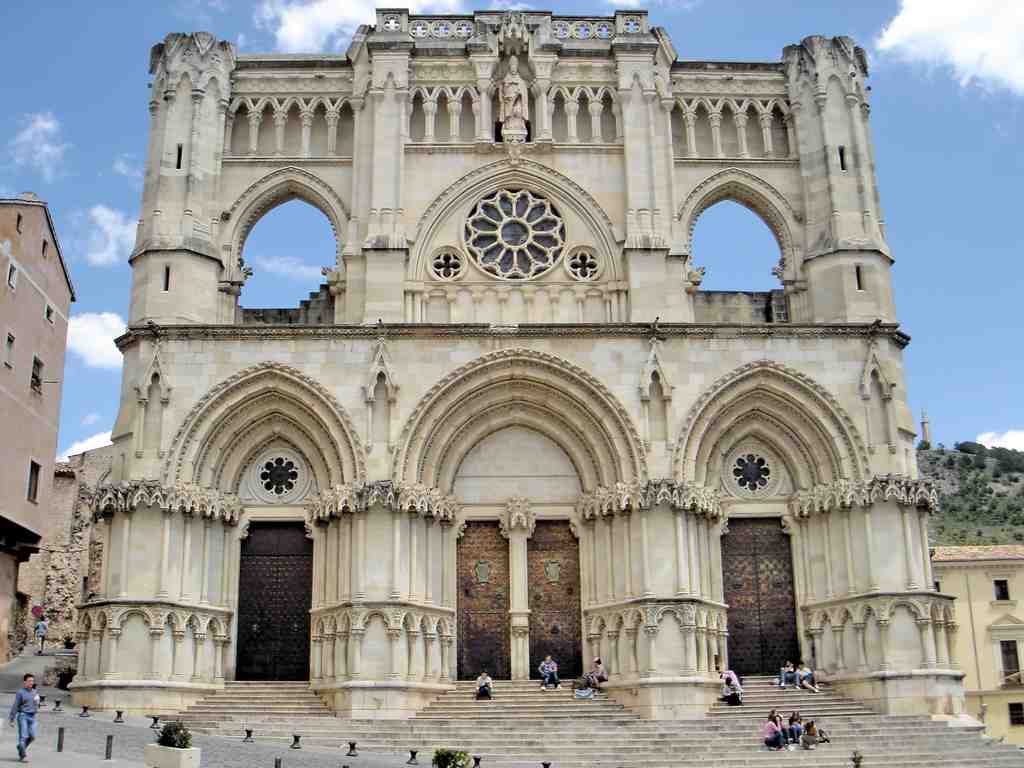
On your right stands the Cathedral of St. Mary and St. Julian, a massive pale stone structure defined by three deeply recessed arched doorways and a striking central rose window set below two large, empty arched openings.
This commanding building traces its roots back to 1177, when Alfonso VIII of Castile conquered Cuenca from the ruling Almoravids. While Alfonso secured the territory, it was his wife, Leonor of England, who truly shaped the cathedral you are looking at now. Leonor was the daughter of the formidable Eleanor of Aquitaine, and she brought Norman knights with her dowry. Thanks to their influence, when construction began in 1196, Cuenca became home to one of the very first Gothic cathedrals in Castile. It was a bold departure from the heavy, rounded arches of the Romanesque style that dominated Spanish Christian kingdoms at the time, introducing the soaring, pointed elegance of the French and Norman architectural worlds. If you want a closer look at how this early Anglo-Norman influence carried over into the fine carved details, take a glance at your screen.
But monumental architecture is only half the story here. The true ambition of this place was not just in reaching for the heavens, it was in capturing the human mind. For over thirty years in the late sixteenth and early seventeenth centuries, a man named Sebastián de Covarrubias served as a canon here. A canon is a senior member of the clergy who manages cathedral affairs, which sounds like a rather busy job. Yet Covarrubias somehow found the time to write a monumental manuscript in his house, published in 1611. It was the Tesoro de la lengua castellana o española, the very first monolingual dictionary of the Spanish language. Right here, in the shadow of these grand stone walls, the vast, chaotic vocabulary of an entire empire was meticulously cataloged and tamed.
Of course, earthly reality has a habit of testing divine ambition. The grand facade standing before you is actually not the original thirteenth-century stonework. In 1902, the cathedral's great bell tower tragically collapsed. It was a disaster that claimed four lives and sparked a massive political scandal in Madrid when politicians tried to blame the collapse on the vibration from the ringing of the bells, rather than decades of ignored structural warnings. Politics, it seems, never changes. The entire front was eventually redesigned in a neo-Gothic style inspired by the Cathedral of Reims, a dramatic transformation you can see for yourself if you check the before and after pictures in the app.
This cathedral stands as a fascinating intersection of lofty ideals, human intellect, and raw survival against gravity and time. If you decide to explore the interior chapels and cloisters, keep in mind it is generally open from ten in the morning until five in the afternoon, staying open until seven on Saturdays.
For now, direct your gaze upward past the rooflines toward the Mangana tower in the distance. It is an enduring symbol of time and dominance over the city, and it happens to be our next destination, just a four-minute walk away.




