AudaTours logoAudaTours

Lerwick Audio Tour: Lerwick's Landmark Audio Walk

Audio guide12 stops

In the heart of Lerwick cannon smoke once drifted above ancient stones while silent tides carried secrets into hidden harbors. Beneath the weathered walls and striking waterfronts lies a city of unlikely intrigue. This is your self-guided audio adventure. Wander cobbled lanes and wind-battered fortresses to uncover stories that most eyes—and ears—pass by. Who risked everything behind Fort Charlotte’s ramparts on the brink of invasion? Which lost artifact still haunts the Shetland Museum’s shadows, its origin fiercely debated? Why was an obscure concert at Mareel the catalyst for a controversy that divided locals for years? Move through centuries in minutes as legends flicker beside you, scandals echo off stone, and timeworn tales spill into today’s bustling life. Each stop transforms familiar ground into a stage of forgotten rebellion, lively innovation, and enduring mystery. Dare to unlock Lerwick’s unseen layers. Let the journey begin where history whispers loudest.

Tour preview

map

About this tour

  • schedule
    Duration 90–110 minsGo at your own pace
  • straighten
    3.6 km walking routeFollow the guided path
  • location_on
  • wifi_off
    Works offlineDownload once, use anywhere
  • all_inclusive
    Lifetime accessReplay anytime, forever
  • location_on
    Starts at Viking bus station

Stops on this tour

lock_open 3 free previews · 9 unlock with purchase

  1. location_on
    1
    You’re looking for a low, angular building of pale concrete and glass, with a sheltered frontage and the Great Wall restaurant sign set above the station level. At first glance,…Read moreShow less

    You’re looking for a low, angular building of pale concrete and glass, with a sheltered frontage and the Great Wall restaurant sign set above the station level.

    At first glance, Viking Bus Station can seem almost modest, the sort of place a town simply gets on with. Yet this is where Lerwick quietly shows you how an island keeps itself connected. Not only passengers pass through here. Locals know that freight has long travelled by bus as well, parcels and practical necessities moving through the same hub as people, which makes this building less a waiting room than a working artery.

    The site served buses before the present building arrived, but in nineteen eighty-five the council pushed forward plans for something new. In March nineteen ninety, the Shetland firm D-I-T-T began construction, and on the twenty-second of May, nineteen ninety-one, the station opened after an investment of about nine hundred thousand pounds. If you glance at the image on your screen, you can catch one clue to its later life: the station did not stay only a station, because the upper floor became home to the Great Wall restaurant.

    That habit of adaptation runs straight through the place. In two thousand and seven, the station received a mural to mark the opening of the Shetland Museum; later, in twenty eighteen, artists replaced it with a new spray-painted work. In two thousand and fourteen, when ownership passed to Natalie and Alan Ho, they promised to keep free waiting facilities for passengers. By December two thousand and sixteen, the old waiting room had become Teamore, their café downstairs, so a threatened public space found a second life without losing its everyday purpose.

    And threatened it truly was. In early two thousand and thirteen, councillors considered closing the waiting room and shifting freight operations to Gremista to save nearly eighty thousand pounds a year. Users fought back hard. More than five hundred people signed a petition in just three days, and locals lobbied so fiercely that the station became a test of what Lerwick would and would not surrender. If a place you relied on every week were judged disposable by officials, how stubbornly would you defend it?

    One man gives that question a face. Andrew Leask, of John Leask and Son, said farewell here in August two thousand and twenty when the family’s Scalloway service left Viking for the last time. He had spent fifty-two years in the business and remembered starting full-time work on the very day he sat his last higher exam. That is the scale of attachment hidden in a bus station.

    If you look at the older mural on your phone, you can see how even its walls have carried the town’s changing self-image. Keep that in mind as we head toward Mareel, about three minutes away, where Lerwick remakes itself again at the edge of work, water, and public life.

    Open dedicated page →
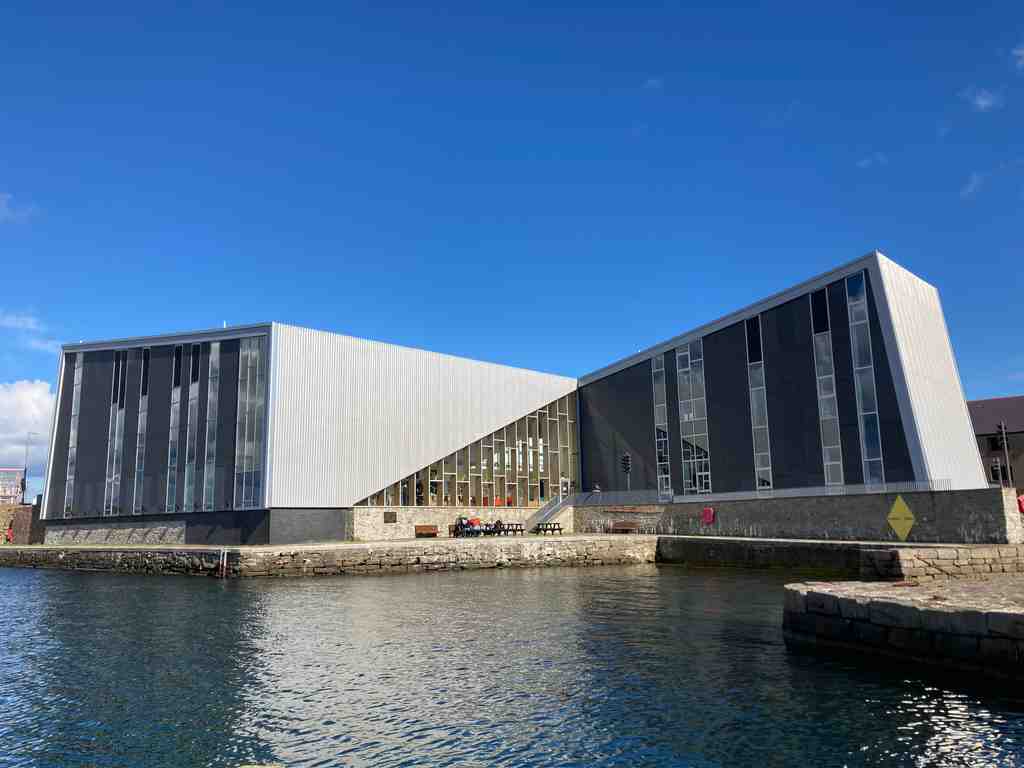
  2. On your right, Mareel is a long, angular building of dark cladding and glass, with a stepped roofline and a broad waterfront face that gives it the look of a modern harbour shed…Read moreShow less
    Mareel
    MareelPhoto: Tine, Wikimedia Commons, CC BY-SA 4.0. Cropped & resized.

    On your right, Mareel is a long, angular building of dark cladding and glass, with a stepped roofline and a broad waterfront face that gives it the look of a modern harbour shed refined into something far more purposeful.

    Here on the Hay’s Dock waterfront, Lerwick shows one of its clearest transformations. This edge of town once spoke chiefly of loading, landing, and hard practical work. Now it still serves the town, only in a different key. Mareel is not simply a place for a pleasant evening out. It is infrastructure of another sort: a cultural engine, built so island talent would not have to leave home quite so quickly to find a screen, a stage, a studio, or a future.

    Its name is lovely and precise. Mareel means phosphorescence on the ocean, that shimmer of living light on dark water. If you glance at the image on your screen, you can see how the building’s clean waterfront profile suits that name.

    The idea took years to gather force. In nineteen eighty-nine, Shetland lost its only cinema when the North Star closed as a picture house. Campaigners began pressing for something new, and by two thousand and one the council chose a combined venue rather than separate cinema and music buildings, because it would cost less to construct and run. That decision matters. Mareel was conceived as a hub for the creative industries, meaning the working world built around music, film, design, recording, and digital production, not just art for art’s sake.

    Inside are the kinds of spaces a small island capital had been missing: a main auditorium, which simply means the principal performance hall, with room for about six hundred and fifty standing or around two hundred and fifty seated, plus a balcony for another eighty-five; two cinemas; a recording studio; rehearsal rooms with sprung floors, built to flex slightly and protect dancers and movement; and a multimedia suite for film, television, graphics, music, and websites. Shetland College U-H-I began teaching music courses here in the twenty twelve to twenty thirteen academic year, so the building quickly became a workshop as much as a venue.

    One figure worth keeping in mind is Gwilym Gibbons, the first director of Shetland Arts Development Agency. At the public launch in October two thousand and eight, he thanked his colleague Kathy Hubbard for helping raise the money, and she remembered the very first meeting, when Mareel existed only as a fragile idea. That launch spilled along the waterfront with local music from Brack da Brod, Sheila Henderson, and Brian Nicholson. It felt less like a construction announcement than a community deciding what it wanted to keep alive.

    Not everyone approved. Pub and nightclub owners feared competition, an anonymous State Aid complaint went to Europe and failed, and the council itself split nine to nine before convener Sandy Cluness used his casting vote and said, “As far as I am concerned you can go ahead and build Mareel.” Even then, trouble lingered. D-I-T-T, the local contractor, and Shetland Arts argued publicly over delays and design changes before the building finally opened in November two thousand and twelve.

    And yet, once open, it justified the fight. The Revellers played the first sell-out standing gig here, then recorded Renegades, the first album entirely recorded, produced, mixed, and mastered in the building. Students launched their own EPs-extended-play recordings-from these rooms. This is Shetland’s creative community in one place: artists, technicians, teachers, students, promoters, and audiences sustaining the town in a different register.

    Next, make for the Shetland Museum, where this modern confidence meets the deeper memory of the islands, about three minutes away. As a practical note, Mareel is usually closed on Mondays and otherwise opens from ten in the morning until eleven at night.

    Open dedicated page →
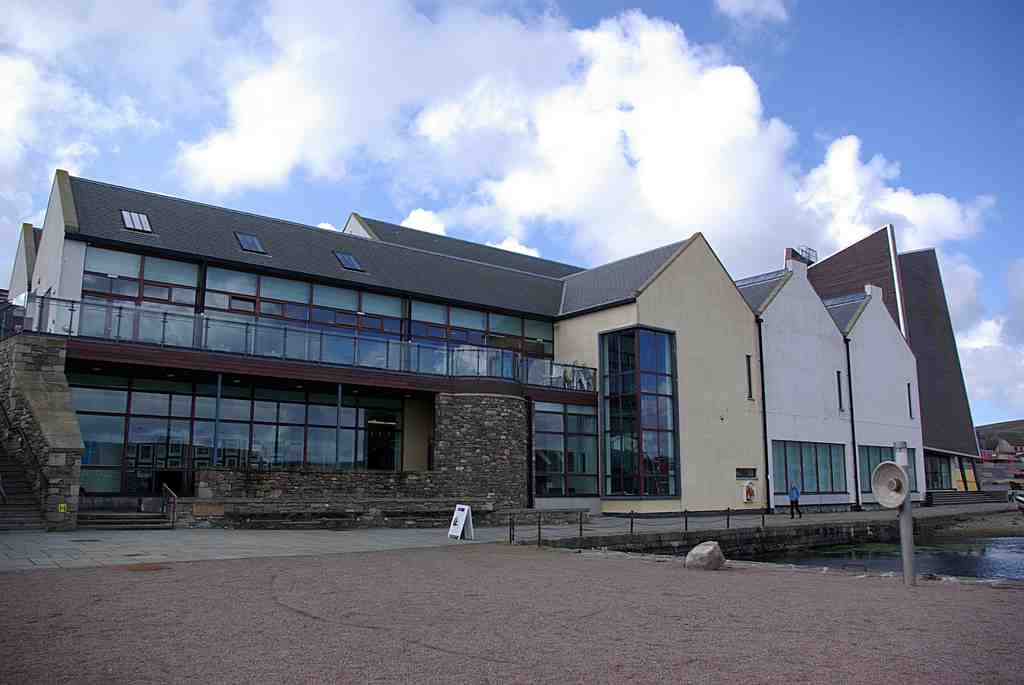
  3. On your right, the Shetland Museum is a long timber-clad and glass building set around a stone dock, with a tall glazed boat hall rising above the waterfront like a working shed…Read moreShow less
    Shetland Museum
    Shetland MuseumPhoto: Clemensfranz, Wikimedia Commons, CC BY-SA 3.0. Cropped & resized.

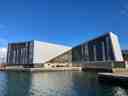
    On your right, the Shetland Museum is a long timber-clad and glass building set around a stone dock, with a tall glazed boat hall rising above the waterfront like a working shed given a very elegant second life.

    This place keeps its memories in public view, but it also hides them in its bones. The museum service began in nineteen sixty-five, when local historian Tom Henderson became its first curator, and a year later Zetland County Council opened a shared library and museum building elsewhere in Lerwick. Useful, certainly, but modest. What stands here now at Hay’s Dock opened on the thirty-first of May, two thousand and seven, when Charles and Camilla, then Duke and Duchess of Rothesay, came with Queen Sonja of Norway to mark a much grander chapter.

    And yet the cleverness of this museum is that it never pretends to begin in two thousand and seven. Look carefully at the dockside setting for a moment. Ask yourself what seems newly shaped, and what seems carried forward rather than swept away.

    That question matters here. Hay’s Dock itself dates from eighteen fifteen, when Hay and Ogilvy created this working harbour space, now the museum’s largest object in a sense, a listed dock that frames the entire site. During the restoration, the team did not treat the place as empty ground waiting for a fresh design. They reused materials from the dock and from Shetland’s maritime past. The detail locals quietly treasure is inside: timber from the hull of the sunken Elenore Von Flotow was refashioned into the reception desk. So even before you look at a single exhibit, you are already standing inside a story pieced together from salvage.

    The image on your screen shows how the building settles into the old dock rather than overpowering it. That is why this museum feels less like a warehouse of objects and more like a vault of lived memory. It has five times the exhibition space of the old museum, including a three-storey boat hall, and galleries that move from early settlers, farming, fishing, folklore and small boats to the last two centuries of politics, industry, knitwear and seafaring. The archives stretch from the fifteenth century to the twenty-first. More intimate still, since the nineteen eighties staff have recorded islanders speaking about their lives and work, building an audio archive that preserves Shetland voices, not just paper.

    There is a rather lovely honesty to that. Lace shawls sit in the same institution as complete boats; delicate memory beside hulking craft. On another image in the app, you can see some of those boats laid out at Hay’s Dock, echoing the museum’s great boat hall and the sea-minded life of these islands. The wider dock has become part of the collection too: restored pier buildings, commissioned artworks, spaces for launches, exhibitions, gatherings, even weddings. A working harbour learned a cultural language without forgetting the old one. No wonder the millionth visitor arrived in two thousand and eighteen as part of an ordinary family outing: Dr David Malcolm, with his grandson Oliver. That tells you everything. This place belongs to daily life, not just display cases.

    Next, the story hardens. In about eight minutes, Fort Charlotte asks what Lerwick did when memory alone was not enough, and the town had to defend itself by force. If you plan to go inside later, the museum generally opens from midday on Sundays and Mondays, and from ten o’clock the rest of the week.
    Open dedicated page →
Show 9 more stopsShow fewer stopsexpand_moreexpand_less
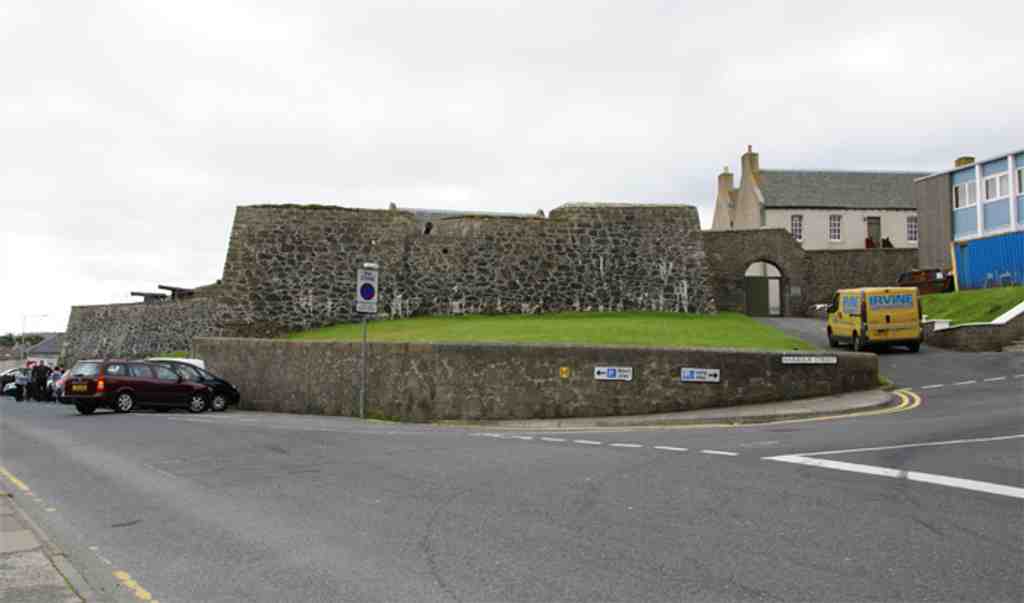
  1. On your right stands a low, stone, five-sided fort, its thick walls broken by sharp-angled bastions and a formal arched gate. Fort Charlotte looks compact now, almost folded into…Read moreShow less
    Fort Charlotte, Shetland
    Fort Charlotte, ShetlandPhoto: Otter, Wikimedia Commons, CC BY-SA 3.0. Cropped & resized.

    On your right stands a low, stone, five-sided fort, its thick walls broken by sharp-angled bastions and a formal arched gate.

    Fort Charlotte looks compact now, almost folded into the town around it, but it tells a rather dangerous truth about Lerwick: trade and threat grew up together. Even in the seventeenth century, local histories say this fort gave the young town a push, and merchants gathered nearby. Protection drew commerce close. The same sea that brought business could also bring an enemy.

    The first fort here went up between sixteen fifty-two and sixteen fifty-three during the First Anglo-Dutch War, though almost nothing of that version survives. What you see now is part of a story rebuilt in layers. In sixteen sixty-five, at the opening of the Second Anglo-Dutch War, Charles the Second ordered Robert Mylne to raise a new fort on this site, spending twenty-eight thousand pounds, a sum worth several million pounds today. If you glance at the image in the app, you can see how tightly the fort still sits beside Lerwick’s commercial heart.

    Then came the bluff. In sixteen sixty-seven, a Dutch fleet approached and decided this place looked far more heavily armed and manned than it truly was. In reality, the walls were unfinished and the guns were few. That illusion saved Lerwick. But the protection was fragile. After the war, the government chose not to keep a garrison here, and when the Dutch returned in sixteen seventy-three during the Third Anglo-Dutch War, they found the fort abandoned and burned the barrack block. The war scares were not distant rumours here; they were the reason people paid so close attention to this fort.

    And that raises a delicious question: does a fort matter most for the battles it fights, or for the nerve it lends to the town sheltering behind it?

    The present fort took shape in seventeen eighty-one and took Queen Charlotte’s name. Those angled corners are bastions, projecting points designed so defenders could fire along the walls beside them. From the ground you cannot quite read the full plan now; land reclaimed in front of the fort has stolen its old command of the shoreline, and only from the air does the whole design reveal itself.

    Its life changed again. During the Napoleonic wars, soldiers garrisoned it. Later it became Lerwick’s jail and courthouse. Shetland Museum and Archives preserves the records of inmates, including one Customs and Excise tidewaiter imprisoned here for debt, not violence. For islanders who disliked customs men for interfering with smuggling and wreck recovery, his confinement would have carried a certain edge.

    Today the fort remains unusually alive, still serving as the base of an Army Reserve unit as well as a heritage site. Soon, the watch over these waters changes form: not cannon waiting for attack, but rescuers waiting to launch. The Lifeboat Station is about six minutes away. If you plan to return inside, the fort generally opens daily from ten in the morning until four in the afternoon.

    Open dedicated page →
  2. On your left is a solid harbour-side building of grey stone, broad and rectangular under a dark roof, with large waterside openings that mark its working purpose. Here, living on…Read moreShow less

    On your left is a solid harbour-side building of grey stone, broad and rectangular under a dark roof, with large waterside openings that mark its working purpose.

    Here, living on the edge of sea and danger is not a romantic phrase at all. In Lerwick, the sea brings trade, fish, mail, strangers, and livelihood, but it also brings breakdowns, wrecks, groundings, and the dreadful knowledge that help may be very far away. That is why rescue here became more than a service. It became a reflex of character.

    Most visitors notice the station and assume the story begins with the Royal National Lifeboat Institution, the R-N-L-I. Locals know it starts earlier, with James Jamieson. In eighteen ninety-five, before any lifeboat station stood here, he saved two men from the fishing boat Jessie after she sank off Oxna Island in a strong southerly gale, and the R-N-L-I awarded him a Silver Medal. That little detail matters. Lerwick did not wait for a formal institution before it learned how to answer distress.

    The official station came soon after tragedy made delay intolerable. On the twentieth of March, nineteen thirty, the R-N-L-I committee agreed to establish a station here, encouraged by improved coast communications across Shetland. Only eight days later, the trawler Ben Doran was wrecked off Shetland and all nine crew were lost. The nearest lifeboat had to come from Stromness, a punishing journey that took fifty-five hours. After that, the argument was no longer abstract.

    Lerwick’s station became operational on the seventeenth of July, nineteen thirty, when a fifty-one foot Barnett-class lifeboat arrived from Cowes after an eight-day passage. She was deliberately chosen as a powerful mass-rescue boat, able to carry about one hundred people aboard. That tells you something important: this was never meant for neat, local incidents. It was built for distance, for urgency, for the kind of emergency that can swallow many lives at once.

    If you glance at the image on your phone, you can see the Old Tolbooth, which became the station’s new shore facility in two thousand and five. An old harbour building taking on rescue work again rather suits Lerwick. This town keeps finding new uses for courage.

    One of the station’s defining names is Hewitt Clark, the coxswain, meaning the lifeboat’s skipper. In nineteen ninety-seven, only four months after the all-weather lifeboat Michael and Jane Vernon came on station, Clark and his crew answered the Green Lily. The cargo ship lost power about fifteen miles out. Tugs failed to secure her. The lifeboat fought alongside repeatedly and took off five crewmen. Then helicopter winchman Bill Deacon went down onto the rolling ship and helped send the remaining ten men up in pairs. As the last two left, a wave washed Deacon overboard. He was later awarded the George Medal after his death; Clark received the R-N-L-I Gold Medal, and the lifeboat crew were honoured too. Rescue here is never only about seamanship. It is about who steps forward when the cost is plain.

    On your screen, the lifeboat in harbour offers the calmer image of that calling. By the station’s ninetieth anniversary in twenty twenty, Lerwick’s volunteer crews had saved more than eight hundred lives and earned sixty-two gallantry awards.

    The harbour once feared hostile sails from abroad; now the danger usually comes as failure, rock, and sea. Yet the answer is the same: somebody goes.

    And after that going, how does a community hold care, grief, and continuity on land? The parish church, two minutes away, keeps part of that answer.

    Open dedicated page →
  3. On your right stands St Columba’s, the Lerwick face of Lerwick and Bressay Parish Church, the largest Church of Scotland congregation in Shetland. It serves the capital and…Read moreShow less

    On your right stands St Columba’s, the Lerwick face of Lerwick and Bressay Parish Church, the largest Church of Scotland congregation in Shetland. It serves the capital and beyond, with worship shared across three places: Gulberwick, this church here in town, and Bressay across the water. That sounds orderly. In truth, it carries all the quiet strain of deciding which old vessels can still keep a community afloat.

    This building rose in the late eighteen twenties, and it remains the largest church building in Shetland, a protected listed one. In eighteen seventy-one, the congregation installed an organ here, only the second Church of Scotland church to do so after church law finally relaxed in eighteen sixty-six and allowed instruments in worship again. Even praise, it seems, had to reinvent itself.

    That question of what continues, and what must change, returned sharply in recent years. Parish trustees and reorganisers became the practical voice of inheritance, weighing money, buildings, and shrinking use, and deciding which sacred places could remain active. In twenty eighteen they proposed closing Bressay Church. That simple building had already lived several lives: it replaced a church from around seventeen twenty-two, which itself replaced three much older chapels. Its off-centre doors were set to dodge the worst coastal wind. Inside, memorial windows honoured people such as John Ross, a local schoolteacher, and Sir George Crookshank Hamilton. By March twenty twenty, Bressay Church had gone up for sale for twelve thousand pounds, with plans to remove memorials, before a local family stepped in hoping to keep it for community use.

    Here in Lerwick, renewal took a gentler form. After renovation in two thousand eight, around three hundred worshippers gathered for a rededication in January two thousand nine. The Very Reverend Alexander MacDonald led it. Dr Ramsay Napier and Sadie Napier gave a new oak font - the basin used for baptism - crafted by Cecil Tait, with a bowl carved from local elm burr from Seafield.

    A church keeps memory through prayer; next, the library keeps it through books, records, and shared knowledge. This site is generally open daily from nine in the morning until five in the afternoon.

    Open dedicated page →
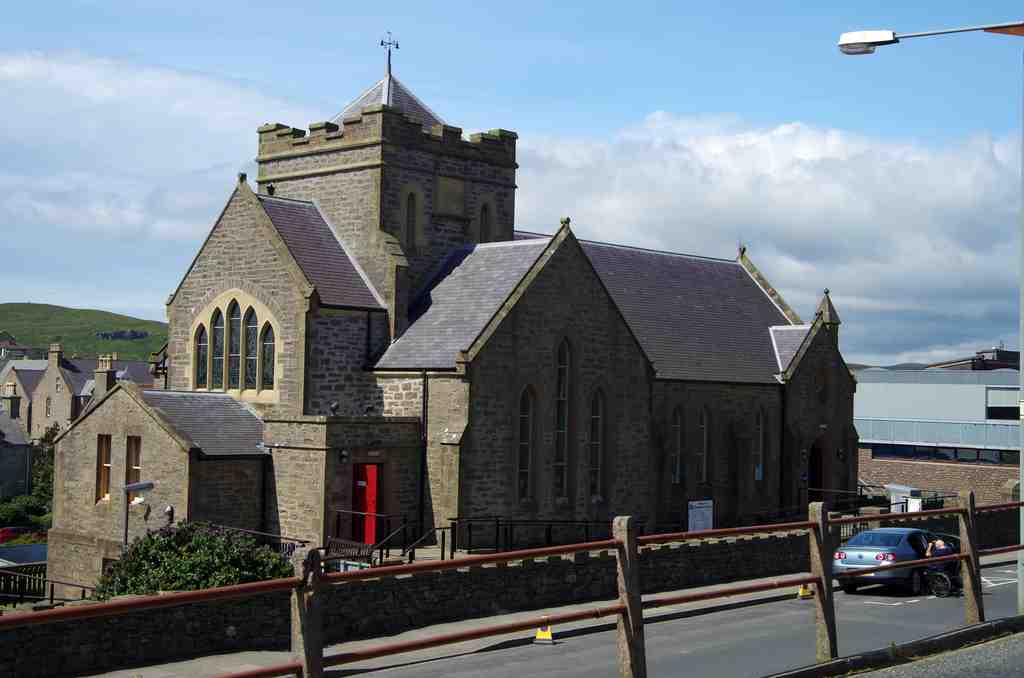
  4. The library on your left is a sturdy public building here on Lower Hillhead, and the image in your app shows its other unforgettable form: grey sandstone, pointed Gothic windows,…Read moreShow less
    Shetland Library
    Shetland LibraryPhoto: Balou46, Wikimedia Commons, CC BY-SA 4.0. Cropped & resized.

    The library on your left is a sturdy public building here on Lower Hillhead, and the image in your app shows its other unforgettable form: grey sandstone, pointed Gothic windows, and the squat crenellated tower of the former St Ringan’s Church. This is one of Lerwick’s most important promises made solid. A library can seem quieter than a fort or a lifeboat station, but the idea behind it is bold: knowledge made public. Here, that means residents and visitors alike, children, older readers, people in town, and people far out in the islands all count equally.

    Shetland Library began in nineteen sixteen, before Scottish county libraries were even required by law. A pilot scheme funded by the Carnegie United Kingdom Trust helped open the door early, and that matters. Shetland did not wait to be told that books, information, and learning should belong to everyone.

    What makes this place so revealing is that the story is not neat at all. The library spent decades improvising. From nineteen forty-eight onward, it occupied “temporary” accommodation that dragged on for years. Then, on the twenty-ninth of June, nineteen sixty-six, the Lord Lieutenant, R. H. W. Bruce, opened a new shared library and museum building here on Lower Hillhead. It should have felt like an answer. Instead, it became only one chapter in a longer habit of adaptation.

    Most visitors never quite grasp the twist. For years, the main library lived inside the former St Ringan’s Church, a place of worship turned into a house of public reading. In eighteen eighty-five and eighteen eighty-six, the Liverpool architect R. G. Sykes gave that church its Gothic shape in grey sandstone, with a central tower topped by battlements, those little castle-like blocks along the roofline. He designed it for a congregation. By the late twentieth century, that congregation had dwindled, and locals proposed a new use that was almost startling in its simplicity: let the church serve readers instead. The first plan failed, but the building still passed to Shetland Islands Council for one pound. After careful renovation under Historic Environment Scotland, a mezzanine floor and rolling shelves transformed it. Sacred space became civic space.

    And still the story kept turning. During the pandemic, browsing stopped, but staff expanded delivery and collection services so books could keep moving even when people could not move freely. E-books and audiobooks surged. David Gange’s The Frayed Atlantic Edge, launched at the library in twenty nineteen, became the most borrowed physical non-fiction title of twenty twenty. In December twenty twenty-one, the service returned here after refurbishment, shifting more than sixty thousand books and materials into the building and using rolling shelving so rooms could change for talks, launches, and community events.

    Inside, the shelves carry more than fiction and fact. The Shetland Collection gathers books about the islands, pamphlets, maps, periodicals, and newspaper microfilm reaching back into the nineteenth century. The library even publishes local history and poetry itself, and works with Shetland ForWirds to support writing in the Shetland dialect. This is preservation in everyday clothes: less ceremonial than a museum, perhaps, but every bit as crucial.

    From here, continue to Lerwick Town Hall, where learning, ceremony, and public display meet in one grand civic stage, about one minute away. If you plan to return, the library is generally open from ten o’clock most days, with later opening until eight o’clock on Monday, Tuesday, and Thursday, and it closes on Sunday.

    Open dedicated page →
  5. On your left, look for the pale sandstone frontage with its five-bay shape, arched central doorway, and battlemented tower rising at one side. Lerwick Town Hall likes to make an…Read moreShow less
    Lerwick Town Hall
    Lerwick Town HallPhoto: Balou46, Wikimedia Commons, CC BY-SA 4.0. Cropped & resized.

    On your left, look for the pale sandstone frontage with its five-bay shape, arched central doorway, and battlemented tower rising at one side.

    Lerwick Town Hall likes to make an entrance. It was meant to. In the late nineteenth century, the herring trade swelled the town, meetings in the Parish Kirk no longer suited a place with growing confidence, and civic leaders chose this site on Hillhead for something more declarative: a hall that could speak for Lerwick before anyone inside said a word.

    Prince Alfred, Duke of Edinburgh, laid the foundation stone here on the twenty-fourth of January, eighteen eighty-two. And then, by one of those exquisite coincidences history occasionally allows itself, Lerwick staged the first Up Helly Aa torchlight night that very same evening. So the town hall begins not only with ceremony, but with flame, procession, and performance. The official city of papers and seals met the theatrical city of torches and spectacle on the same day, and Shetland has been balancing those two selves ever since.

    Architect Alexander Ross of Inverness gave the building its Scottish Baronial dress: a style that borrows the language of castles, with battlements and little corner turrets called bartizans. Builder John M. Aitken of Lerwick won the contract for three thousand two hundred and forty pounds, well over four hundred thousand pounds in today’s money. By July of eighteen eighty-three, George Thoms, Sheriff of Caithness, Orkney and Shetland, officially opened the hall. Inside were not just a council chamber and courtroom, but even police cells. Celebration and control lived under one roof.

    Now, pause a moment and study the decorative ambition of the exterior. Ask yourself whether this building seems content merely to house government, or whether it is trying to teach you how Lerwick wished to be seen.

    Because here is the twist: the completed hall was not originally as rich or symbolic as the town wanted you to believe. The first contract allowed for no stained glass, no great decorative programme, none of the visual drama that now defines the building’s reputation. A local merchant named Arthur Laurenson changed that story. He loved Shetland history and the Norse sagas, and he led a committee that raised money first from prominent islanders, then from donors far beyond Shetland, to turn the hall into a civic pageant in stone and glass.

    One of those interior windows appears here. They transformed the hall into a kind of public history book. Ballantine and Son of Edinburgh, along with other makers, filled the building with scenes of royal successions, church foundations, battles, and Scandinavian links. The most famous is the Marriage Window: Princess Margaret of Denmark and King James the Third of Scotland, whose marriage in fourteen sixty-nine helped bind these islands to Scotland when her father could not redeem the pledged dowry lands. You can see that window on your phone as well.

    And yet this grand stage has needed rescuing again and again. Crumbling sandstone, failing repairs, leaks through refurbished windows, decayed steps, even a waterlogged time capsule discovered with only its coins intact: this hall survives because people keep stepping in.

    That matters, because the building’s power was never only festive. A registrar still works here, weddings still unfold here, but this was also the chamber of rule, the place where authority could applaud, record, judge, and confine. In a few minutes, at the County Buildings, we meet that sterner face more directly. If you want to come back inside, the town hall generally opens on weekdays from nine to five and closes at weekends.
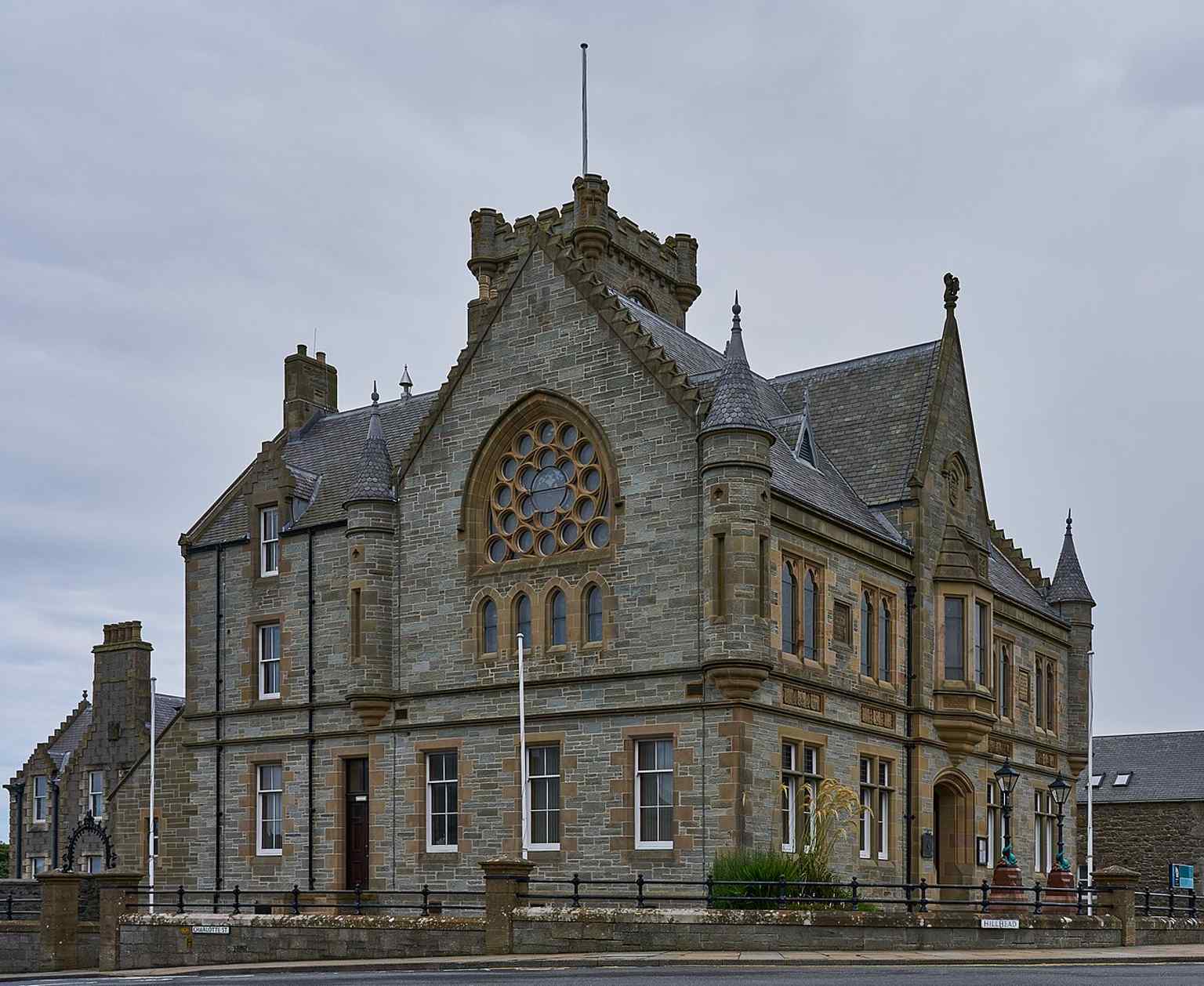
    Northwest view of Lerwick Town Hall, the Scottish Baronial civic building on Hillhead that became the council headquarters in 1883.
    Northwest view of Lerwick Town Hall, the Scottish Baronial civic building on Hillhead that became the council headquarters in 1883.Photo: Virtual-Pano, Wikimedia Commons, CC BY-SA 4.0. Cropped & resized.
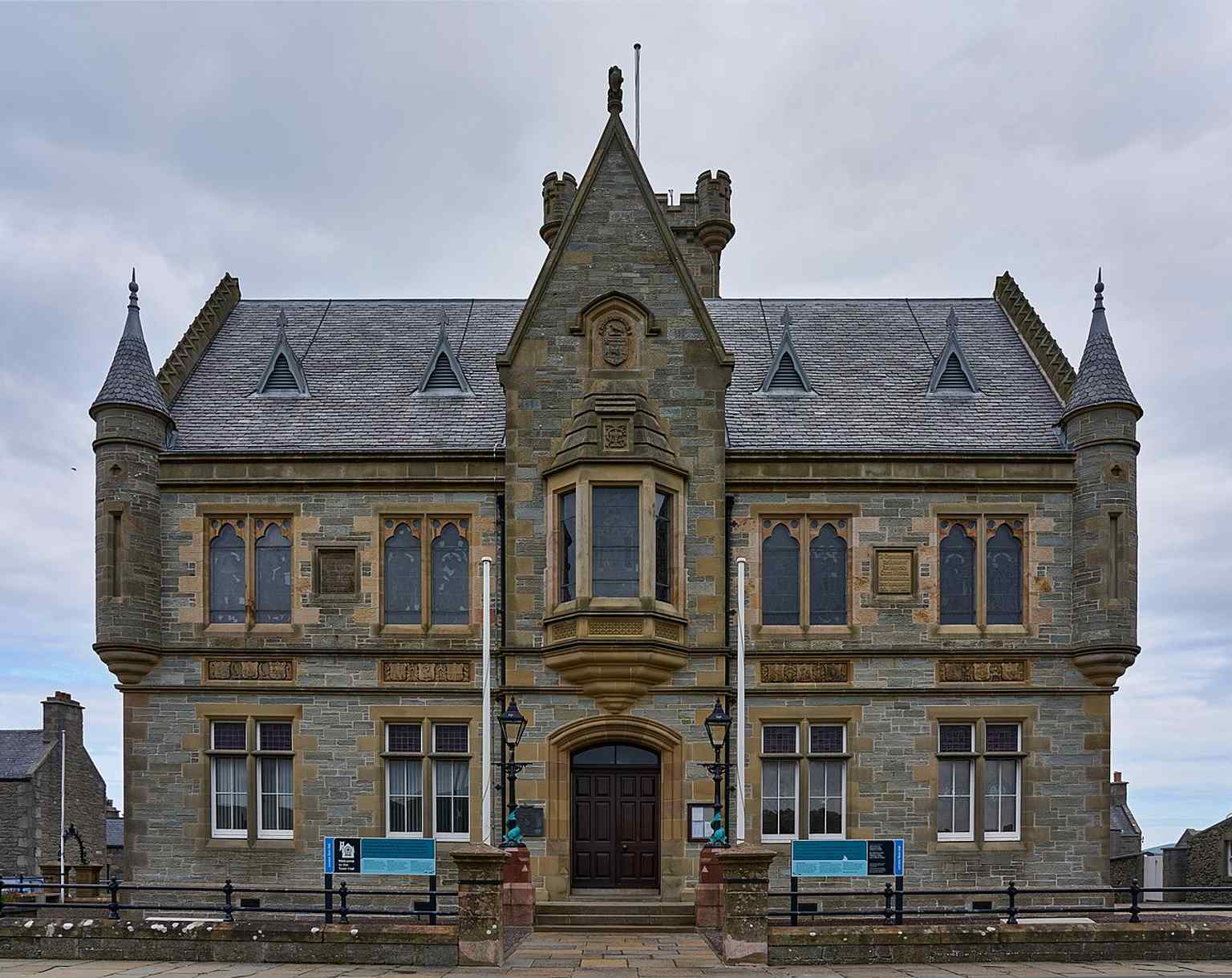
    South side of the town hall showing the listed sandstone façade that has needed repeated conservation work over the years.
    South side of the town hall showing the listed sandstone façade that has needed repeated conservation work over the years.Photo: Virtual-Pano, Wikimedia Commons, CC BY-SA 4.0. Cropped & resized.
    Open dedicated page →
  6. In front of you is a neatly cut stone building with an uneven, castle-like front, a row of stepped gables, and a doorway set beneath a carved hood with a date stone. County…Read moreShow less

    In front of you is a neatly cut stone building with an uneven, castle-like front, a row of stepped gables, and a doorway set beneath a carved hood with a date stone.

    County Buildings looks stern, almost composed for judgment. David Rhind gave Lerwick this Scottish baronial design in eighteen seventy-five, and that style means exactly what it suggests here: a civic building dressed with the manners of a small castle. Contractor D. Outerson and local labour raised it in stone on King Erik Street, and inside they packed together the sheriff court, prison, police station, and the sheriff clerk’s offices. It was practical, certainly, but it also made a statement. Authority in Lerwick would no longer hide in cramped, failing rooms.

    And failing they had been. Before this, justice lived in the old tolbooth on Commercial Street - the town’s courthouse and jail. Local records give that lost building an uncomfortably human face. One name survives with particular force: Benjamin Fountain. He worked as a customs and excise tidewaiter, and in the eighteen twenties he landed in prison for debt, not violence. He stayed there for months. In a small port where customs men were often disliked for interfering with smuggling and the gathering of wreck wood, that confinement must have felt especially raw. His case tells you something most visitors miss: the old jail held civil prisoners too. Poverty could lock the door just as firmly as crime.

    By eighteen thirty-seven, the old tolbooth had become too disgraceful to ignore, and court and prison functions shifted to Fort Charlotte - the same fort we met earlier, raised for one kind of threat and pressed into service for another. Justice here kept changing its shell in order to keep going.

    On your screen, you can see how carefully this front presents itself. Those stepped gables and the slight forward push of the centre make the place look almost ceremonial, but the life inside was never tidy. Even in recent years, inspectors noted that prisoners were led from the cells through a public area and into the single courtroom, handcuffed and exposed to view.

    Later, this complex became the headquarters of Zetland County Council, which held its first meeting here on the twenty-second of May, eighteen ninety. Then it shifted back toward legal work again. So this building has never been one thing for long. It has kept absorbing pressure, changing role, and carrying on.

    Now let the tension ease a little. Ahead, the next stop turns the old world of garrison order toward performance, music, and an audience. Make your way to Garrison Theatre.

    Open dedicated page →
  7. Stand here for a moment and look at the Garrison Theatre. It holds one of Lerwick’s most telling reversals. When it opened in nineteen oh three, nobody came here expecting curtain…Read moreShow less

    Stand here for a moment and look at the Garrison Theatre. It holds one of Lerwick’s most telling reversals. When it opened in nineteen oh three, nobody came here expecting curtain calls. This was a military drill hall and gymnasium, later the headquarters of the seventh Volunteer Battalion, Gordon Highlanders. Before actors learned their lines here, soldiers learned formation, fitness, and obedience. The building began with the hard business of readiness.

    Then, in nineteen forty-two, came the pivot that gives this place its soul. E-N-S-A, the Entertainments National Service Association, turned the hall into a theatre for troops during the Second World War. That is keeping spirits alive in hard times in its clearest form. Sometimes a community protects people with walls and weapons; sometimes it keeps them going with songs, jokes, and the simple relief of sitting in the dark while someone on a stage reminds you that life is larger than fear.

    And people came. In nineteen forty-three, George Formby and Gracie Fields both appeared here, bringing this far northern theatre into the same wartime morale circuit as some of Britain’s most beloved entertainers. Imagine that shift: a room once shaped by marching boots now ringing with laughter, music, and the warm crackle of recognition.

    Inside, the scale is intimate rather than grand: two hundred and eighty seats, nineteen rows named A to S, and a sprung proscenium stage - that means a picture-frame stage, with a little give underfoot to help dancers and performers - measuring twenty-three feet and five inches wide by eighteen feet and two inches deep. Four lighting bars hang above the stage, with more in the auditorium. It is a small house, but it has welcomed big names: Elvis Costello in nineteen eighty-eight, Billy Connolly in nineteen ninety-four, and Dylan Moran in two thousand and eight.

    Yet the Garrison’s real distinction is not celebrity. It is usefulness. The Isleburgh Drama Group has long kept it alive with local productions, and before Mareel opened in two thousand and twelve, this theatre even helped Shetland improvise cinema. Early Screenplay Film Festival screenings unfolded here, alongside village halls, a livestock market, and even a bus shelter in Unst. Art, in Shetland, rarely waits for perfect conditions.

    Locals have defended this place with characteristic honesty. A survey in twenty sixteen found overwhelming support, along with blunt complaints about uncomfortable seats and shallow sightlines. In other words, people cared enough to argue for it properly. The Friends of the Garrison formed the next year to help secure its future.

    That matters. By now, perhaps you can feel the pattern: this town survives by teaching its buildings new tricks. Here, defence became delight, and morale became part of endurance. Carry that thought with you as you walk on to Montfield Hospital, about six minutes from here. In island life, mending the spirit and mending the body often belong to the same story.

    Open dedicated page →
  8. On your left is a long, pale roughcast building with a low horizontal shape and broad veranda fronts running along its face. Montfield tells a very island lesson in improvised…Read moreShow less

    On your left is a long, pale roughcast building with a low horizontal shape and broad veranda fronts running along its face.

    Montfield tells a very island lesson in improvised healthcare: services here kept adapting, room by room and role by role, as need pressed in from every side. When P. Thompson opened this place in November nineteen twenty-eight as the Zetland County Sanatorium, he gave its twenty-four beds verandas so patients could be wheeled outside for open-air treatment, a remarkably bold idea for a hospital this far from bigger centres.

    The National Health Service took it in during nineteen forty-eight, and in nineteen sixty-two it became Montfield Hospital. That same year, a quiet change in authority unfolded as well: Matron Mary C. Johnson became the last matron here, and after her the work passed into a new management pattern, with ward sisters carrying more of the daily burden.

    If you glance at the image in the app, that long frontage still seems to hold the memory of those wheeled beds and careful routines. Later, Montfield turned toward older patients. Harry, admitted after a stroke in September two thousand and seven, insisted he wanted to go home; staff remembered him as one patient who did manage to get home again after a stroke. But hope sat beside strain. By two thousand and nine, thirty-seven people were waiting for care-home places, some for as long as forty-three weeks. The interim unit closed in November two thousand and eleven, and by twenty thirteen N-H-S Shetland had moved its headquarters upstairs.

    What does a community owe its most vulnerable people when every mile of distance makes care more fragile? Gilbert Bain, our final stop, gathers that question into fuller view. Weekday hours here are generally nine till five, with weekends closed.

    Open dedicated page →
  9. On your left is a long, pale-rendered hospital block with flat rooflines, broad rectangular windows, and a simple projecting entrance that gives the building its unmistakably…Read moreShow less

    On your left is a long, pale-rendered hospital block with flat rooflines, broad rectangular windows, and a simple projecting entrance that gives the building its unmistakably practical face.

    Gilbert Bain Hospital does not pretend to grandeur. Its power lies in something more intimate: the determination of a small town to keep remaking care whenever need changes shape.

    That story began even before the hospital took Gilbert Bain’s name. In eighteen eighty-nine, this site answered a brutal local demand for fever beds through the Lerwick Combination Hospital. Then came Bain himself, a Shetland businessman who spent his working life far from home, in India and Singapore, and sent back the gift that opened a cottage hospital on King Harald Street in nineteen oh one. If you glance at your screen, his portrait carries the kind of steady confidence that often changes a town without fuss. And if you look at the older hospital image, you can see how modestly the whole thing began.

    When the N-H-S, the National Health Service, took shape in nineteen forty-eight, Gilbert Bain joined it, and older local arrangements folded into that new public system. Then, in April nineteen fifty-nine, a foundation stone marked a larger ambition. Architect William Arthur Baird Laing drew the new hospital, and Queen Elizabeth The Queen Mother opened it in August nineteen sixty-one on the site of a former infectious diseases hospital. Even that fresh start needed improvisation almost at once: in June nineteen sixty-two, staff opened a maternity annexe in part of the old isolation block beside the main building, because island families needed somewhere for births, and needed it quickly.

    That habit of adapting never stopped. The hospital now runs fifty-six staffed beds and two operating theatres. It welcomes around one hundred and forty births each year, earned full baby-friendly accreditation in two thousand and three, and in two thousand and twenty-two planned a dedicated bereavement suite for parents facing baby loss, with support from local charities. Joy and sorrow, here, share the same corridor.

    You can feel the wider islands gathered into this place. B-B-C One’s Island Medics showed helicopters, fishing-vessel rescues, and the R-N-L-I, the Royal National Lifeboat Institution, all feeding into care here. What rescue crews begin at sea, this hospital must finish on land.

    And yet the story remains unfinished. A C-T scanner arrived in two thousand and seven, wards were refurbished in two thousand and eight, but by two thousand and nineteen the building was judged not fit for purpose: well maintained, yes, yet cramped, costly, and hard to expand. Plans for replacement and repair have carried on into the present.

    If one image from this walk stays with you, let it be this: in Lerwick, buses, boats, archives, courts, churches, theatres, and hospitals all serve the same quiet instinct - when life grows difficult, the town alters its institutions rather than surrendering them. Fittingly, this place never truly closes: it remains open twenty-four hours a day, every day of the week.

    Open dedicated page →

Frequently asked questions

How do I start the tour?

After purchase, download the AudaTours app and enter your redemption code. The tour will be ready to start immediately - just tap play and follow the GPS-guided route.

Do I need internet during the tour?

No! Download the tour before you start and enjoy it fully offline. Only the chat feature requires internet. We recommend downloading on WiFi to save mobile data.

Is this a guided group tour?

No - this is a self-guided audio tour. You explore independently at your own pace, with audio narration playing through your phone. No tour guide, no group, no schedule.

How long does the tour take?

Most tours take 60–90 minutes to complete, but you control the pace entirely. Pause, skip stops, or take breaks whenever you want.

What if I can't finish the tour today?

No problem! Tours have lifetime access. Pause and resume whenever you like - tomorrow, next week, or next year. Your progress is saved.

What languages are available?

All tours are available in 50+ languages. Select your preferred language when redeeming your code. Note: language cannot be changed after tour generation.

Where do I access the tour after purchase?

Download the free AudaTours app from the App Store or Google Play. Enter your redemption code (sent via email) and the tour will appear in your library, ready to download and start.

verified_user
Satisfaction guaranteed

If you don't enjoy the tour, we'll refund your purchase. Contact us at [email protected]

Checkout securely with

Apple PayGoogle PayVisaMastercardPayPal
Loved by travellers

Thousands of tours started.
Plenty of opinions.

4.8 across the App Store and Google Play. Here's a few we keep coming back to.

starstarstarstarstar
This was a solid way to get to know Brighton without feeling like a tourist. The narration had depth and context, but didn't overdo it.
Christoph
Christoph
Brighton Tour
starstarstarstarstar
Started this tour with a croissant in one hand and zero expectations. The app just vibes with you, no pressure, just you, your headphones, and some cool stories.
download Get the app

Pop your headphones in.
Step outside.

Free to download. Tours in every city. Start in 60 seconds — no account, no card.

Download on the App StoreGet it on Google Play
starstarstarstarstar_half
4.8
AudaTours app icon
headphones
~ 4 min until your first tour starts
public
1,000+ cities worldwide
all_inclusive
AudaTours
Unlimited

Every tour. Every city. One subscription.

3096 tours2272 cities138 countries50+ languages