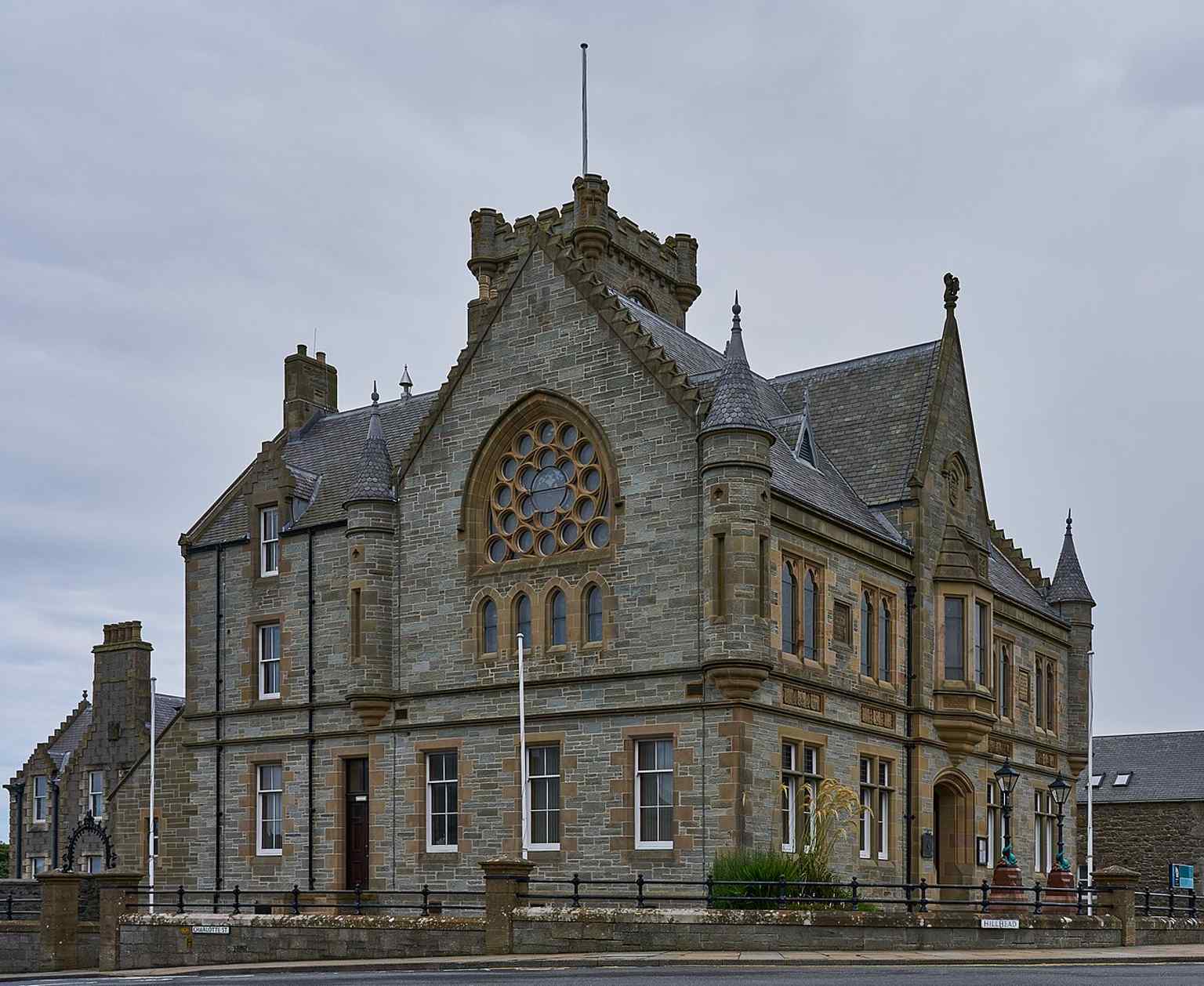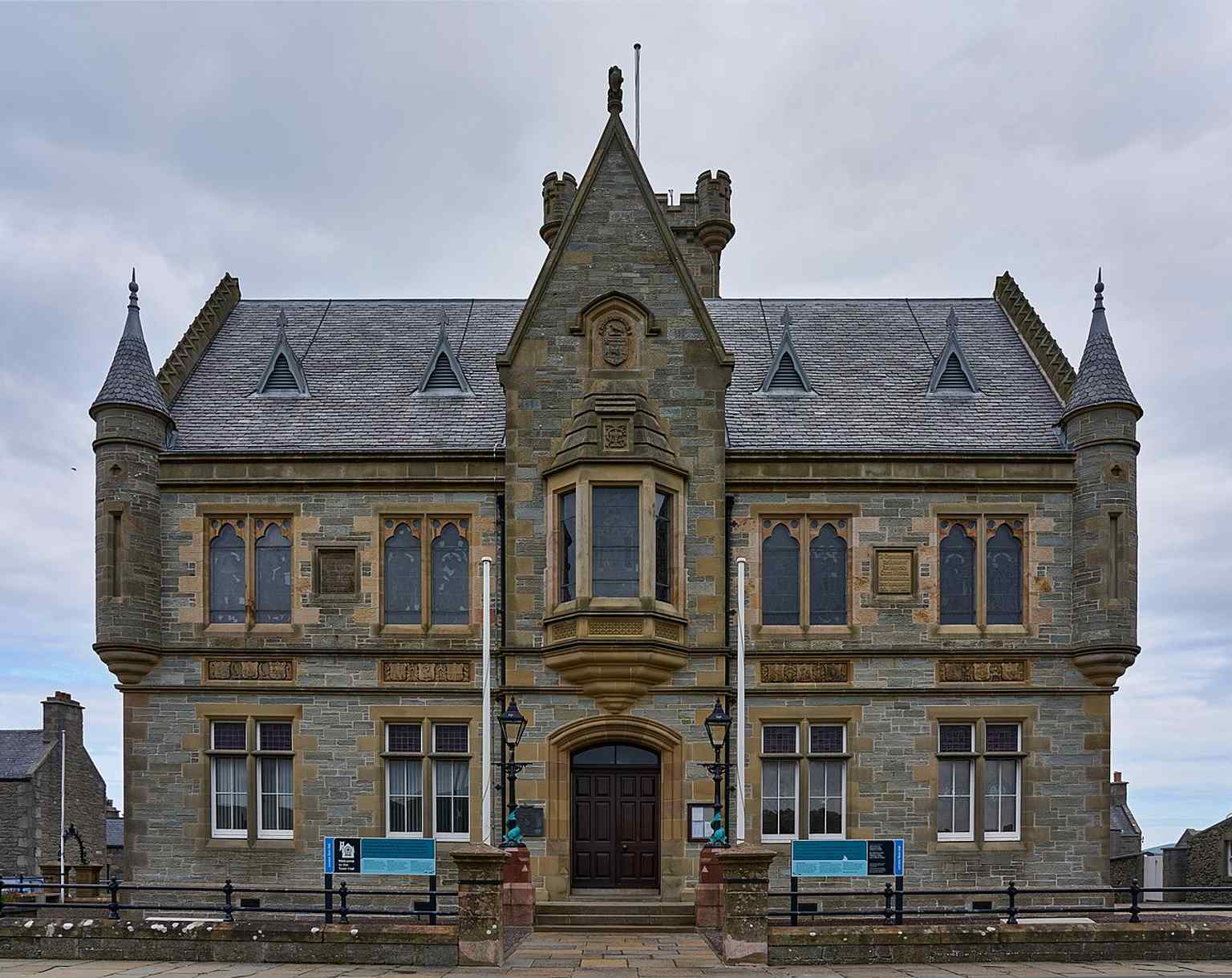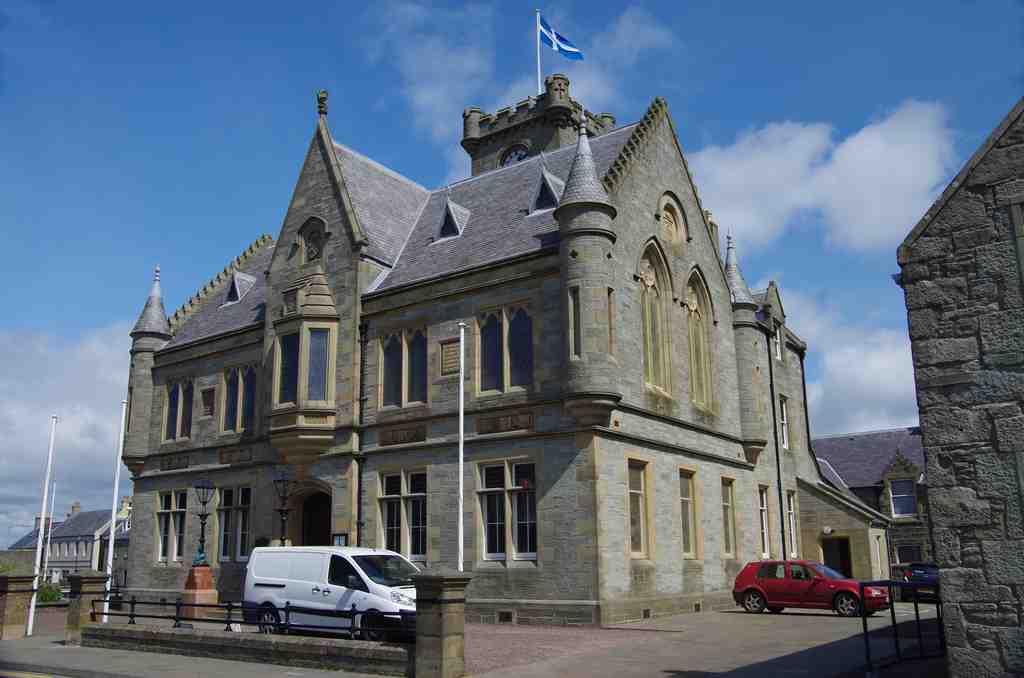
On your left, look for the pale sandstone frontage with its five-bay shape, arched central doorway, and battlemented tower rising at one side.
Lerwick Town Hall likes to make an entrance. It was meant to. In the late nineteenth century, the herring trade swelled the town, meetings in the Parish Kirk no longer suited a place with growing confidence, and civic leaders chose this site on Hillhead for something more declarative: a hall that could speak for Lerwick before anyone inside said a word.
Prince Alfred, Duke of Edinburgh, laid the foundation stone here on the twenty-fourth of January, eighteen eighty-two. And then, by one of those exquisite coincidences history occasionally allows itself, Lerwick staged the first Up Helly Aa torchlight night that very same evening. So the town hall begins not only with ceremony, but with flame, procession, and performance. The official city of papers and seals met the theatrical city of torches and spectacle on the same day, and Shetland has been balancing those two selves ever since.
Architect Alexander Ross of Inverness gave the building its Scottish Baronial dress: a style that borrows the language of castles, with battlements and little corner turrets called bartizans. Builder John M. Aitken of Lerwick won the contract for three thousand two hundred and forty pounds, well over four hundred thousand pounds in today’s money. By July of eighteen eighty-three, George Thoms, Sheriff of Caithness, Orkney and Shetland, officially opened the hall. Inside were not just a council chamber and courtroom, but even police cells. Celebration and control lived under one roof.
Now, pause a moment and study the decorative ambition of the exterior. Ask yourself whether this building seems content merely to house government, or whether it is trying to teach you how Lerwick wished to be seen.
Because here is the twist: the completed hall was not originally as rich or symbolic as the town wanted you to believe. The first contract allowed for no stained glass, no great decorative programme, none of the visual drama that now defines the building’s reputation. A local merchant named Arthur Laurenson changed that story. He loved Shetland history and the Norse sagas, and he led a committee that raised money first from prominent islanders, then from donors far beyond Shetland, to turn the hall into a civic pageant in stone and glass.
One of those interior windows appears here. They transformed the hall into a kind of public history book. Ballantine and Son of Edinburgh, along with other makers, filled the building with scenes of royal successions, church foundations, battles, and Scandinavian links. The most famous is the Marriage Window: Princess Margaret of Denmark and King James the Third of Scotland, whose marriage in fourteen sixty-nine helped bind these islands to Scotland when her father could not redeem the pledged dowry lands. You can see that window on your phone as well.
And yet this grand stage has needed rescuing again and again. Crumbling sandstone, failing repairs, leaks through refurbished windows, decayed steps, even a waterlogged time capsule discovered with only its coins intact: this hall survives because people keep stepping in.
That matters, because the building’s power was never only festive. A registrar still works here, weddings still unfold here, but this was also the chamber of rule, the place where authority could applaud, record, judge, and confine. In a few minutes, at the County Buildings, we meet that sterner face more directly. If you want to come back inside, the town hall generally opens on weekdays from nine to five and closes at weekends.