
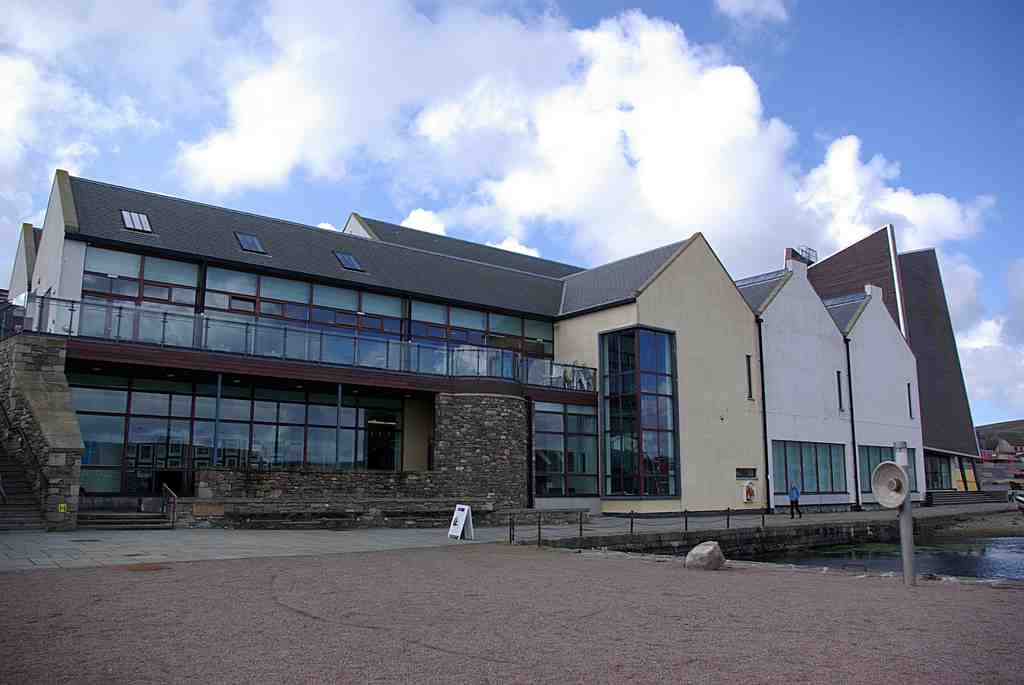
On your right, the Shetland Museum is a long timber-clad and glass building set around a stone dock, with a tall glazed boat hall rising above the waterfront like a working shed given a very elegant second life.
This place keeps its memories in public view, but it also hides them in its bones. The museum service began in nineteen sixty-five, when local historian Tom Henderson became its first curator, and a year later Zetland County Council opened a shared library and museum building elsewhere in Lerwick. Useful, certainly, but modest. What stands here now at Hay’s Dock opened on the thirty-first of May, two thousand and seven, when Charles and Camilla, then Duke and Duchess of Rothesay, came with Queen Sonja of Norway to mark a much grander chapter.
And yet the cleverness of this museum is that it never pretends to begin in two thousand and seven. Look carefully at the dockside setting for a moment. Ask yourself what seems newly shaped, and what seems carried forward rather than swept away.
That question matters here. Hay’s Dock itself dates from eighteen fifteen, when Hay and Ogilvy created this working harbour space, now the museum’s largest object in a sense, a listed dock that frames the entire site. During the restoration, the team did not treat the place as empty ground waiting for a fresh design. They reused materials from the dock and from Shetland’s maritime past. The detail locals quietly treasure is inside: timber from the hull of the sunken Elenore Von Flotow was refashioned into the reception desk. So even before you look at a single exhibit, you are already standing inside a story pieced together from salvage.
The image on your screen shows how the building settles into the old dock rather than overpowering it. That is why this museum feels less like a warehouse of objects and more like a vault of lived memory. It has five times the exhibition space of the old museum, including a three-storey boat hall, and galleries that move from early settlers, farming, fishing, folklore and small boats to the last two centuries of politics, industry, knitwear and seafaring. The archives stretch from the fifteenth century to the twenty-first. More intimate still, since the nineteen eighties staff have recorded islanders speaking about their lives and work, building an audio archive that preserves Shetland voices, not just paper.
There is a rather lovely honesty to that. Lace shawls sit in the same institution as complete boats; delicate memory beside hulking craft. On another image in the app, you can see some of those boats laid out at Hay’s Dock, echoing the museum’s great boat hall and the sea-minded life of these islands. The wider dock has become part of the collection too: restored pier buildings, commissioned artworks, spaces for launches, exhibitions, gatherings, even weddings. A working harbour learned a cultural language without forgetting the old one. No wonder the millionth visitor arrived in two thousand and eighteen as part of an ordinary family outing: Dr David Malcolm, with his grandson Oliver. That tells you everything. This place belongs to daily life, not just display cases.
Next, the story hardens. In about eight minutes, Fort Charlotte asks what Lerwick did when memory alone was not enough, and the town had to defend itself by force. If you plan to go inside later, the museum generally opens from midday on Sundays and Mondays, and from ten o’clock the rest of the week.




