
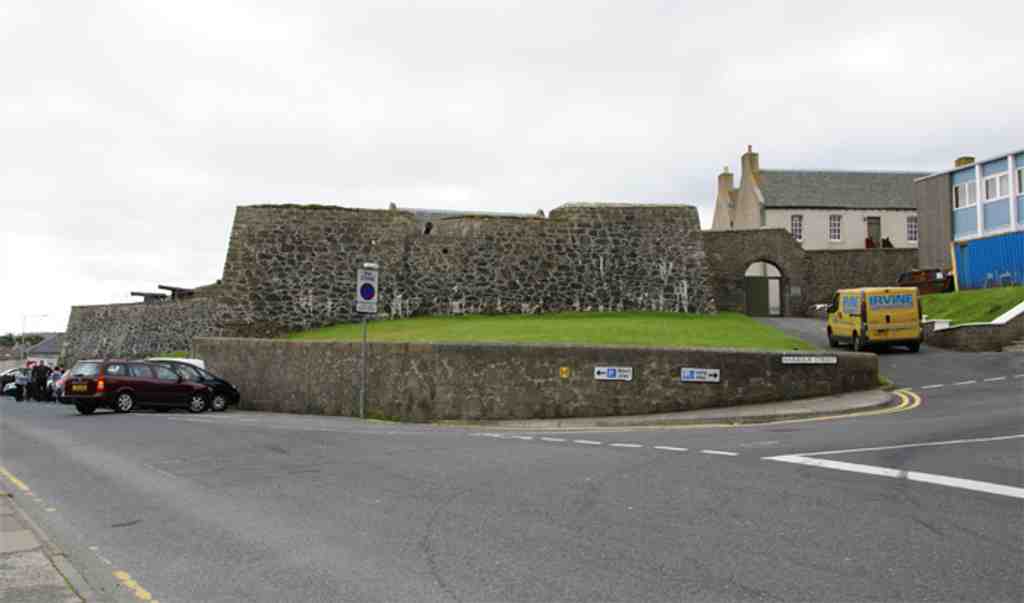
On your right stands a low, stone, five-sided fort, its thick walls broken by sharp-angled bastions and a formal arched gate.
Fort Charlotte looks compact now, almost folded into the town around it, but it tells a rather dangerous truth about Lerwick: trade and threat grew up together. Even in the seventeenth century, local histories say this fort gave the young town a push, and merchants gathered nearby. Protection drew commerce close. The same sea that brought business could also bring an enemy.
The first fort here went up between sixteen fifty-two and sixteen fifty-three during the First Anglo-Dutch War, though almost nothing of that version survives. What you see now is part of a story rebuilt in layers. In sixteen sixty-five, at the opening of the Second Anglo-Dutch War, Charles the Second ordered Robert Mylne to raise a new fort on this site, spending twenty-eight thousand pounds, a sum worth several million pounds today. If you glance at the image in the app, you can see how tightly the fort still sits beside Lerwick’s commercial heart.
Then came the bluff. In sixteen sixty-seven, a Dutch fleet approached and decided this place looked far more heavily armed and manned than it truly was. In reality, the walls were unfinished and the guns were few. That illusion saved Lerwick. But the protection was fragile. After the war, the government chose not to keep a garrison here, and when the Dutch returned in sixteen seventy-three during the Third Anglo-Dutch War, they found the fort abandoned and burned the barrack block. The war scares were not distant rumours here; they were the reason people paid so close attention to this fort.
And that raises a delicious question: does a fort matter most for the battles it fights, or for the nerve it lends to the town sheltering behind it?
The present fort took shape in seventeen eighty-one and took Queen Charlotte’s name. Those angled corners are bastions, projecting points designed so defenders could fire along the walls beside them. From the ground you cannot quite read the full plan now; land reclaimed in front of the fort has stolen its old command of the shoreline, and only from the air does the whole design reveal itself.
Its life changed again. During the Napoleonic wars, soldiers garrisoned it. Later it became Lerwick’s jail and courthouse. Shetland Museum and Archives preserves the records of inmates, including one Customs and Excise tidewaiter imprisoned here for debt, not violence. For islanders who disliked customs men for interfering with smuggling and wreck recovery, his confinement would have carried a certain edge.
Today the fort remains unusually alive, still serving as the base of an Army Reserve unit as well as a heritage site. Soon, the watch over these waters changes form: not cannon waiting for attack, but rescuers waiting to launch. The Lifeboat Station is about six minutes away. If you plan to return inside, the fort generally opens daily from ten in the morning until four in the afternoon.




