
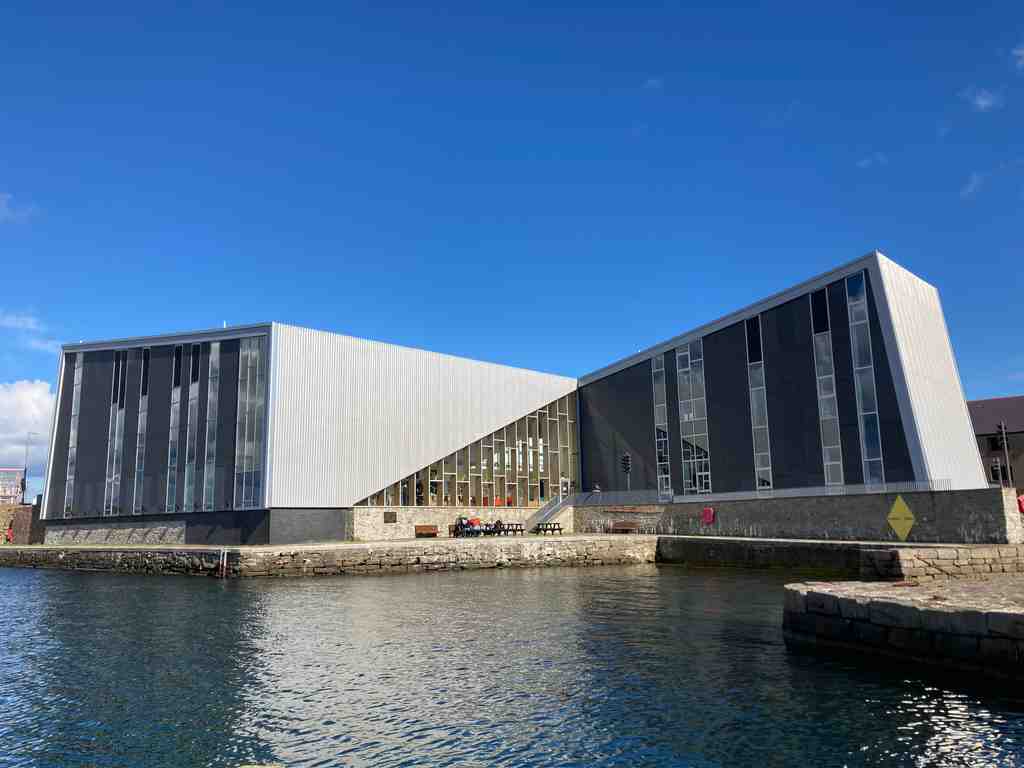
On your right, Mareel is a long, angular building of dark cladding and glass, with a stepped roofline and a broad waterfront face that gives it the look of a modern harbour shed refined into something far more purposeful.
Here on the Hay’s Dock waterfront, Lerwick shows one of its clearest transformations. This edge of town once spoke chiefly of loading, landing, and hard practical work. Now it still serves the town, only in a different key. Mareel is not simply a place for a pleasant evening out. It is infrastructure of another sort: a cultural engine, built so island talent would not have to leave home quite so quickly to find a screen, a stage, a studio, or a future.
Its name is lovely and precise. Mareel means phosphorescence on the ocean, that shimmer of living light on dark water. If you glance at the image on your screen, you can see how the building’s clean waterfront profile suits that name.
The idea took years to gather force. In nineteen eighty-nine, Shetland lost its only cinema when the North Star closed as a picture house. Campaigners began pressing for something new, and by two thousand and one the council chose a combined venue rather than separate cinema and music buildings, because it would cost less to construct and run. That decision matters. Mareel was conceived as a hub for the creative industries, meaning the working world built around music, film, design, recording, and digital production, not just art for art’s sake.
Inside are the kinds of spaces a small island capital had been missing: a main auditorium, which simply means the principal performance hall, with room for about six hundred and fifty standing or around two hundred and fifty seated, plus a balcony for another eighty-five; two cinemas; a recording studio; rehearsal rooms with sprung floors, built to flex slightly and protect dancers and movement; and a multimedia suite for film, television, graphics, music, and websites. Shetland College U-H-I began teaching music courses here in the twenty twelve to twenty thirteen academic year, so the building quickly became a workshop as much as a venue.
One figure worth keeping in mind is Gwilym Gibbons, the first director of Shetland Arts Development Agency. At the public launch in October two thousand and eight, he thanked his colleague Kathy Hubbard for helping raise the money, and she remembered the very first meeting, when Mareel existed only as a fragile idea. That launch spilled along the waterfront with local music from Brack da Brod, Sheila Henderson, and Brian Nicholson. It felt less like a construction announcement than a community deciding what it wanted to keep alive.
Not everyone approved. Pub and nightclub owners feared competition, an anonymous State Aid complaint went to Europe and failed, and the council itself split nine to nine before convener Sandy Cluness used his casting vote and said, “As far as I am concerned you can go ahead and build Mareel.” Even then, trouble lingered. D-I-T-T, the local contractor, and Shetland Arts argued publicly over delays and design changes before the building finally opened in November two thousand and twelve.
And yet, once open, it justified the fight. The Revellers played the first sell-out standing gig here, then recorded Renegades, the first album entirely recorded, produced, mixed, and mastered in the building. Students launched their own EPs-extended-play recordings-from these rooms. This is Shetland’s creative community in one place: artists, technicians, teachers, students, promoters, and audiences sustaining the town in a different register.
Next, make for the Shetland Museum, where this modern confidence meets the deeper memory of the islands, about three minutes away. As a practical note, Mareel is usually closed on Mondays and otherwise opens from ten in the morning until eleven at night.




