
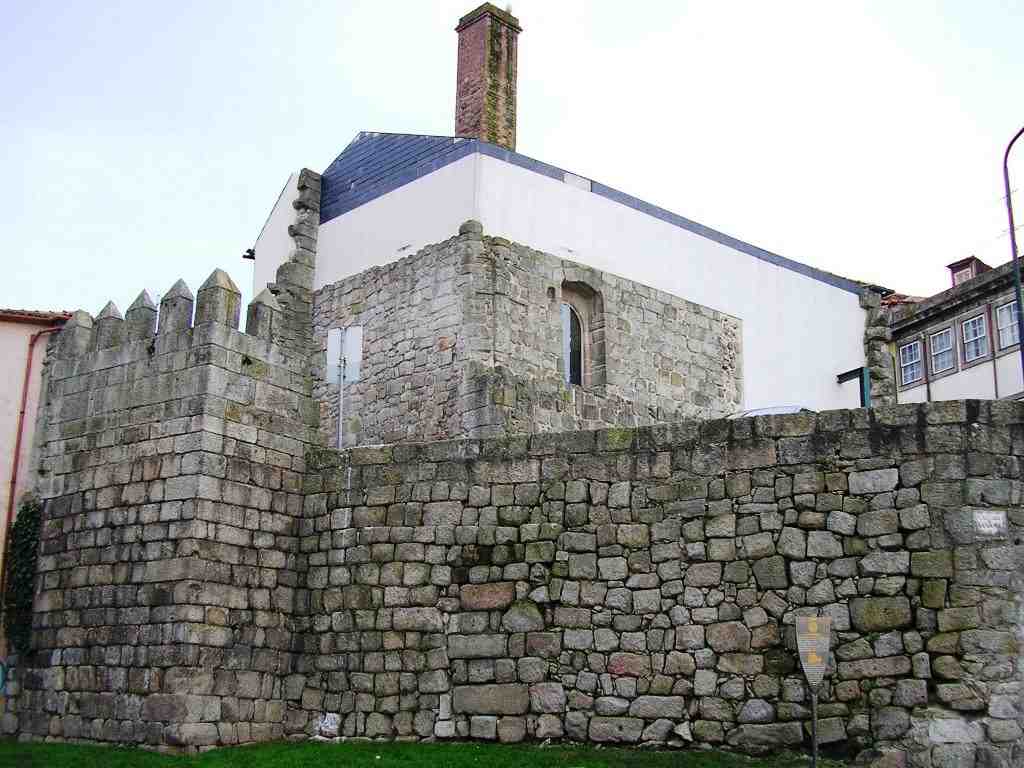
On your left, look for a severe stone house with a tall, narrow façade, later rectangular openings cut into older masonry, and a surviving stretch of medieval wall fused into its side.
This address refuses to behave like a single thing. It is a house, yes, but also a tower, a fragment of defence, and an archaeological site in disguise. The structure at Rua de Dom Hugo number five began as a late medieval house-tower, and much of that original frame survived even after the first Gothic residence disappeared. Later owners did not start fresh; they reused the old walls and cut new openings into them. That is why the front still carries what historians call a reversed Gothic face, where an old entrance and a narrow light opening remain visible through later change.
Here is where archaeology begins to argue with lived memory. Documents give us people we can name, such as Manuel Cardoso Corte Real, who owned the property in eighteen seventy-one. He matters because he stands near the edge of one story: after him, the trail of ordinary ownership starts to fade, and the deeper, stranger biography of the site takes over.
In the nineteen eighties, archaeologists dug inside this very building. At about three metres down, and through twenty distinct layers, they found evidence of occupation reaching back to the fourth or fifth century: first a proto-historic castro, a fortified settlement, then Roman remains, then Suevo-Visigothic and early medieval traces, and later medieval building again. That sequence helps suggest how Portucale was already gaining importance by the late sixth century.
If you glance at the image in the app, you can see the preserved line of wall that later construction swallowed and protected at the same time. Locals tend to notice that detail before anything else.
In nineteen ninety-three, architects restored the building and moved their northern regional headquarters here, turning preservation into daily use rather than a sealed display. Which is perhaps the real lesson of this address: in Porto, a home can become evidence without ever entirely ceasing to be a home. And even here, the file never quite closes. In a moment, we’ll continue to the Casa-Museu Guerra Junqueiro, just a one-minute walk away.




