
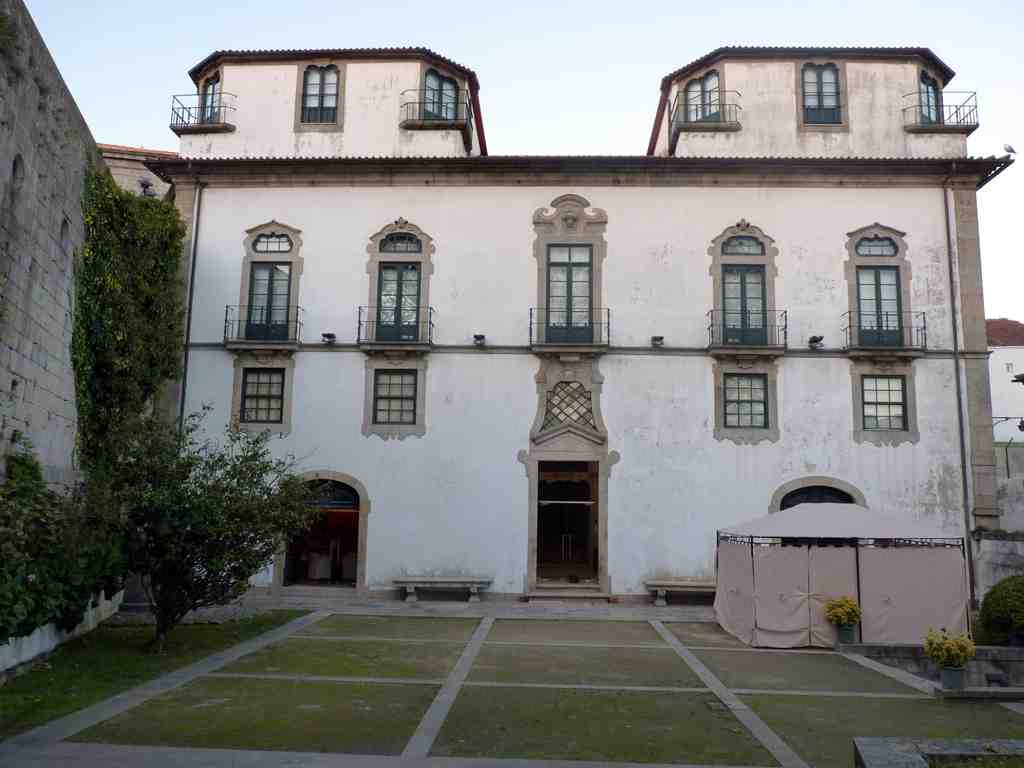
In front of you stands a pale granite Baroque townhouse, tall and rectangular, with wrought-iron balconies and a carved stone doorway that gives the house an air of quiet rank.
This began, not as a museum, but as a very confident private residence. Between seventeen thirty and seventeen forty-six, Domingos Barbosa, a senior cleric of Porto Cathedral, ordered this house for himself. That already tells you something important about this hill: churchmen here did not always live modestly. They could live with the scale, polish and ceremony of the urban elite.
For a long while, people linked the house to Nicolau Nasoni. He is one of those magnetic figures in Porto whose name seems to settle on buildings almost by instinct, because his style shaped so much of the city and his reputation grew faster than certainty. Sometimes that fame rests on firm evidence; sometimes it survives by repetition, a handsome legend attached to handsome stone.
This house sits squarely inside that uncertainty. Older tradition gave it to Nasoni, but newer study points toward António Pereira instead, largely because this façade resembles the Palácio de São João Novo so closely that scholars suspect the same architect at work. In Porto, even the most elegant buildings can carry an argument in their bones.
If you want a sense of that shifting identity, have a look at the older photograph on your screen. It reminds you that the building itself has stayed put while the story attached to it keeps being revised.
Now, pause at the doorway and imagine what lies just beyond it: a monumental staircase rising from the entrance hall to the upper floor. Not merely a way to get upstairs, but a piece of social theatre. A guest would ascend slowly, seen from below, moving from the street into a carefully staged world of status, taste and control. Houses like this performed power as deliberately as palaces.
That theatrical interior later found a second life thanks to one very personal decision. Guerra Junqueiro’s daughter, Maria Isabel Guerra Junqueiro, bought the house in nineteen thirty-four. In nineteen forty, she and her mother, Filomena Neves, gave it to the city on one condition: Porto must turn it into a house-museum for her father’s art and literary collections. The gift was substantial, not sentimental alone, around six hundred pieces, and the museum reopened in nineteen forty-two with furniture, sculpture, Nuremberg plates and ceramics arranged to recover the feel of a lived noble home.
Junqueiro himself mattered here not only as a poet, but as a collector with a sharp eye. One especially striking object inside is the sixteenth-century Virgem do Leite from Coimbra, an image of the Virgin nursing Christ. That kind of image had once been common, then church reformers after the Council of Trent, the Catholic Church’s reform council, discouraged it for being too bodily, too openly feminine. Its survival in this collection feels like a small victory for things history tried to tidy away.
And the house kept changing costume. In the nineteen nineties, architect Alcino Soutinho remodelled it with exhibition space, a small auditorium, café and shop, proving that preservation here never meant freezing the place into silence.
That, perhaps, is the real lesson of this façade: refinement does not cancel uncertainty. Just beside the cathedral, sacred authority lived in rooms of domestic splendour, and in a moment we shall see that the bishops made the same claim on an even grander scale at the Episcopal Palace.




