
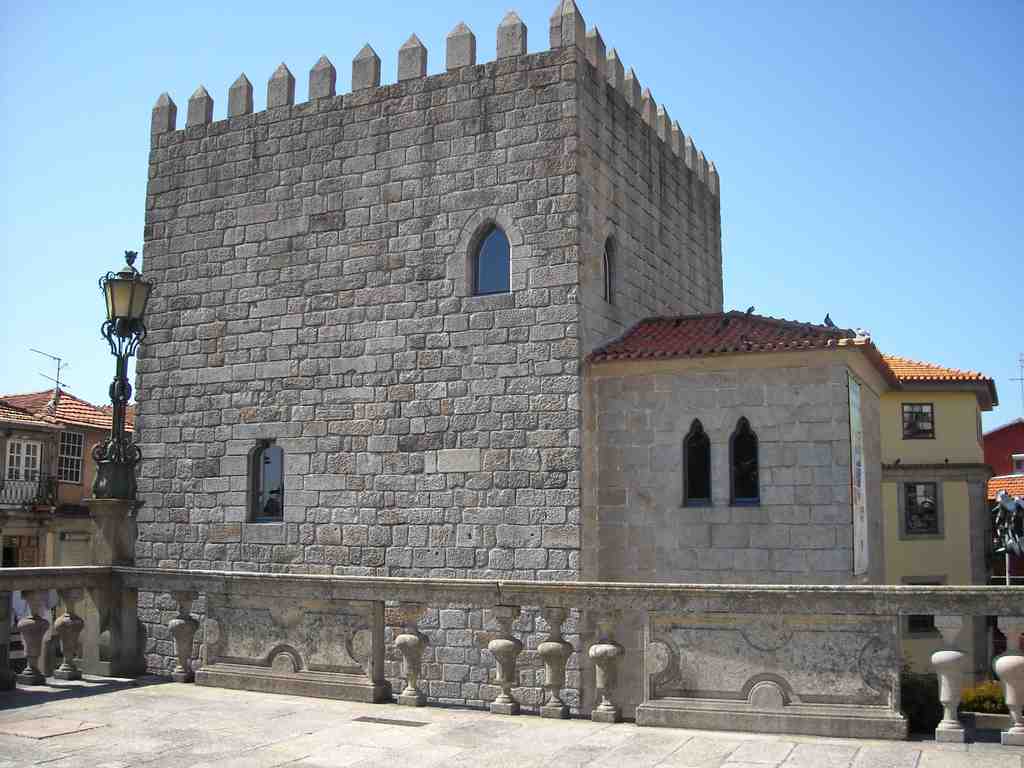
On your right is a compact granite tower made of two stacked rectangular blocks, topped with tooth-like triangular battlements and marked by a small stone balcony that gives it a faintly Gothic profile.
This is the Tower of D. Pedro Pitões, though the name solves less than it suggests. D. Pedro Pitões was a twelfth-century archdeacon of Porto, remembered for his part in the Reconquista and for supporting the First Crusade. By attaching his name to this tower, Porto wrapped the building in crusading-era memory. The slight complication is that nobody can say with full confidence what the tower originally was.
And that uncertainty is the point.
The structure came back into view in nineteen forty, during demolition around the cathedral precinct, in the old Largo do Açougue, as the city reshaped the area around the Terreiro da Sé. For centuries it had been swallowed by later buildings. Then, as walls came down, this older fragment emerged from inside the city like a bone from the earth. If you glance at the image on your screen, you can see the setting that nearly erased it and then, belatedly, saved it.
Most visitors assume the tower has stood on this exact patch of ground ever since the Middle Ages. Not quite. Porto decided, late in the works, not to clear it away. Instead, the city shifted it about fifteen meters and rebuilt it near its original site. So the tower before you is both genuine and displaced: an authentic relic, but also a carefully staged survivor. That is a very Porto sort of truth.
Its first job remains unsettled. Some heritage accounts call it a fortification. Others suggest it may have been the residence of a prosperous burgher, meaning a wealthy townsman rather than a noble lord. In other words, this may have been less a defensive stronghold than a proud urban house with a stern face. Look at the front: the arched doorway, the paired windows cut into soft three-lobed shapes, the upper openings that seem half domestic, half defensive. The building never quite chooses one identity.
Architect Rogério de Azevedo directed the reconstruction and added the stone balcony you can see today, with a distinctly Gothic flourish. If you look at the closer image in the app, that detail becomes obvious. So even its silhouette is a conversation between medieval stone and twentieth-century imagination.
Then the tower changed costume again. From nineteen forty to nineteen sixty, Porto installed the Gabinete de História da Cidade here, the City History Office, which is wonderfully ironic: the building held the city’s memory while keeping its own secrets. Older locals still know it as the Torre da Cidade, the City Tower. After the Carnation Revolution, on the twenty-fifth of April, nineteen seventy-four, residents occupied it and set up the Centro Social e Cultural da Sé. That matters. Preservation rescued the stone for archaeology, but neighbours claimed it for lived memory.
Manuel Magalhães led another rehabilitation in nineteen ninety-seven, and by nineteen ninety-eight the tower had become a tourist post. Yet another role, another layer.
From here, we turn toward the Church of Misericórdia do Porto, about eight minutes away, where the city claimed moral authority not through battlements or bishops, but through organized charity. And this little rescued tower, at least from the street, can be visited at any hour.




