
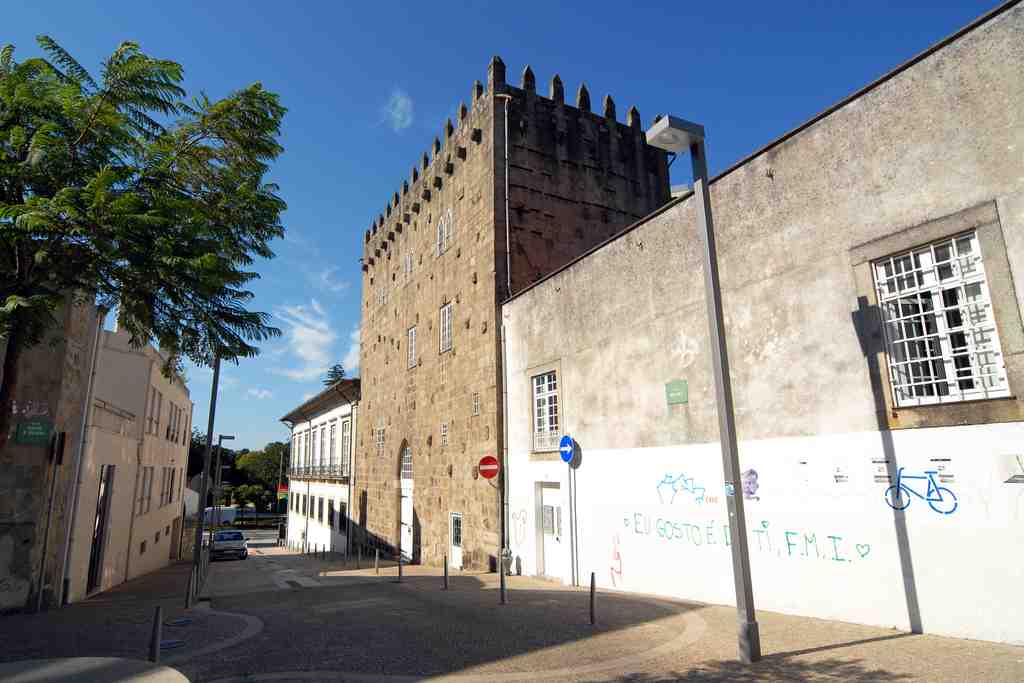
Look for a tall rectangular stone tower, partly folded into a larger palace block, with a crenellated top and small trilobed windows cut into its upper walls.
This tower carries a harder message than many buildings in Porto. It does not simply say someone lived here. It says someone meant to be obeyed here.
Pedro de Sem, chancellor to King Dom Afonso the Fourth, ordered this tower in the first half of the fourteenth century. On the surface, it looks like a noble tower-house: a residence with the manners of a fort. But the Portuguese heritage survey, S-I-P-A, reads it more sharply. Pedro de Sem was a royal officer, and this tower helped project the crown’s authority at Porto’s edge while Afonso the Fourth’s new walls were rising. That matters. This was not only family property. It was a sign planted in stone, telling the city where power stood.
You can still read that double purpose in the building itself. The tower is defensive, with a battlemented crown and openings high above, yet it also belonged to an estate and served as the centre of a pre-urban property on the outskirts of the medieval town. Defensive shell or family home? In truth, both. And that blurred line tells you a great deal about medieval rule. Government did not always sit in a separate office. Quite often, it lived behind the same walls that guarded land, collected loyalties, and watched the road.
The family story stretched on. By the early fifteen hundreds, the estate had passed through Pedro de Sem’s descendants. One of them, Martim d’Océm, his great-grandson and also a royal chancellor, held it in fourteen thirty-one. Even his tomb led a second life, moved later from São Domingos in Santarém to the Museum of São João de Alporão. The family itself faded from the property, but its name clung to the stone.
Then the Brandão family took over, and in fifteen seventy-six Rui Brandão Sanches created what lawyers called a majorat, a legal arrangement meant to keep the estate bundled inside one inheritance line. That helps explain why this place stayed in the same family orbit for centuries. Later, the Brandãos added a palace beside the tower, and that is why so much of the medieval structure now seems absorbed into later architecture. Most people notice the age of the tower. Fewer notice how thoroughly later Porto tried to domesticate it without quite managing to erase it.
There is even a local legend that Pedro Sem, once wealthy, ended by begging beside his own tower. It is only a legend, and the details shift, but the tale survived because places like this invite moral stories about pride, rank, and decline.
Its later life kept changing. The Diocese of Porto bought the complex in nineteen nineteen. It served as a bishop’s residence, then as a Catholic cultural centre. In nineteen eighty-six, the architect Abrunhosa de Brito remade the interior almost entirely for residential use. So what stands before you is old stone with a much newer inside: another Porto habit, keeping the shell, rewriting the use.
And that is the lasting note here. Authority changes hands. Families vanish. Interiors are rebuilt. But the old line in the landscape remains.
In about thirteen minutes, at the Church of São Martinho de Cedofeita, we go deeper still, toward an earlier Porto: before grand civic life, before the modern city, when this was a frontier place learning how to endure.




