
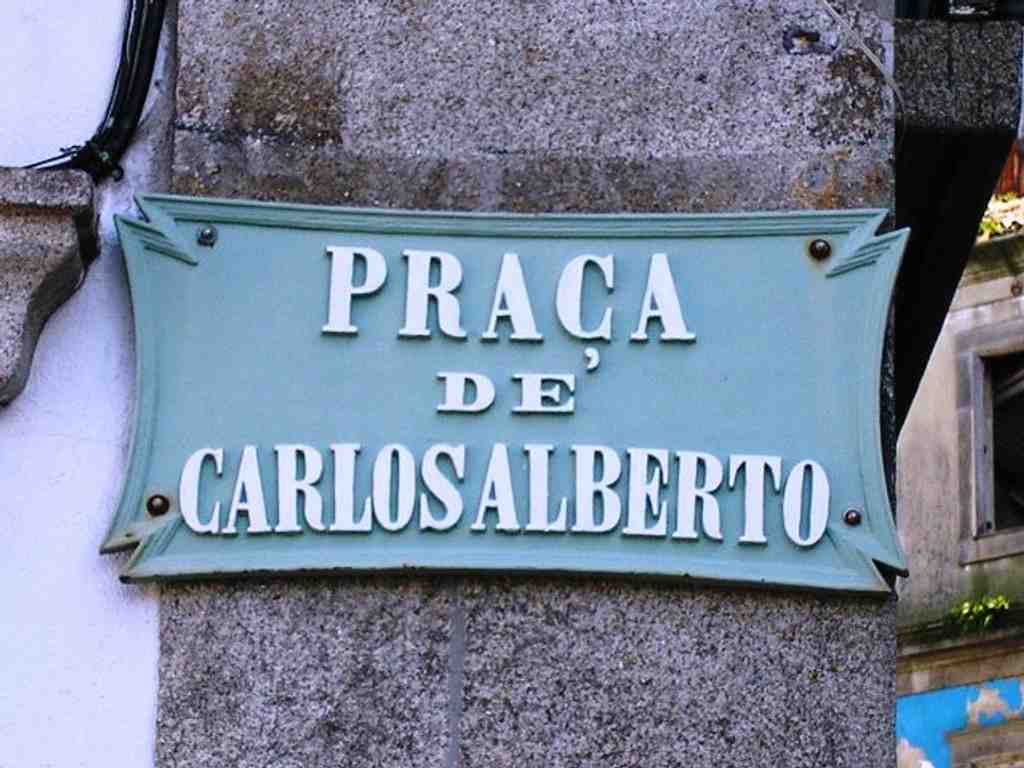
On your right, look for a broad square paved in pale limestone and dark basalt, shaped by formal garden beds and anchored by a tall memorial rising from its centre.
Praça de Carlos Alberto feels open and public now, but it began as a hardworking crossroads. In the seventeenth century people called it Largo dos Ferradores, the Farriers’ Square, because this was where men shod horses and readied mounts for the long roads ahead. Just beyond the old Porta do Olival, the routes split here toward Braga by today’s Rua de Cedofeita, and toward Guimarães by Rua das Oliveiras. Inns gathered around the traffic, and so did trade. Later, people nicknamed it Feira das Caixas, the Fair of Boxes, because carpenters here made the trunks that emigrants carried to Brazil.
Then, in eighteen forty-nine, this practical square took on a strangely intimate sorrow. Carlos Alberto, the deposed king of Piedmont and Sardinia, arrived in Porto after losing the Battle of Novara and giving up his throne. He came here not in procession, but in refuge. On the nineteenth of April, he lodged in the Hospedaria do Peixe, inside the Palacete of the Viscounts of Balsemão, right on this square. It is quite a thought: a fallen king entering an inn in a place known for horses, luggage, and departures. He stayed only briefly, moved on to the Quinta da Macieirinha, and died about three months later. Soon after, the square took his name. Porto has a habit, you notice, of first receiving the wounded and only later deciding what to call the moment.
If Praça Nova, today’s Praça da Liberdade, carried the spectacle of political power, this place keeps the quieter aftermath. Here, history shrinks to a room, a bed, a man in exile. And yet even that private grief left a dynastic echo: Carlos Alberto would become the grandfather of Maria Pia, future queen of Portugal.
The square did not stop being useful because a king suffered here. It kept changing occupations. It hosted fairs for cattle, cloth, animals, grass, charcoal, and firewood. It became a hiring ground where farm servants and domestic workers came from the outskirts to bargain directly with future employers. From eighteen fifty-three to nineteen ten, the terminal for the Carros Ripert stood here by the Havaneza tobacco shop, a heavy wood-and-iron horse-drawn vehicle linking Porto to São Mamede de Infesta. And on the twelfth of August, eighteen seventy-four, Porto’s first carro americano, a horsecar and direct ancestor of the electric tram, departed from this square for Cadouços in Foz.
Later, memory grew more monumental. Henrique Moreira’s memorial to the dead of the Great War, unveiled in nineteen twenty-eight after an earlier statue was rejected and removed, gave the square a more solemn centre. In nineteen fifty-eight, an immense crowd followed Humberto Delgado here, and decades later José Rodrigues fixed that act of defiance in bronze nearby. Even the recent redesign tells its own tale: plans to radically remake the square met resistance, so Porto kept the gardens and the stone paving, choosing adjustment over amnesia.
That may be this city’s gentlest strength: it does not merely produce history, it shelters those broken by it. When you are ready, continue to the Carmelite church, only a couple of minutes away. And, as public squares tend to do, this one remains open at all hours.




