
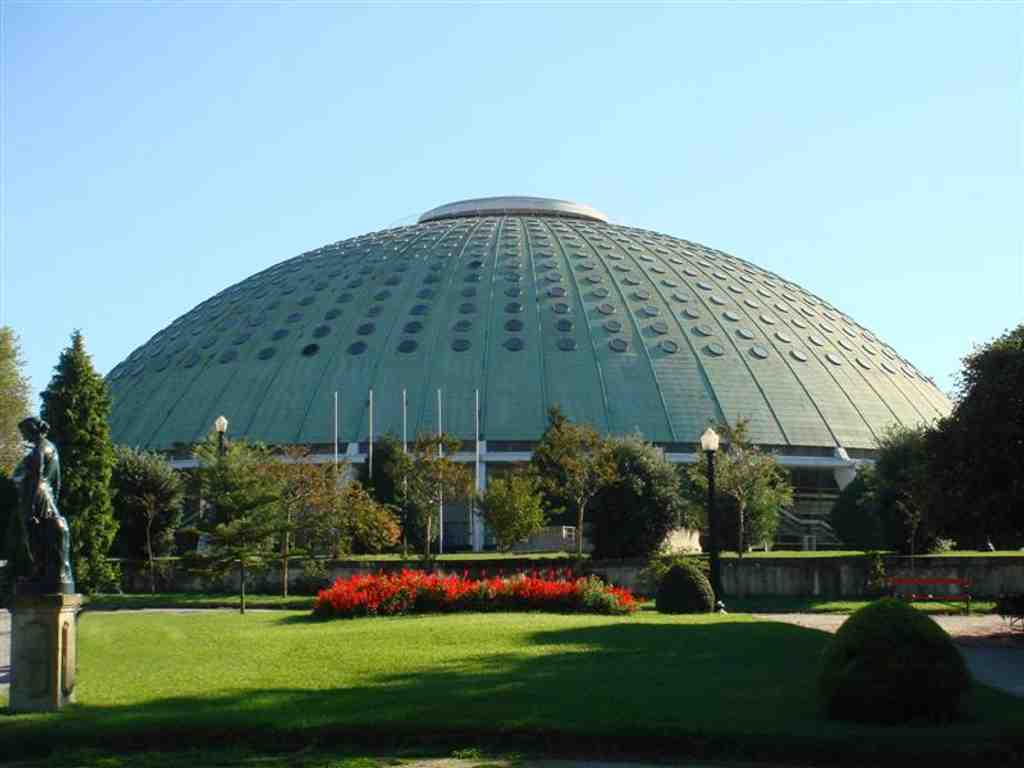
In front of you rises a huge concrete half-dome, smooth and low like an upturned bowl, with a ring of distinctive round windows set into its crown.
This is the Super Bock Arena, still called by many people the Pavilhão Rosa Mota, and by quite a few, even now, simply the Palácio de Cristal. That last name tells you almost everything about Porto’s stubborn memory.
On this very site, the city opened the original Palácio de Cristal in eighteen sixty-five, a glass-and-iron exhibition palace inspired by the famous Crystal Palace in London. People loved it. Then, in nineteen fifty-one, Porto chose to demolish it and replace it with a modern sports pavilion. The decision caused one of the city’s deepest heritage quarrels. Some losses arrive like the tragedy of the Ponte das Barcas, sudden and catastrophic. This one came by intention, with plans, votes, and arguments. It cut differently, but it marked the city just as surely.
Porto gave the new commission to José Carlos Loureiro, a startlingly young architect who had finished his course only a year earlier. Consider this: a man barely out of school was asked to redraw one of the most sensitive pieces of Porto’s public landscape. He answered with this great dome, a bold modern shell rising thirty metres high. Even before workers finished the roof, the pavilion entered local legend. In nineteen fifty-two, with the dome still incomplete, it hosted the Roller Hockey World Championship, and Portugal won. So the new building began not with quiet acceptance, but with patriotic triumph.
After that, it became one of those rare urban containers that can absorb almost anything. Hockey, basketball, boxing, judo, gymnastics, fencing, concerts, theatre, circus, congresses, exhibitions, even trade fairs once housed by the older palace. In other words, the function changed, but the site kept doing what it had long done: gathering the city indoors.
Then came another layer of feeling. In nineteen ninety-one, the pavilion took the name Rosa Mota, honouring Porto’s great marathon champion. Yet even naming turned awkward here. When the renovated venue reopened in twenty nineteen under the commercial title Super Bock Arena - Pavilhão Rosa Mota, Rosa Mota herself stayed away, saying she felt misled because she expected her name to come first. In a place already haunted by replacement, even the order of words mattered.
The recent rehabilitation kept Loureiro’s concrete structure and those emblematic windows while transforming the interior into a far more flexible hall, with seating for around five thousand five hundred and capacity for more than eight thousand at certain events. It also gained a congress centre below and modern systems to control sound and light. So yes, the building adapted. Porto insisted on usefulness. But usefulness never entirely settled the older grief.
And perhaps that is the real lesson standing before you: when a cherished building disappears, can a city repair the wound by keeping the name alive, or does something finer and harder to restore slip away all the same?
In a moment, continue into the Crystal Palace Gardens, where the old name survived the old building and still shades everything around it. If you plan to return inside, the venue is generally closed on Mondays and opens from ten to one and from two to six on the other days.




