
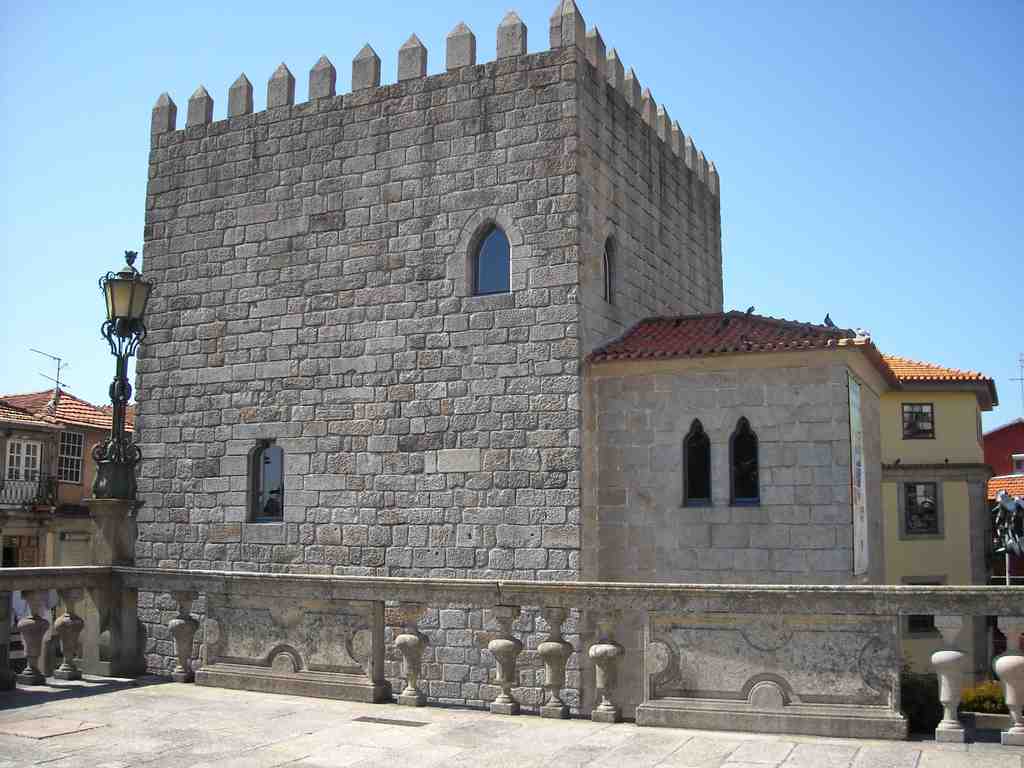
On your left, look for a compact granite tower made of two joined rectangular blocks, topped with pointed stone crenellations and marked by a small Gothic-style balcony.
This little tower carries itself like a survivor, but it is also, rather wonderfully, a question mark.
Its name reaches back to D. Pedro Pitões, a twelfth-century archdeacon of Porto. Heritage accounts remember him for his part in the Reconquista, the long Christian campaign to retake Iberian territory, and for supporting the First Crusade. So the tower borrows his prestige and his medieval aura. Yet the structure in front of you did not pass cleanly from that age into ours. It vanished into the fabric of the city and only returned to notice much later.
That uncertainty is the key here. People often call it a fortification, and certainly it looks the part: granite walls, narrow openings, a sturdy upward thrust. But one heritage account suggests something more intriguing. This may not have been a military stronghold at all, or not only that. It may have been the residence of a prosperous burgher, meaning a wealthy townsman. In other words: fortress or home? Defense or status? Porto leaves the answer slightly ajar, and this tower seems content to keep its secret.
Most visitors never realise the oddest part. In nineteen forty, workers demolishing buildings around the Sé Cathedral uncovered the tower in the Largo do Açougue. The city had been clearing space for the new Terreiro da Sé, and this fragment of older Porto suddenly emerged from within later construction. Then came the decision that saved it: instead of sweeping it away, Porto shifted it roughly fifteen metres and rebuilt it near its original site. If you look at the image on your screen, you can see the silhouette that survived by moving rather than standing still. So what you are seeing is both old and interpreted. Architect Rogério de Azevedo directed the reconstruction and gave the tower some of its present character, including that stone balcony with a distinctly Gothic flavour. If you study the masonry in the app image, you can catch that slightly deliberate medieval look: not fake, exactly, but carefully composed. The structure itself helps the puzzle along. It has two rectangular volumes, one with two storeys and one taller with three, both under tiled roofs. The taller section wears triangular merlons, those tooth-like battlements along the top. Arched doorways and multi-lobed windows soften the severity, as if domestic life once pressed close against defense. Even its neighbours tell a layered story: the Arco de São Sebastião beside it, homes pressed around it, the cathedral group just beyond.
Then the tower changed roles again. Between nineteen forty and nineteen sixty, the Gabinete de História da Cidade, the City History Office, worked here, which is why some older locals still call it the Torre da Cidade. After the Carnation Revolution in nineteen seventy-four, residents occupied it and installed the Centro Social e Cultural da Sé. A restored monument became a neighbourhood space. Then, after Manuel Magalhães led another rehabilitation in nineteen ninety-seven, it turned again, opening in nineteen ninety-eight as a tourist post.
That is the irony of this place: it endured not because everyone always honoured it, but because Porto nearly lost it, noticed it in time, and moved it out of danger. Keep that thought as you head to Porto Cathedral, about five minutes away, where the city’s grand certainties also sit on disturbed ground. And in keeping with its unceremonious history, you can come by this tower at any hour.




