
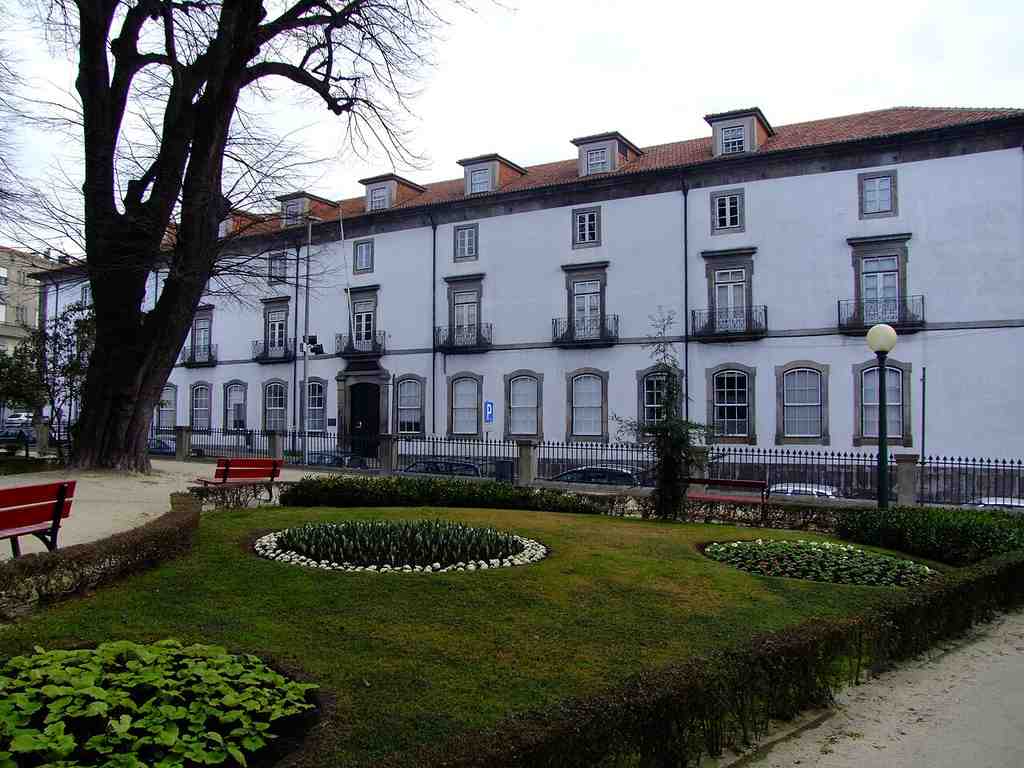
On your right, look for the long stucco-and-granite frontage, stretched in a sober rectangle with a steady rhythm of tall windows and the unmistakable scale of an old convent turned civic building.
This is the Porto Municipal Public Library, and few places in the city show more clearly how one life can be folded into another without the older one quite disappearing. Behind this façade stands the former Convent of Santo António da Cidade, a religious house that now serves a public purpose, while still carrying the gravity of its first calling. The building itself earned official protection as a site of public interest in nineteen seventy-four.
The library began in upheaval. On the ninth of July, eighteen thirty-three, Dom Pedro, Duke of Bragança, signed its founding in the royal palace of Porto. He meant it to honour the city’s anniversary, and he gave it an ambitious name: the Royal Public Library of the city of Porto. It first opened elsewhere, in the Franciscan hospice at Cordoaria, in eighteen forty-one. A year later, it settled here, in this former convent by the Jardim de São Lázaro, and here it took root.
Most tourists notice the old religious shell. What they usually miss is that the first soul of the library came from other vanished religious worlds. Its earliest holdings were gathered largely from the book collections of abandoned convents, and from the remarkable library of Dom João de Magalhães e Avelar, bishop of the diocese. He spent more than thirty years building that collection volume by volume. When it passed into the future public library, people treated the transfer almost as a national event. Alexandre Herculano counted about thirty-six thousand volumes and three hundred handwritten codices - manuscript books, copied by hand before printing took over. The bishop’s heirs disputed the transfer for years, and the government eventually paid a large sum to settle it.
Herculano matters here for another reason. He became the library’s first librarian, and he did not behave like a caretaker polishing shelves. After the religious orders were dissolved in eighteen thirty-four, he rescued manuscripts from the old Library of Santa Cruz in Coimbra and brought them into public protection, rather than letting one of the country’s great medieval collections scatter. So this place did not merely receive books. It saved them.
By eighteen forty-two, the library already listed more than twenty-four thousand works in over forty-seven thousand volumes, with tens of thousands more still waiting in reserve, including thousands from the suppressed convents around Vila do Conde. Later, in eighteen seventy-six, the crown turned it formally into a municipal library. A year after that, the Count of Azevedo enriched its manuscripts again. Then, between nineteen twenty-nine and nineteen thirty-two, even endangered art came here for shelter: Hispano-Moorish tiles from the Convent of Santa Clara in Vila do Conde found refuge inside this building.
That pattern continues. Even its recent requalification has stirred debate about how much a historic place may change and still remain itself. Porto has always argued that point most fiercely where memory is thickest.
Stand here a moment with the odd beauty of it: suppression created access. Knowledge once kept in cloisters, episcopal rooms, and convent libraries became a public inheritance. From here, in about eight minutes, we’ll meet the Church of Santo Ildefonso, where the city’s outer brilliance tells another, rather different story.




