
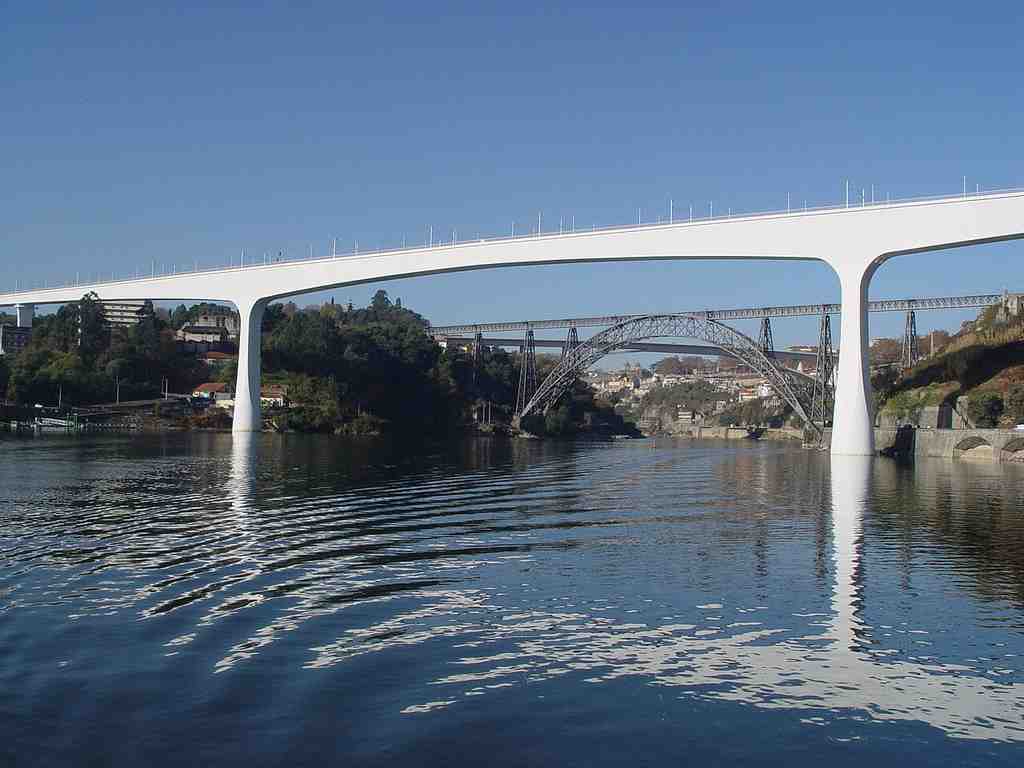
On your right, St. John’s Bridge appears as a long pale concrete railway deck on straight vertical piers, its flat box-like form crossing the Douro without a single arch.
That absence matters. In Porto, bridges so often announce themselves with a grand curve, a flourish, a bit of theatre. This one does something rather bolder: it trusts structure more than ornament. Ponte de São João carries the Linha do Norte, the main north-south railway line, across the river in double track, and it opened on the twenty-fourth of June, nineteen ninety-one, the very day the old Maria Pia Bridge stopped carrying trains. Porto did not erase the old crossing; it simply gave the job to a stronger successor.
The engineer was Edgar Cardoso, one of the great figures of modern Portuguese bridge design, a man who understood both daring and calculation. He had already shaped some of the country’s most admired spans, and here he chose a different language. Instead of an arch, he designed a continuous portal bridge, meaning the deck is held by vertical supports and a rigid frame rather than a curved rib. The main bridge has three spans: a central stretch of two hundred and fifty metres, then two side spans of one hundred and twenty-five metres each. At the time, that central span was widely praised for its unusually long reach on a railway bridge of this type.
If you glance at the image in the app, you can see that calm confidence very clearly: the bridge does not leap, it extends, as if certainty itself had been poured into concrete. And poured is the word. The whole structure, together with its access viaducts, runs to about one thousand one hundred and forty metres, formed as one great continuous piece of reinforced and pre-stressed concrete. Pre-stressed means the concrete was tightened internally with steel so it could carry heavier loads over longer distances. Even the approach viaducts were joined monolithically, as one solid body, so the crossing behaves less like separate parts and more like a single muscular line.
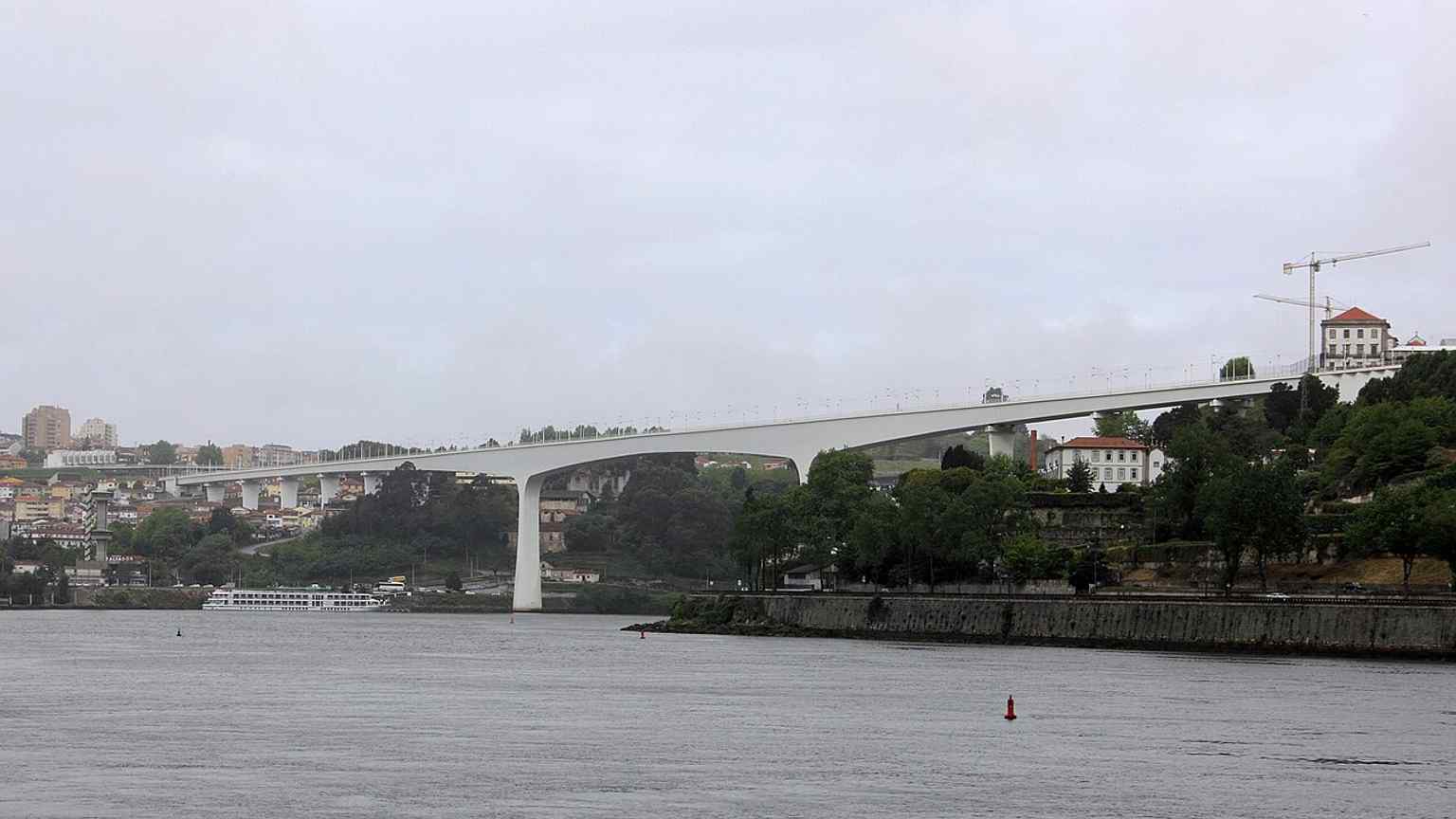
The details are wonderfully practical. The main beam is a hollow box girder, a deep trapezoid in section, rising from about four metres on the viaducts to fourteen metres over the river piers. The rails sit directly on the top slab, and between the tracks lies porous concrete designed to help slow a train if it ever derails. Beneath the river, each main pier foundation was strengthened with one hundred and thirty reinforced concrete micropiles driven into the rocky bed.
Cardoso’s methods could be unexpectedly human. His longtime collaborator Aristides Fernandes said the engineer sometimes shaped carrots with a craft knife to test the form of the piers before turning to formal calculations. There is something delightfully Porto about that: world-class engineering beginning, at least for a moment, with a vegetable on a workbench.
This bridge also belongs to a longer local memory. After the catastrophe of the Ponte das Barcas, and after decades of railway bottlenecks on the single-track Maria Pia, the city kept searching for crossings that were safer, stronger, and more dependable. So this modern form answers an old question. The silhouette is new, the materials are modern, but the challenge is as old as the Douro itself.
From here, we head on toward the Municipal Public Library, about twenty-seven minutes away. And, rather fittingly for a working railway bridge, this one never really closes.





