
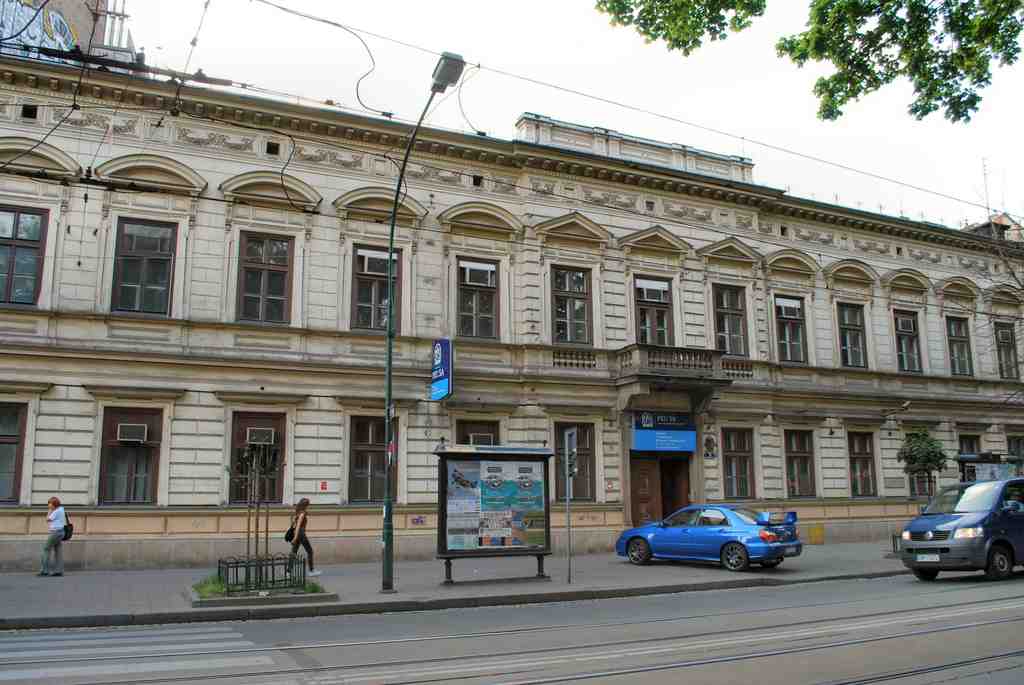
On your left, look for the pale stucco facade with tall rectangular windows, a stone-framed entrance, and a pronounced cornice drawing a firm line across the front.
This quiet building held one of Kraków’s strangest archives: the Museum of Insurance, founded in nineteen eighty-seven inside the historic district branch of PZU, the state insurance company. It sounds dry, almost comic, until you realise what people chose to save here. Under the director Marianna Halota, this little museum gathered more than thirty-five thousand documents and certificates from twenty-eight countries, spanning two centuries. It was the only museum of its kind devoted to the full history of insurance in Poland and the former Polish lands.
The image in the app catches the disguise of it all: an ordinary institutional facade concealing remarkable memory.
The prize object reached straight into Napoleon’s circle: the original life insurance policy of Count Aleksander Colonna-Walewski, the illegitimate son of Napoleon Bonaparte and Countess Maria Walewska, issued in eighteen twenty-nine by the French company Union. Suddenly actuarial tables become love, empire, and scandal.
And then there was the oldest survivor: a receipt dated the fourteenth of December, eighteen oh four, issued to Woyciech Kirster by the Fire Society for Cities in South Prussia. The museum also kept cattle ear-tagging kits for livestock insurance and heavy metal fire marks, plaques fixed to houses so private fire brigades knew a building was insured and worth saving.
It closed quietly around twenty fifteen. Even so, it leaves a deliciously unsettling question: which scraps of paperwork does a city decide are worth a future?
From here, memory shifts from paperwork to revolution as we continue to Kapucyńska Street, about four minutes away.




