
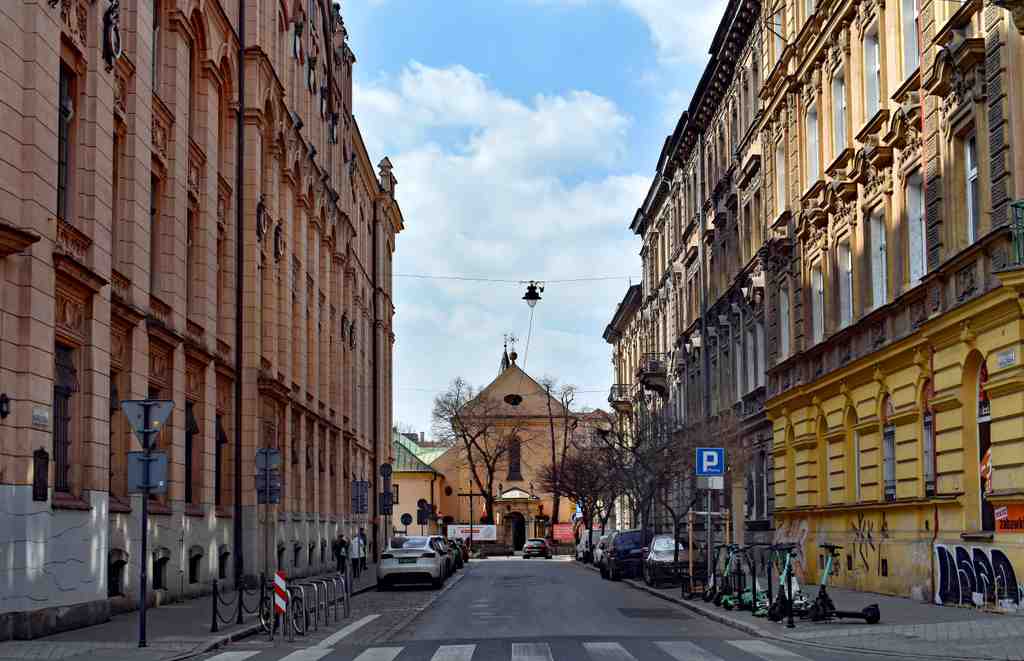
Look for a narrow street lined with tall stone and stucco façades, especially the rounded corner building crowned by a wavy roofline and a clock set inside a sculpted shield.
Kapucyńska is easy to miss. It is short, single-carriageway, almost modest, running between Loretańska and Podwale and marking the edge between Nowy Świat and Piasek. Yet that modesty is part of its trick. Streets like this keep their most consequential moments hidden behind ordinary walls.
Its name, given in eighteen eighty-one, comes from the nearby Capuchin monastery and church, founded here in sixteen ninety-nine after the order arrived in Kraków in sixteen ninety-five. Before that, this ground belonged to a jurisdiction called Ogrodniki, the Gardeners. So the street began not as a grand urban statement, but as something looser, more rural. In old photographs it still looks like a dirt lane with two rows of poplars, and a column of Our Lady of Grace standing in the middle like a quiet witness.
Now the frame tightens. On the night of the twenty-third of March, seventeen ninety-four, Tadeusz Kościuszko slept in the Wodzicki manor that once stood along this street. General Józef Wodzicki hosted him there. At dawn, before the insurrection formally began in the Main Market Square, Kościuszko slipped through a small gate in the garden wall, crossed toward the Capuchin church, and entered for Mass with Wodzicki. There, before the altar, they blessed their sabres and swore loyalty to the homeland. It is one of those rare moments when private prayer and public revolt touch the same stone threshold.
That old manor is gone. Lawyer Józef Rettinger demolished it in the eighteen nineties and split the garden into plots for tenement houses. One fragment survived for a time: the so-called Kościuszko Tower, a small sixteenth-century brick gatehouse tied to the legend of his passage. Then, in nineteen oh nine, Jan Kanty Federowicz secretly tore it down at night, ignoring strict orders from monument conservators. Kraków erupted in anger. People understood exactly what had been lost: not only a building, but a claim on memory.
And this street holds darker layers too. On the opposite side, before schools rose here, the open ground known as the square below the Capuchins served the army for brutal corporal punishment. Kazimierz Girtler, who saw it as a schoolboy in eighteen fourteen, wrote that his heart clenched and he had to run from the sight of soldiers beaten senseless with rods.
So keep Kościuszko in mind as you continue. Follow the line he took, urgent and inward, toward Loretańska Street, only a minute away.




