
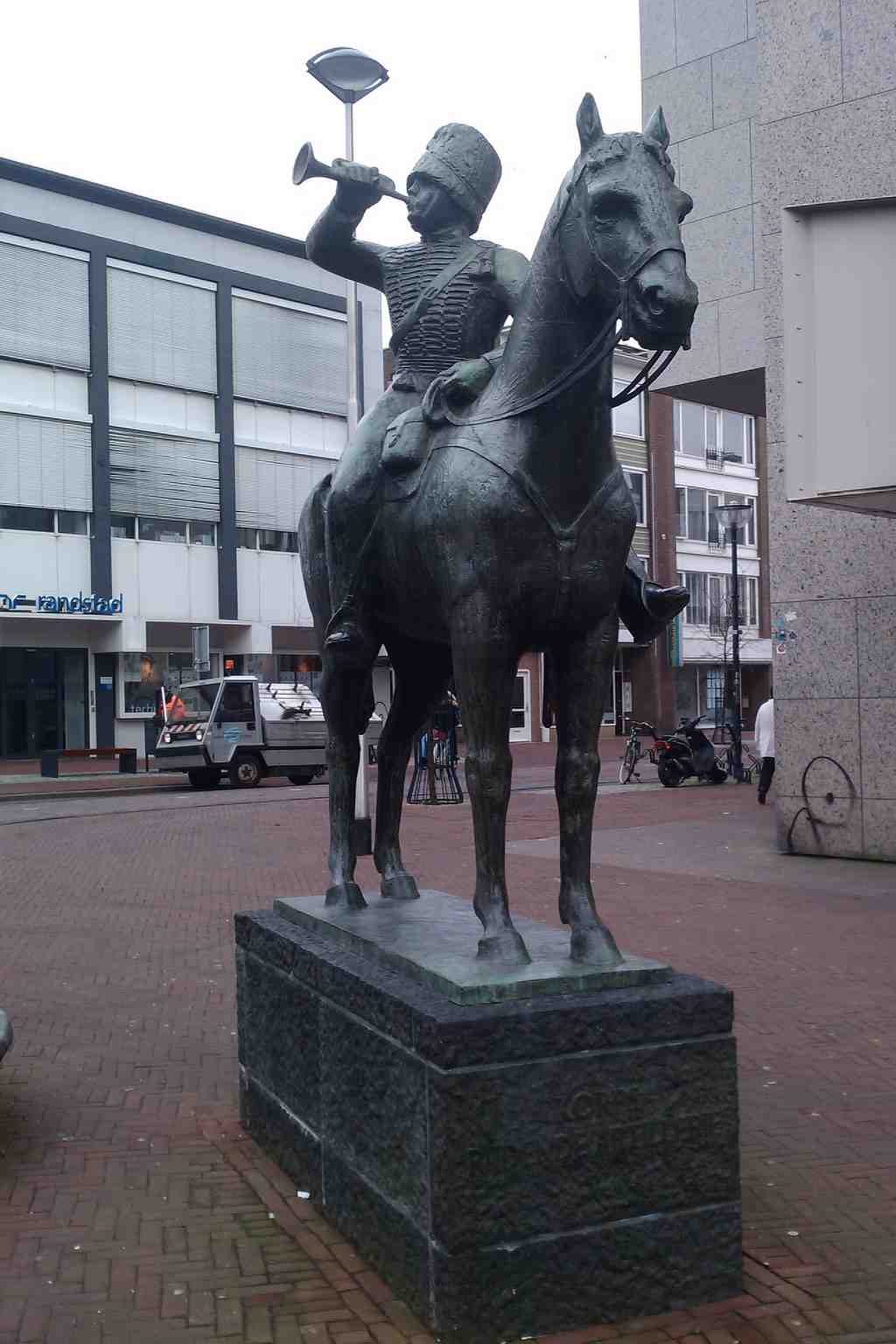
On your left, Yellow Riders Square opens as a broad stone plaza, marked by a bronze horseman and the blue basin of the A-K-U fountain beside a long pergola.
This square carries many lives at once. Before the war, the Willemskazerne barracks stood here, along with a school building later rebuilt as the Thorbecke Lyceum. Then came the bombardments of September nineteen forty-four. The barracks and Café Royal took heavy blows. One school building still stood, but it was too damaged, and too small, to serve again... so the school moved elsewhere, and this scar in the city slowly became an open square.
Arnhem has a tender habit of placing memory where ordinary life keeps moving. Not only in grand memorials, but in squares people cross, fountains people sit beside, and routes people hardly think about until a story opens them up. This is one of those places. Destruction did not end its meaning; it gave the ground a new job.
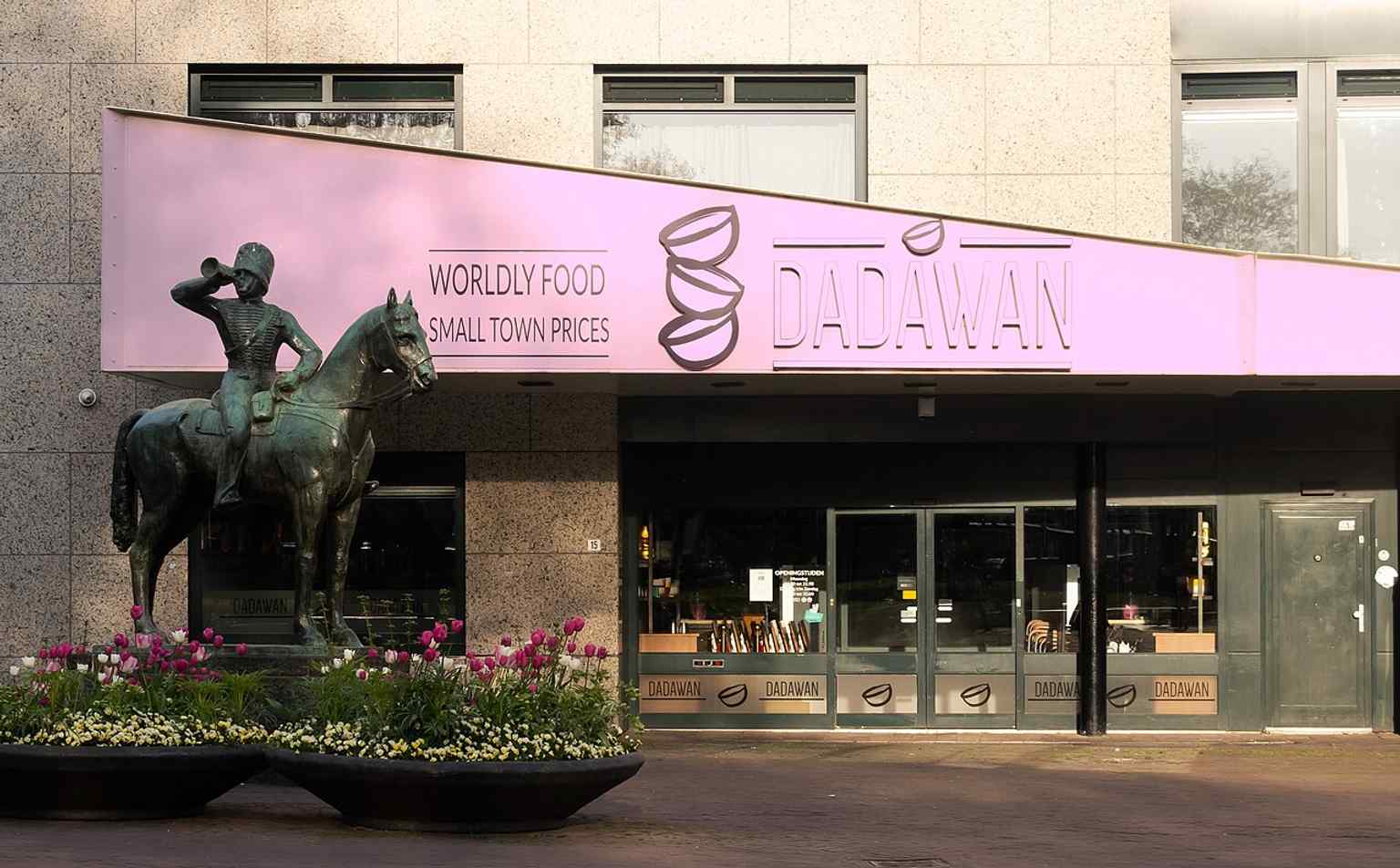
The name comes from the “Yellow Riders,” the nickname of the mounted artillery corps once stationed in the barracks here. If you glance at the image on your screen, you can see the rider who still keeps their place in bronze, alert and upright. Arnhem sculptor Gijs Jacobs van den Hof created that statue. He taught himself first as a furniture maker, wandered through Amsterdam, then came home and taught at Kunstoefening from nineteen twenty-one until nineteen fifty-four. For decades, he helped shape Arnhem’s face through memorials and war monuments. So this rider is not only about soldiers; it is also about an Arnhem artist leaving care and memory in the middle of daily traffic.
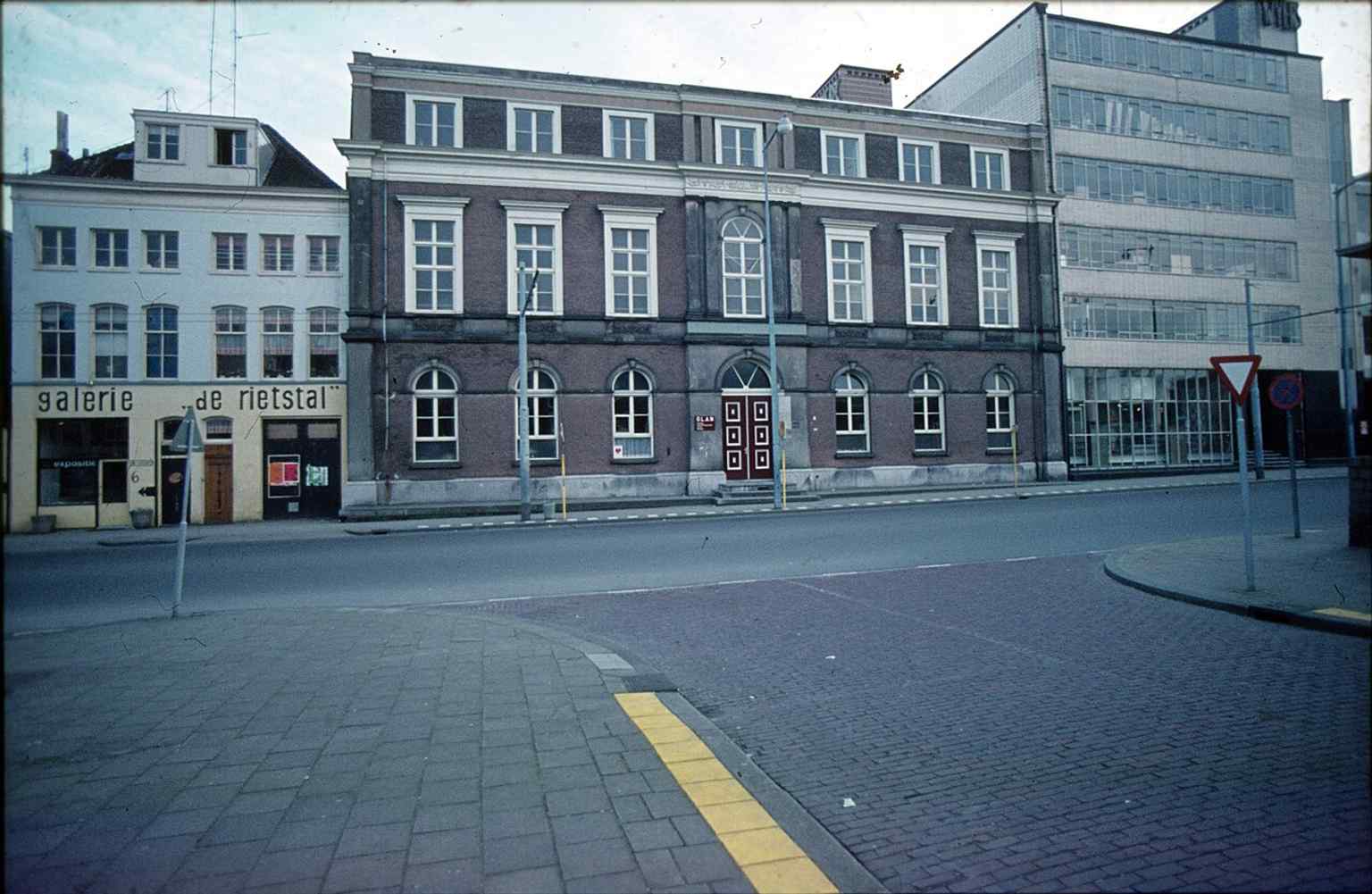
Then, in nineteen sixty-one, the A-K-U, Algemene Kunstzijde Unie, a predecessor of AkzoNobel, gave the city a fountain for its fiftieth anniversary. Architect Henk Brouwer designed the ensemble: a blue basin, a pedestal, and on top the sculpture Libelle by Shinkichi Tajiri, with a pergola-covered gallery and a patio with benches. If you look at the older photo in the app, you can see how the gallery once worked like an outdoor room for the city.
People fought to keep that idea alive. When the city council chose in twenty seventeen to remove the pergola, neighbors and heritage groups objected so strongly that the demolition permit was withdrawn a year later. During the redesign in twenty nineteen, workers also uncovered part of the old Sint-Jansbeek: a sixteenth-century brick-vaulted watercourse, still hidden under the square. So even here, one city rests inside another.
Before we move on, let your eyes travel across the open space, the rider, the fountain, and the steady movement around them... what kind of remembrance can survive in a place that must also serve ordinary life? In about two minutes, the Historical Museum Arnhem gathers the memories that squares like this can only hint at. For planning purposes, this site is generally listed as open from seven thirty in the morning until seven thirty in the evening, and closed on Saturdays and Sundays.






