
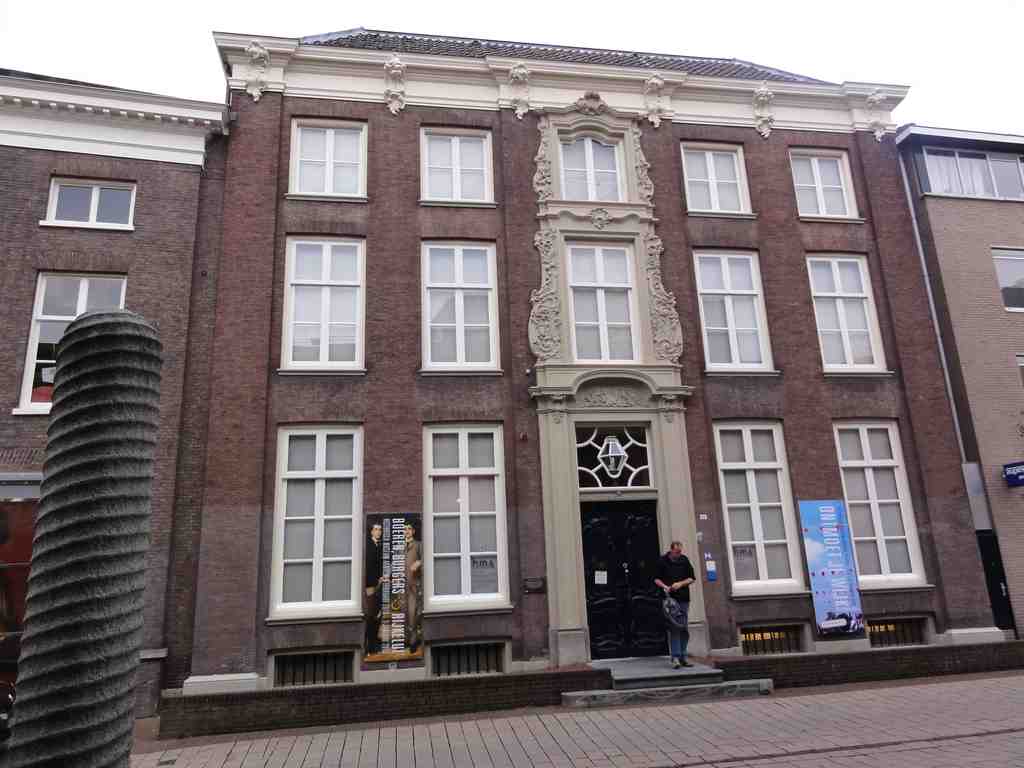
On your right is a stately brick town house with a symmetrical facade, tall sash windows, and a dignified central doorway beneath a simple eighteenth-century roofline.
This house holds Arnhem in a different way than a square or a church does. Out there, memory stands in public. Here... it was once kept in rooms, cupboards, drawers, and careful hands.
Around seventeen fifty, Arnhem mayor and merchant Cornelis van der Hart shaped this place into a patrician home after buying the fading Hof van Anholt estate with his brother-in-law. One front room became his showpiece, the room where he presented himself to the world. Then the city turned the story. From the eighteen forties until nineteen twenty, the same house became the Burgerweeshuis, the civic orphanage. The grand room of private pride became the regents’ room, where adults governed a house full of children who had lost their parents. That change tells you something important about Arnhem: buildings here rarely keep just one identity.
If you glance at the image on your screen, you can see that calm, respectable face the house still wears... and how much life it has carried behind it.
When the Historical Museum Arnhem opened here in nineteen ninety-six, it gave the city a memory vault. Not just big public history, but intimate history too. A painting of Caspar, one of the Three Wise Men, held devotion in paint. Lizzy Ansingh’s dollhouse, more than a century old, preserved the tenderness and order of domestic life; she used it herself to display her dolls, which makes it feel less like a toy and more like a little stage for a vanished home. And then there was a detail locals remember with real affection: a tiny Terlenka advertising elephant. Small enough to miss, but it quietly tied Arnhem’s story to the textile mills and factories that employed so many families here and in the surrounding towns.
The building itself nearly slipped away. After the orphanage years, it served as offices and storage, and for a while people even squatted here. During the fighting in September nineteen forty-four, this house stood on the route to the Rhine bridge and landed in the line of fire. Its survival matters. So does the careful restoration in nineteen ninety-four and nineteen ninety-five, when people brought back not only the main rooms, but also the cellars, attic, washhouse, mangle room - that is, the laundry room with a heavy press for smoothing linen - and even the old rainwater and well pumps.
The museum closed in early twenty twelve, and much of the collection found a new life in Rozet, where Arnhem’s past now lives among books, objects, and digital records. But standing here, you can feel the older truth: a city needs places that remember what streets alone cannot hold.
In about three minutes, the inner city opens that question wider, because out there the past is less curated... and more scattered through the ground plan itself. If you want to return another time, the site’s visitor hours were generally Tuesday through Sunday, from eleven in the morning to five in the afternoon.





