
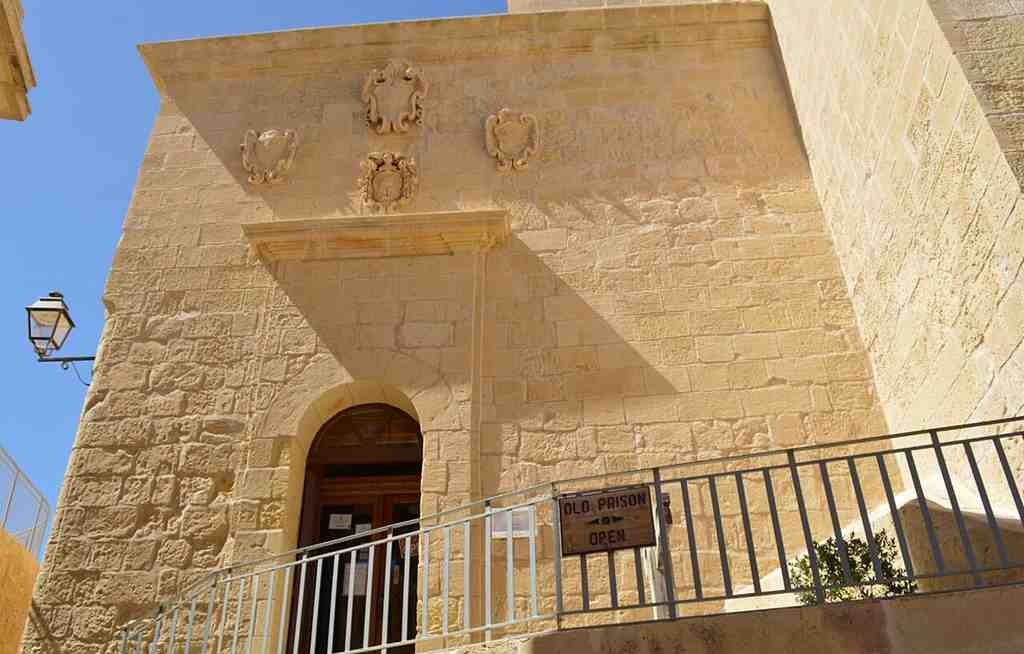
Look for a plain limestone facade with a low rectangular doorway and small grilled openings, tucked into the Citadel wall beside the old law courts.
This place has a double identity. It was a prison, yes, but not simply a gloomy box for punishment; because it stood right beside the Courts of Justice and was once connected to them, it also worked as a holding place for people awaiting trial and as a tool for keeping order when tempers, rules, or reputations went off the rails.
The story here reaches back deep into the Knights’ period. Records say that by fifteen thirty-five, two Knights of Saint John had already been sentenced to prison in Gozo, and in fifteen forty-eight the archives mention a new prison under construction. So even if historians still argue over the exact earliest site, this patch of the Citadel had a long memory for discipline. The prison stayed active from the mid-sixteenth century all the way to nineteen sixty-two... which is a surprisingly long career for a building devoted to bad decisions.
Its most famous inmate gives the place a sharp edge. Fra Jean Parisot de La Valette, the future Grand Master whose name would later cling to Valletta, landed here in fifteen thirty-eight after he attacked a layman. He spent four months in the Gozo prison, then the authorities sent him into exile in Tripoli for two years to cool his temper. Apparently even legends sometimes need a timeout.
By the nineteenth century, the prison’s job had shifted. A newer prison elsewhere in the Citadel took on more of the hard labor of incarceration, while this one increasingly held people waiting for judgment. The building changed too: an upper wing rose above older cells, proof that even a prison had to adapt when the system got crowded.
What lasts most powerfully here are the marks people left behind. If you check the image on your screen, you can see the graffiti cut into the limestone walls: ships, crosses, names, dates, handprints, even little game boards for trija, a simple three-men’s game scratched out to pass the time. Restoration in nineteen ninety-six removed thick whitewash and revealed those carvings again. Prisoners had no knives, so they improvised with bone points, bits of cutlery, or sharp stones. Another image shows how rough and intimate those lines are.
One cell seems to have held members of the Order, because it carries many eight-pointed crosses and the date sixteen thirty-eight. Elsewhere, hand symbols may have served as signatures for men who could not write, or as small charms for luck. And despite the building’s grim reputation, Heritage Malta says there is not enough evidence to confirm torture here... which, in a place like this, feels like a rare and modest mercy.
From open squares and civic offices to these enclosed cells, the Citadel kept finding ways to manage human behavior. Our final stop offers a strange release from all that: a museum set in an old inn and wartime shelter, the Gozo Nature Museum, about a one-minute walk away. If you want to come back inside here later, it is generally open from Tuesday to Sunday, from nine in the morning until five in the afternoon, and closed on Monday.




