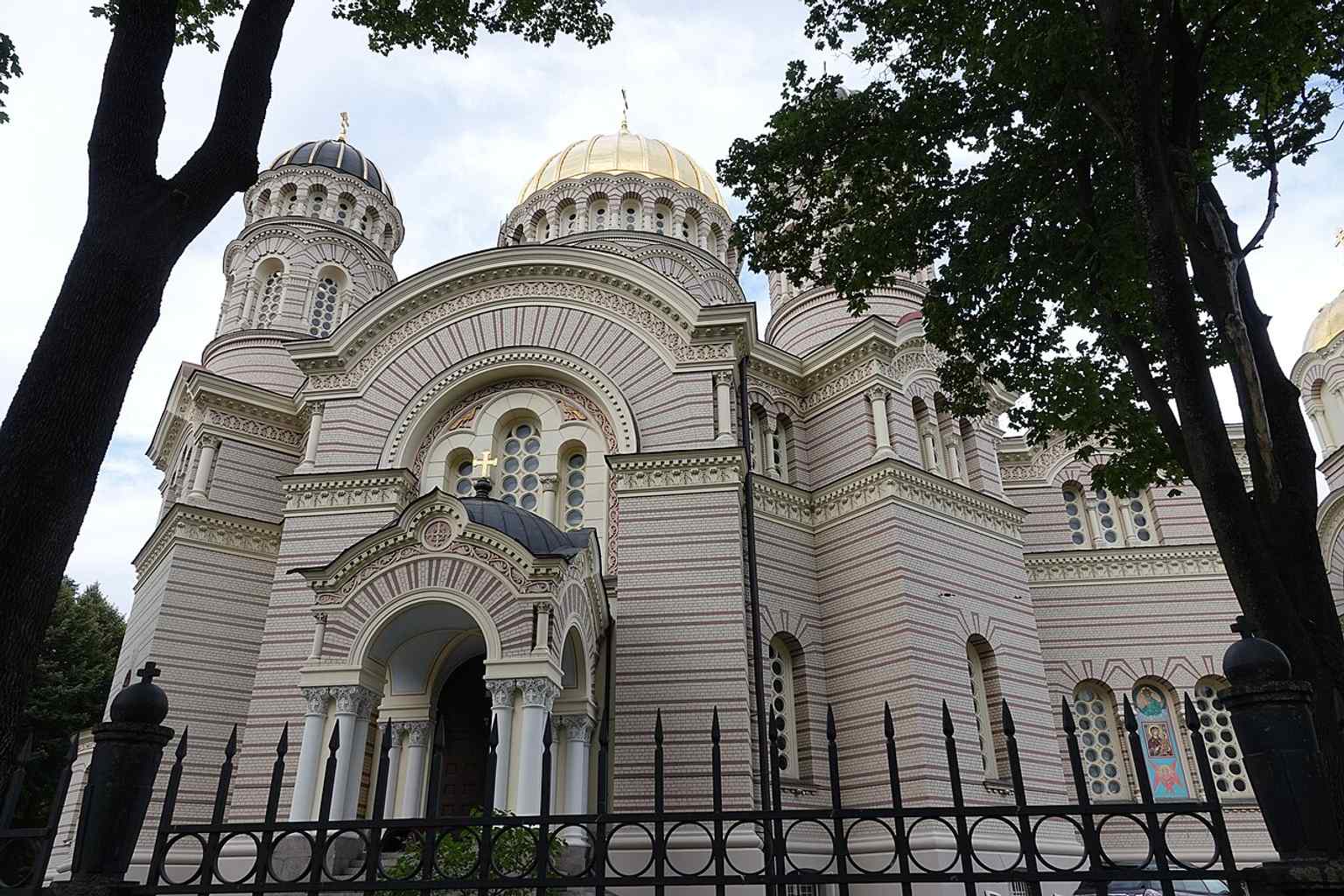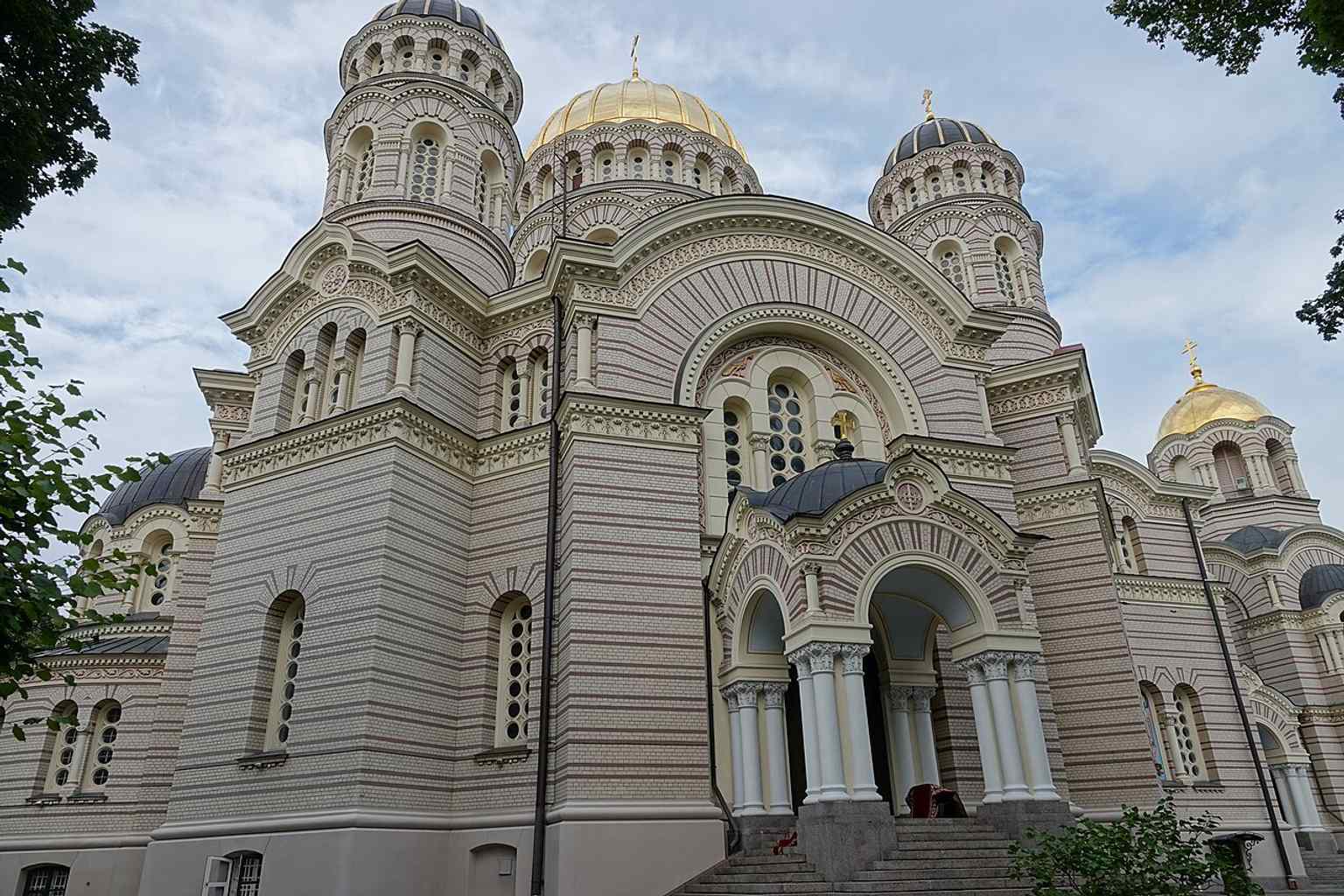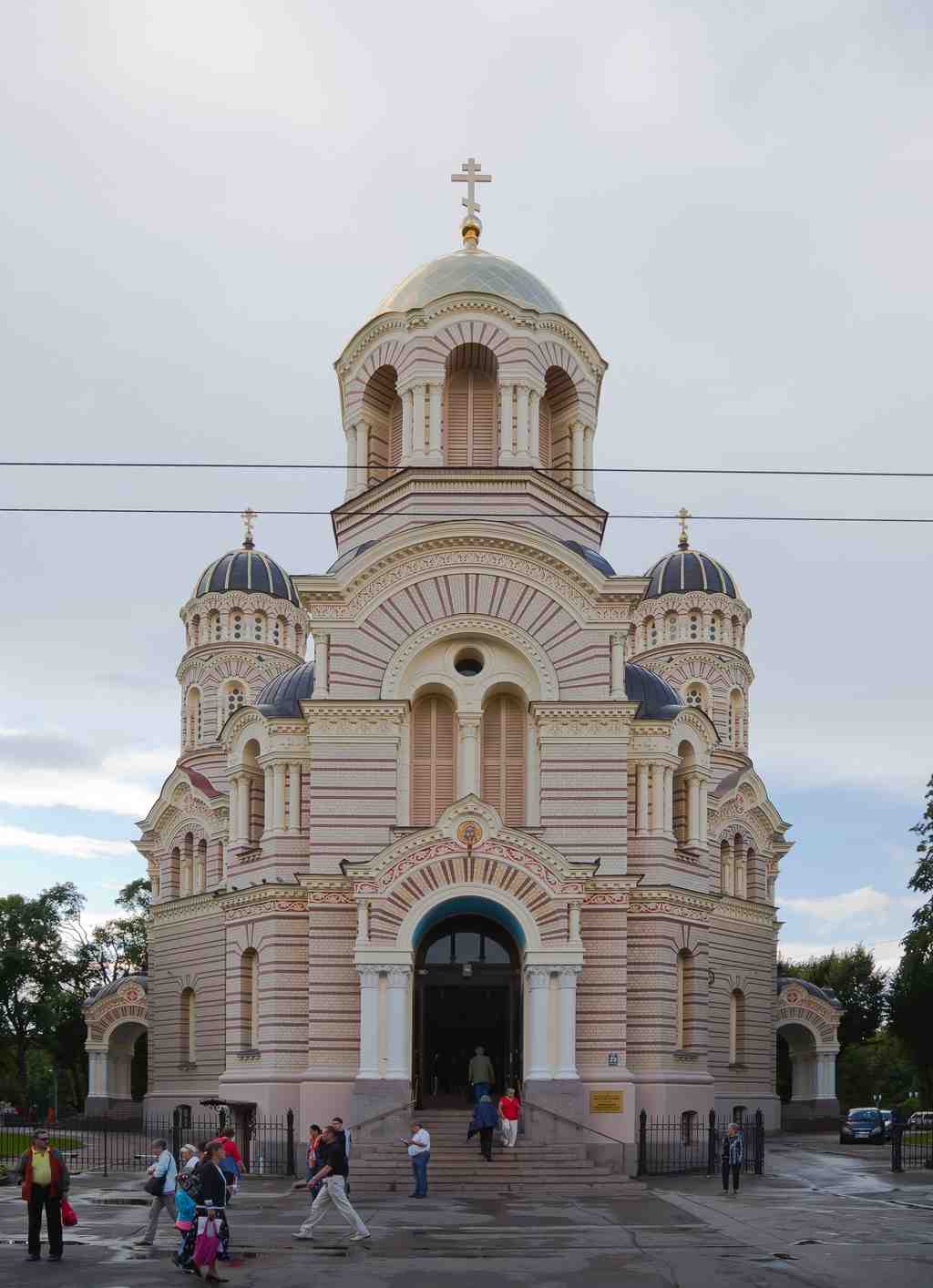
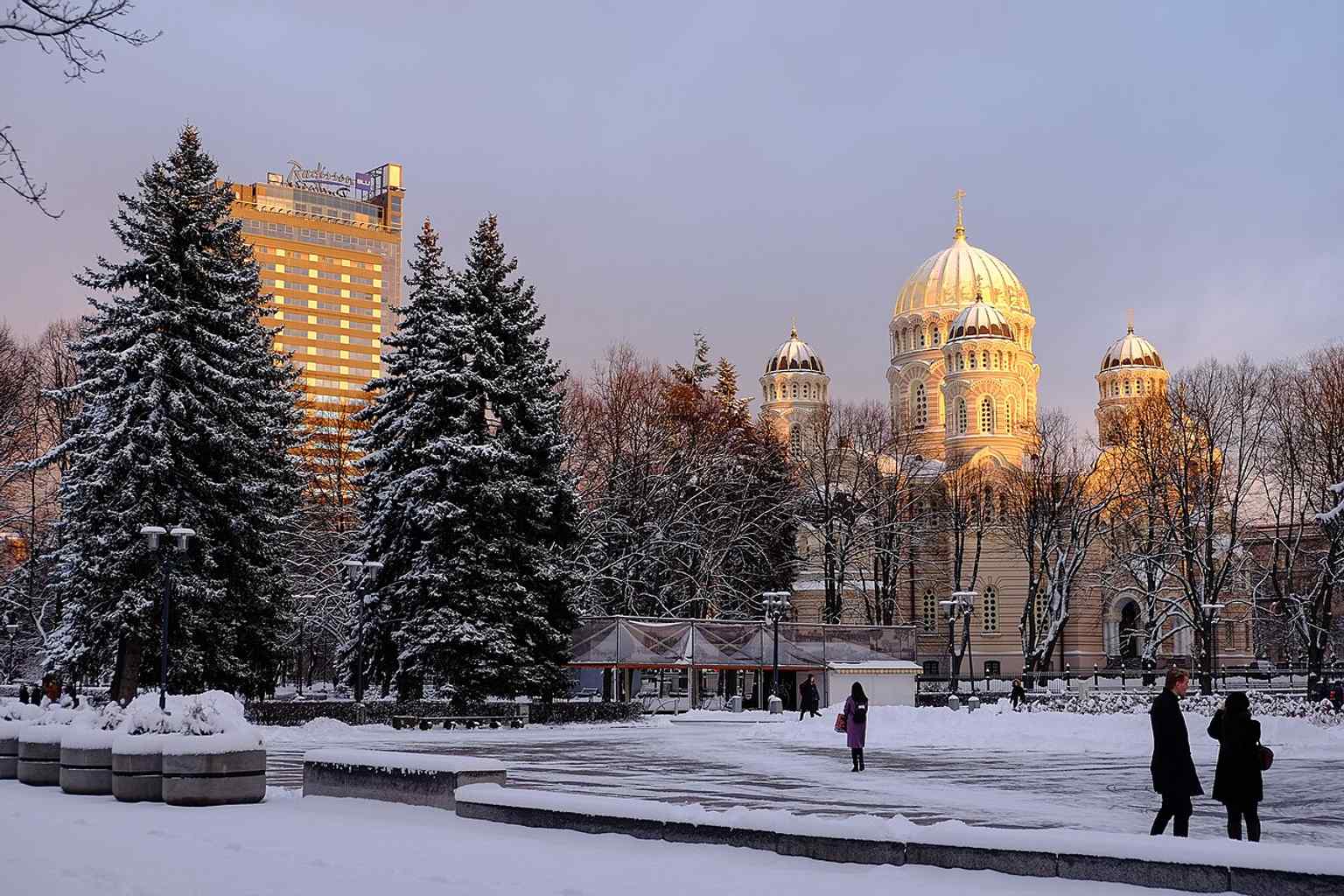
On your left rises a pale masonry cathedral with rounded gilded domes and a tall bell-tower dome, marked by dark arched windows and Orthodox crosses.
This is the Cathedral of the Nativity of Christ, and it carries Riga’s harder histories with remarkable calm. Nikolai Chagin and Robert Pflug designed it in a Neo-Byzantine style - that is, a nineteenth-century revival of the great domed church architecture of the eastern Christian world - and they raised it here between eighteen seventy-six and eighteen eighty-three. With the blessing of Tsar Alexander the Second, and the backing of governor-general Pyotr Bagration and Bishop Veniamin Karelin, Riga gained the largest Orthodox cathedral in the Baltic provinces. August Volz’s firm supplied much of the decoration, and inside, some of the icons - sacred painted images used in prayer - came from the hand of Vasili Vereshchagin.
Its final shape owed a good deal to imperial surprise. The architects had not planned a separate belfry, but then the Tsar unexpectedly sent twelve bells. One does not lightly decline such a gift, so the design had to change, and an extra dome rose to house them. A look at the image on your screen shows how those domes command the whole setting around the Esplanade. Then the twentieth century got to work. During the First World War, German troops occupied Riga and turned this Orthodox cathedral into a Lutheran church. Kaiser Wilhelm the Second even stood on these steps to award Iron Crosses to his soldiers, using the building as a bit of imperial theatre. In nineteen twenty-one, independent Latvia returned it to the Orthodox Church, and Archbishop Jānis Pommers fought fiercely to keep it. He lived here in a cramped basement room he called “my cave,” refusing comfort while he defended the cathedral from a government deeply suspicious of Orthodoxy. His murder in nineteen thirty-four remains unsolved.
The Soviets were even more thorough. In the early nineteen sixties they closed the cathedral, renamed it the Republic House of Knowledge, cut off the crosses, destroyed the bells, and installed a planetarium under the central dome. Saints disappeared behind partitions and murals of cosmonauts and socialist heroes. Yet one side chapel became a café nicknamed “God’s Ear,” where artists and dissidents gathered in the half-dark to speak a little more freely than elsewhere. The historical image in the app rather suits that long, unsettled life. Since nineteen ninety-one, the cathedral has been restored; new bells arrived in two thousand and two from Moscow’s Z-I-L factory, famous for trucks and Soviet leaders’ armoured limousines, and in two thousand and ten the bell tower and dome were gilded again. Through the Svet, or Light, project, twelve original Vereshchagin icons returned to the iconostasis, the screen of icons before the sanctuary.
If you wish to step inside, it generally opens from early morning until early evening, with slightly longer hours on Saturday and an earlier start on Sunday.
Few places in Riga show so plainly how power can occupy a building, and faith quietly reclaim it. When you are ready, continue on toward the Old Town.