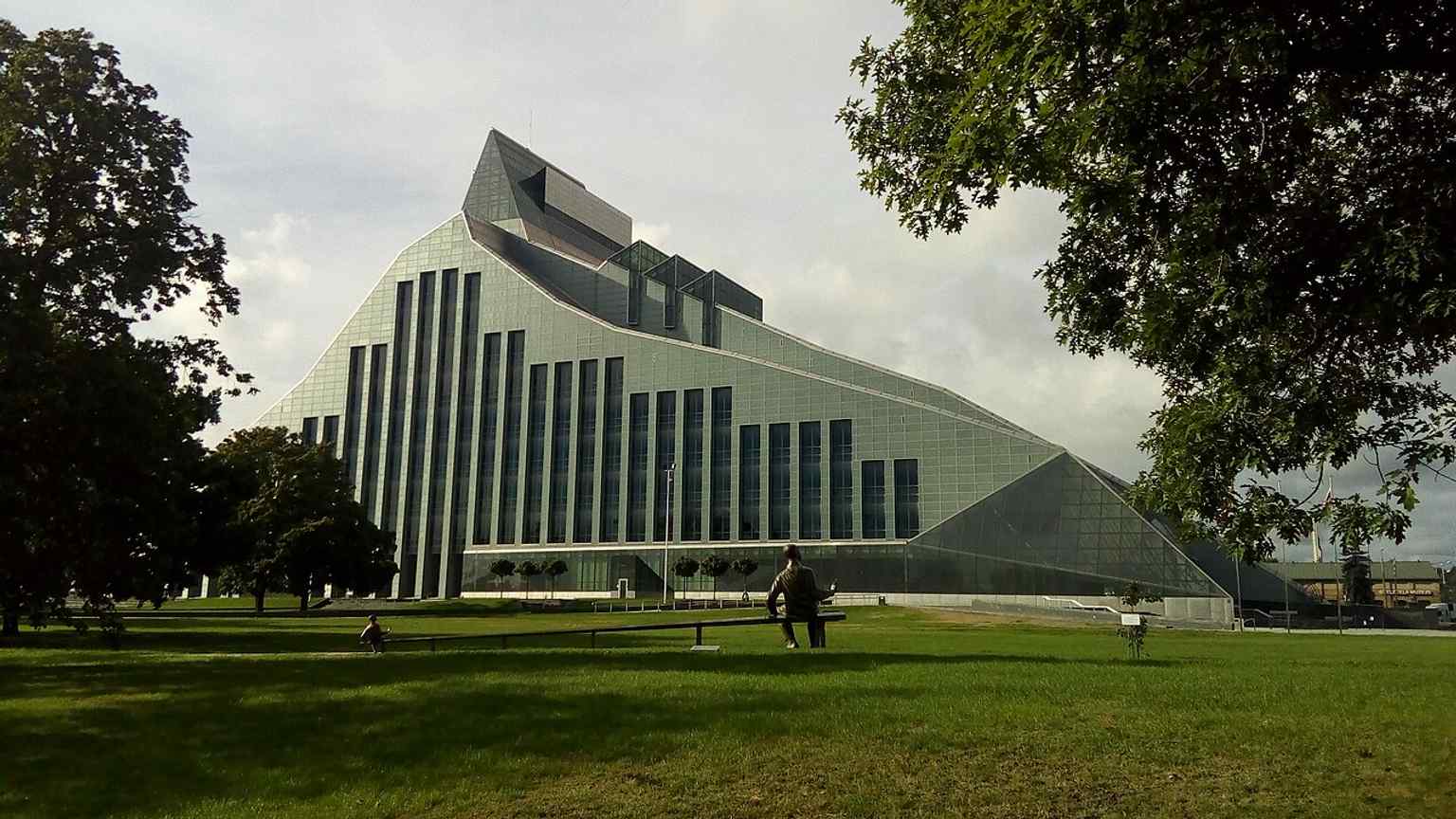
On your right stands a glass-and-steel mountain of a building, its sharp stepped profile rising to a peak that gives Riga its unmistakable Castle of Light.
That name is not merely poetic flourish. This is the National Library of Latvia, and its modern home deliberately borrows from Latvian legend: the Castle of Light and the Glass Mountain, places of wisdom, trial, and hard-won truth. The architect, Gunnar Birkerts, a Latvian-American who built his career in the United States, drew this design in nineteen eighty-nine, long before the building itself finally took shape. When it opened here in two thousand and fourteen, it looked less like a conventional library than an idea made solid.
The institution itself is older by nearly a century. Latvia proclaimed independence in nineteen eighteen, and on the twenty-ninth of August, nineteen nineteen, the new state founded its national library. Its first leader, Jānis Misiņš, did something wonderfully practical and rather noble: he gave his own private collection to form the library’s core. Within a year, the holdings had grown to two hundred and fifty thousand volumes. From nineteen twenty onward, publishers had to deposit a copy of everything they printed, which meant the library became not just a storehouse of books, but the memory of a nation in paper form.
The older building on Krišjāņa Barona Street gives a sense of the library’s previous life before this dramatic move. By the late twentieth century, the collection had outgrown building after building. Some books even ended up stored in a former Soviet missile bunker outside Riga, which is about as far from a romantic reading room as one can imagine.
The library’s history also mirrors Latvia’s own upheavals. Under German occupation in the Second World War, officials stripped away the word “state” and renamed it the Country Library, erasing the language of Latvian sovereignty. Under Soviet rule, it carried the name of the Latvian Soviet republic, and from nineteen forty-six onward, books judged dangerous by Soviet authorities were removed from open shelves. Until nineteen eighty-eight, readers needed special permission to see them. A library, you see, can reveal a great deal about freedom simply by showing which books are hidden.
Since renewed independence in nineteen ninety-one, the National Library has reclaimed its full role. Today it holds more than five million titles, including around eighteen thousand manuscripts ranging from the fourteenth century to modern times. It is also deeply involved in the digital age: Letonica and its other projects have digitised newspapers, maps, music, photographs, and records of Latvia’s great Song and Dance Festivals. On your phone, you might also peek at the People’s Bookshelf inside, a fitting symbol of the library’s promise to preserve national literature for everyone, not merely specialists.
One of the most moving moments in this building’s story came before the opening, when people formed a human chain across Riga and passed selected books hand to hand from the old library to this one. It was ceremonial, certainly, but not empty ceremony. It said, quite plainly, that knowledge belongs to the people who carry it forward.
If you plan to step inside another time, it is generally open from ten until eight Monday to Friday, from eleven until six on Saturday, and closed on Sunday.
This place guards Latvia’s memory while keeping it alive.
When you are ready, continue on and let the city tell you its next chapter.