
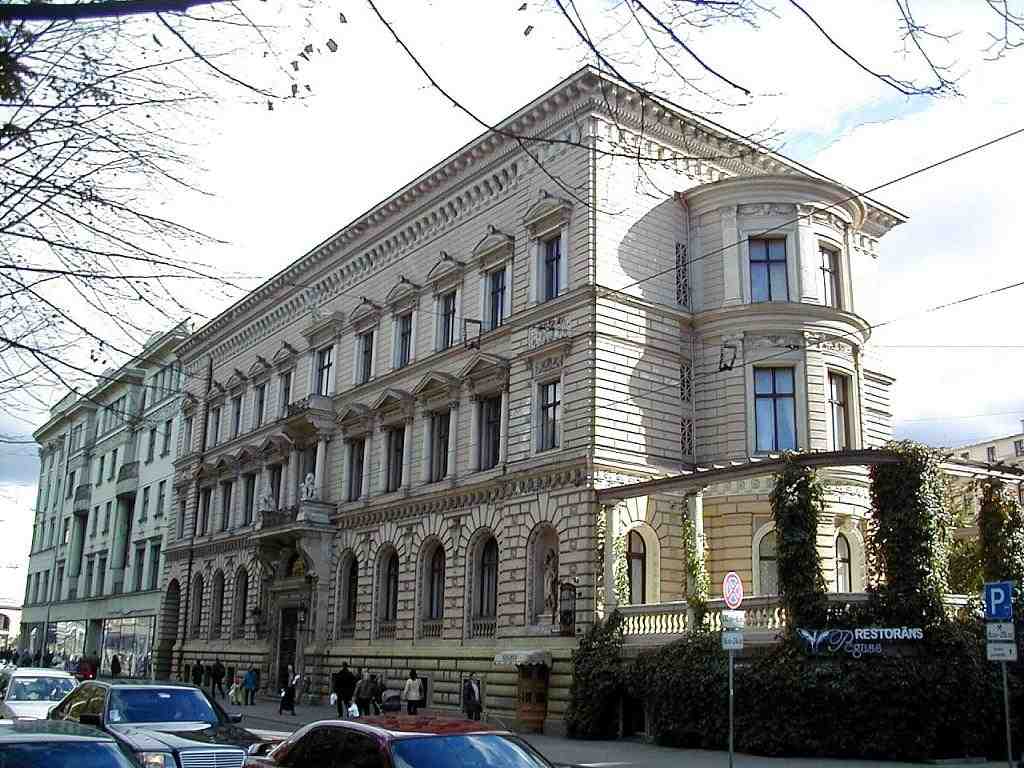
On your right, look for a pale stone mansion with a broad terrace, a stone-railed balcony, and two carved lions gripping shields on the front.
This is Benjamin House, one of Riga’s grandest private mansions. In eighteen seventy-six, merchant Nikolai Ehlert Pfab claimed this newly opened land, freed when the old fortifications came down, and he invited two Berlin architects, Wilhelm Beckmann and Gerhard Ende, to design something rather bold for Riga: a true city mansion in the centre, the first of its kind here.
The house speaks in symbols. Those lions on the balcony advertise noble ambition. Above the main entrance, two sculpted young women hold flax and a spinning wheel, quietly announcing the owner’s trade and prosperity. In a niche on the facade, a vestal - a guardian of the sacred household fire in ancient Rome - watches over the home. The sculptor August Volz created all this ornament, and the commission helped turn him into the fashionable sculptor of prosperous Riga.
Inside, Pfab spared little. Wilhelm Timm shaped the interiors, with help from his young nephew, the future architect Wilhelm Bockslaff, on the very first steps of his career. Later owners made the house even more famous. In nineteen twenty-eight, Anton and Emīlija Benjamin, powerful media publishers, bought it and turned it into a literary and artistic salon. Ministers, diplomats, journalists, and writers gathered here under a vast Venetian chandelier said to be the largest in the Baltics. Architect Eižens Laube reworked the interiors for them, though he admitted he often had to negotiate with their rather exacting tastes.
After nineteen forty, the Soviet state nationalised the house and deported Emīlija. From nineteen forty-five onward, writers, artists, and composers filled these rooms with exhibitions, lectures, poetry, and music. Even cinema moved in: director Janis Streics used the house in the film Theatre.
Few buildings in Riga carry wealth, taste, loss, and reinvention quite so gracefully.
When you are ready, continue on for the next chapter of the city’s story.




