
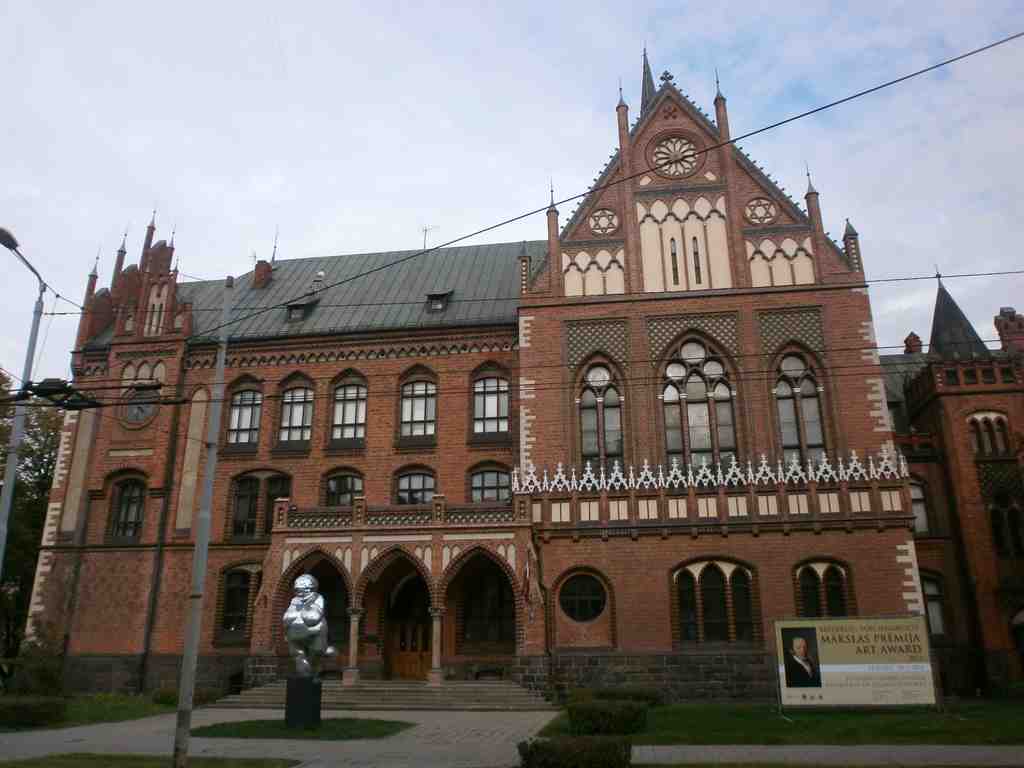
On your left stands a red-brick neo-Gothic building with steep gables, pointed spires, and a row of small turret-like shafts pricking the roofline.
It has the air of a small castle, and Riga locals often say so, sometimes with a grin and a comparison to Hogwarts. The picture in the app shows exactly why. But this fantasy in brick hides a rather practical mind. Architect Wilhelm Bokslaff designed the building in nineteen hundred and two, and builders finished it in nineteen hundred and five, not as an art school, but as the Commercial School of the Stock Exchange. He chose neo-Gothic, a revival style that borrowed the pointed shapes and upward sweep of medieval buildings, and August Voltz added the sandstone column capitals and sculptural details.
Now for the clever bit. The soil beneath this part of Riga is sandy, so Bokslaff had to support the whole structure on a foundation only about two and a half metres deep. That is a rather delicate footing for so weighty a building. He also wanted to avoid the indignity of exposed utility pipes spoiling the design, so he disguised the ventilation shafts as decorative roof turrets. Those little peaks above you are not just romantic decoration; they are engineering in costume.
The building found its true purpose after Latvia's first independence. In nineteen nineteen, the painter Vilhelms Purvitis became the founding force and first rector of the Art Academy of Latvia. The institution formally took shape that year, opened ceremonially in nineteen twenty-one, and moved into this building in nineteen twenty-two. Purvitis was famous for a teacher's challenge that sounds almost biblical in its simplicity. He would draw a charcoal line on the wall and tell his students, many will get this far, but only a few will go beyond it. Beyond this line, the artist begins.
That line grew harder to cross as the century darkened. Under Soviet occupation, the Academy changed names and endured purges against what officials called formalism, a vague charge used against artists whose work did not fit approved Socialist Realism, the state's preferred style of heroic workers and obedient optimism. Some students and teachers fled west, some were deported, and some survived by painting safer subjects. Purvitis himself escaped in nineteen forty-four as the Red Army approached. He carried hundreds of his paintings into exile, and most were lost in the chaos of war. He died in Germany in nineteen forty-five, never returning here.
And still the place endured. It continued to train painters, sculptors, designers, restorers, and makers of moving image and sound. It also kept its unruly student spirit. The Academy Carnival became legendary, turning these stern corridors into a wildly inventive maze of costumes, sets, and artistic mischief. One image in the app hints at that habit of letting art spill beyond the walls and into public space. If you ever want to step inside on another visit, the Academy is generally open from eight in the morning until eight in the evening, and it closes on Sundays. This is a building where discipline and imagination have negotiated with one another for more than a century. When you are ready, continue on to the museum nearby, where that imagination steps into the public eye.




