
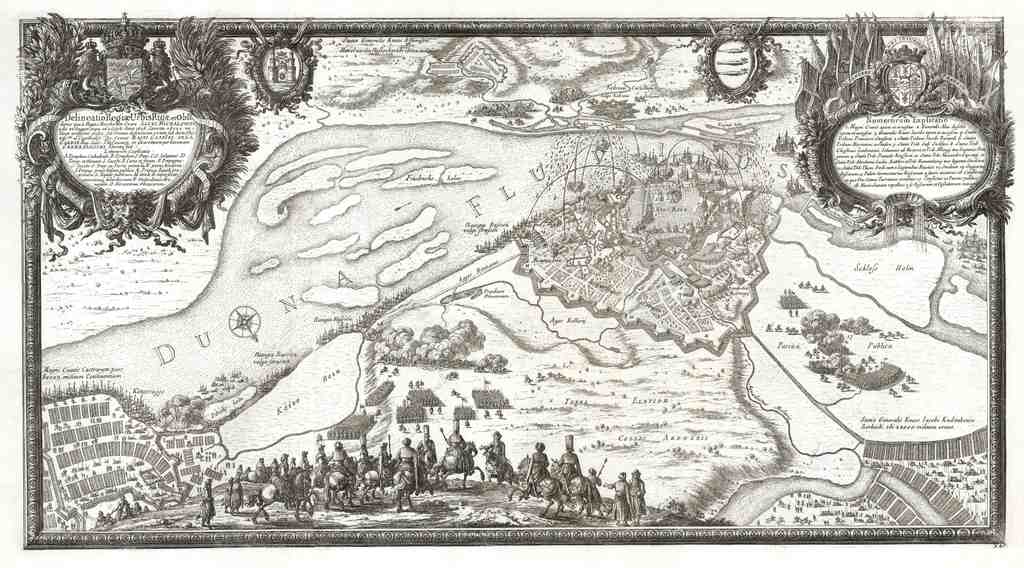
Look for a light stone facade with a broad rectangular wall and a dark metal marker, set apart by engraved battle imagery.
This stop remembers the siege of Riga in sixteen fifty-six, when Tsar Alexei Mikhailovich decided to hit Sweden first rather than wait for trouble to arrive at his door. Sweden had just surged through Poland and Lithuania, and the Lithuanian grand hetman Janusz Radziwiłł accepted Swedish protection in the Union of Kėdainiai. That wiped out a good deal of Russia’s recent gains and blocked the road to the Baltic. So Alexei changed course, made a truce with Poland, and declared war on Sweden.
Now here is the part with real ambition. In the upper reaches of the Western Dvina, Alexei’s men built a river fleet of six hundred strugs, shallow transport boats. Some stretched to roughly sixteen to thirty-five meters and could carry about fifty soldiers each. Others hauled food, wounded men, and, most importantly, siege guns. Livonian roads were miserable for heavy artillery, so the Russians simply floated the problem downstream. Logistics is rarely glamorous... but it wins arguments.
After taking Dinaburg and Kokenhausen, the army reached Riga. The Swedish commander, Magnus de la Gardie, pulled back behind the city’s stronger defenses. In one early clash, the Swedish cavalry commander, Count Heinrich von Thurn, rode into an ambush and lost his head, literally. In a grim little moment of seventeenth-century honor, the Russians sent his severed head back into Riga with respect, on orders from Colonel Vladimir Fonvizin, who later died in the same campaign.
The Russians worked fast. Using the abandoned suburban gardens for cover, soldiers and streltsy, musketeer units, built twelve earthen shelters and gun positions. On the first of September, they opened a brutal bombardment. They fired iron cannonballs, grenades, heated shot meant to start fires, and even newer mortars that threw stone balls. On one day alone, the city endured about one thousand seven hundred shots. Prisoners said townspeople begged the governor to surrender, while the soldiers refused and waited for help from their king.
Help arrived because the sea stayed open. Russia failed to seal Riga off from the water, and the Danish fleet never solved that problem. Then a Swedish relief force got through with food and ammunition. Alexei called a war council. General Avram Leslie and several colonels advised retreat. The tsar wanted an assault anyway.
Before the Russians could storm the city on the second of October, the Swedes struck first with a sudden attack out of the gates. They smashed four regiments, broke a streltsy unit, and captured seventeen banners. After that came rumors of plague inside Riga, and that changed the math very quickly. On the fifth of October, Alexei lifted the siege.
So Riga survived not by miracle, but by walls, timing, supply lines, and a refusal to panic. When you’re ready, continue on and let the next stop show you the city that outlasted the guns. If this venue interests you, it’s open Wednesday through Sunday from ten to six, and closed Monday and Tuesday.




