
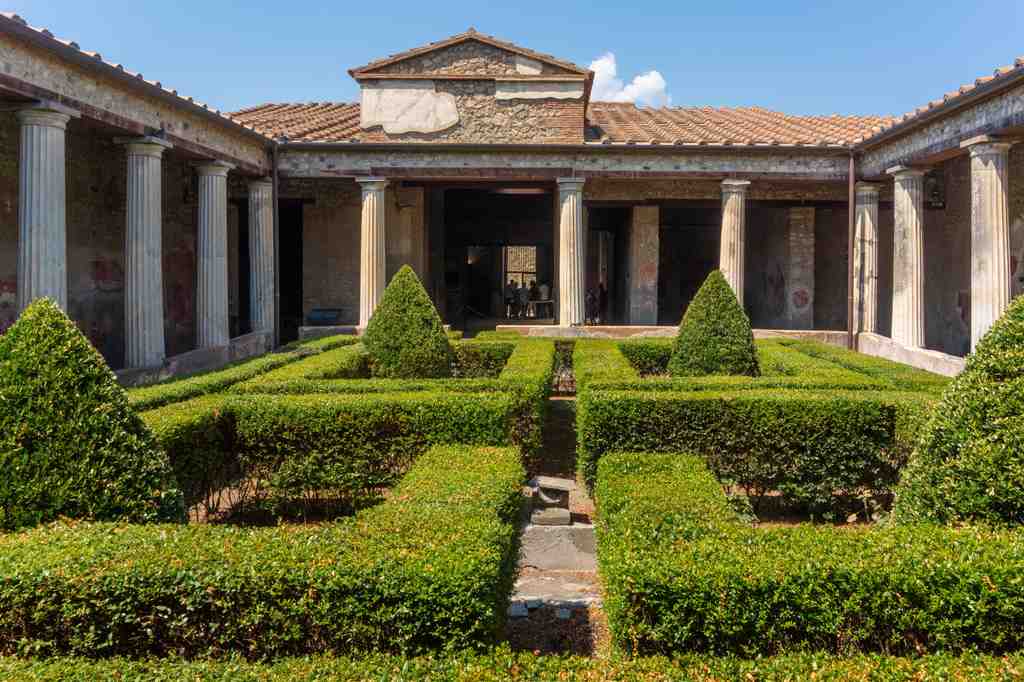
The excavation of the House of Menander took place between November 1926 and June 1932. It is located in Region I, Insula 10, Entrance 4 of the city. The oldest part of the house dates back to 250 BC and comprises a relatively modest atrium and nearby rooms. However, about a hundred years later, the house underwent a renovation, evident in the use of tuff capitals for the entrance door and the tablinum, showcasing the owner's desire for modernity.
During the Augustan period, further modifications were made to the house. A peristyle, surrounded by the remains of adjacent residential buildings, was added. To the west, an exquisitely adorned thermal bath was built, featuring a charming little atrium supported by eight columns. Interestingly, the absence of a bath in the caldarium suggests that it was not in use during the time of the catastrophic eruption of Mount Vesuvius in 79 AD.
Moving to the east side of the house, we find the business section, indicating the multifaceted nature of this property. Just before the eruption, additional modernization works were carried out, evidenced by amphorae filled with stucco and an improvised oven. Curiously, everyday objects related to food were not found, leading experts to believe that the house was sparsely occupied at the time.
Tragically, the house became a tomb for eighteen victims of the eruption. Two men and a woman were found in room 19, ten more in the corridor, two in room 43 (one on a bed), and three others in the courtyard. The presence of lamps, pickaxes, and shovels with the bodies in the corridor suggests that they may have been looting the house after the initial pumice eruptions, but were eventually caught by the final volcanic outbursts.
Some fascinating clues have been discovered within the house, leading to intriguing speculations about its ownership. The seal and graffiti mentioning 'Quintus' in the entrance corridor have led some to believe that the owner could be Quintus Poppaeus Sabinus, possibly a local magistrate. Furthermore, a ring seal found in the servant's quarters hints that the property might have belonged to Quintus Poppaeus, a potential relative of Poppaea Sabina, the second wife of Emperor Nero.
The debate about the owner's nationality is still ongoing. Since Pompeii's Mediterranean climate lured many Romans to invest in holiday villas here, it is possible that the owner at the time of Vesuvius' eruption in 79 AD was a wealthy tourist, rather than a local resident. Nonetheless, the estate came to be known as "The House of Menander" due to the discovery of a remarkably well-preserved fresco depicting the ancient Greek dramatist Menander in a small chamber off the peristyle. Some experts even speculate whether the painting truly represents Menander or actually portrays the house's owner or someone engrossed in reading Menander's works.
Aside from the Menander fresco, the House of Menander boasts other captivating frescoes. One notable example depicts the death of Laocoön. In addition to the striking visual elements, the large columns in the peristyle showcase the Doric style of architecture, an offshoot of the classical style prevalent in ancient Greece. It is not surprising to see this influence, considering that Greek sailors had been trading in the nearby port long before the establishment of Pompeii in the 6th century BC.
As you explore the exterior walls of the house, take note of the numerous Roman graffiti, offering glimpses into the daily lives and thoughts of its inhabitants. These inscriptions provide a fascinating insight into the city's vibrant past.


