
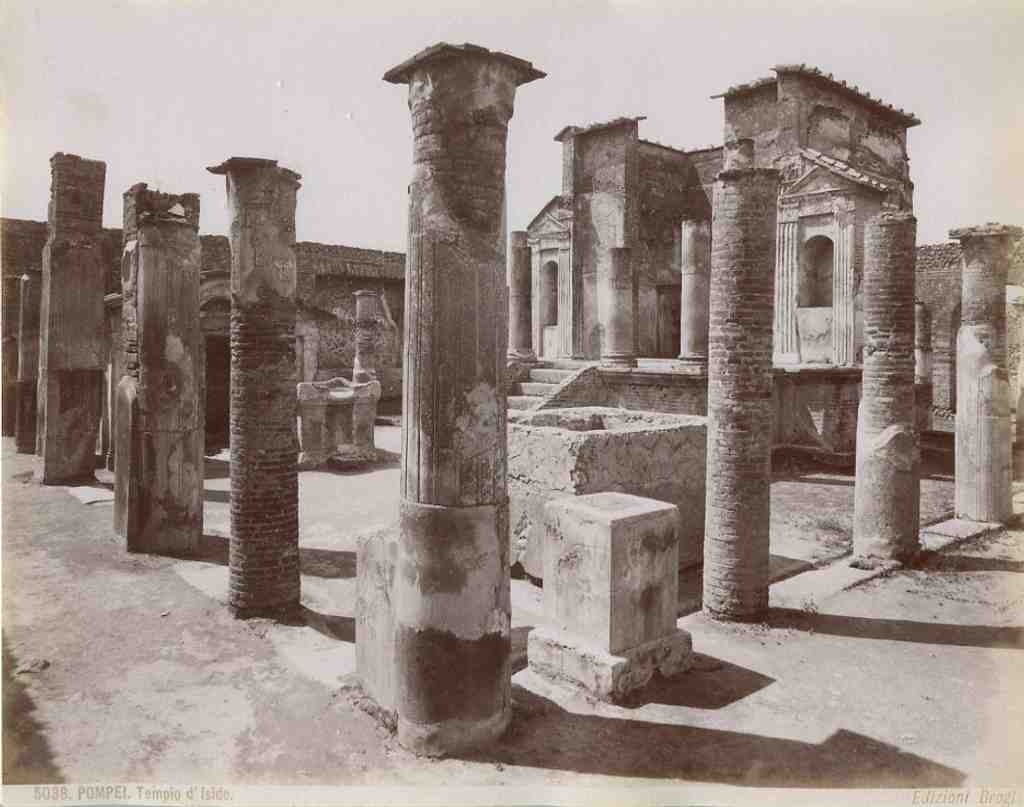
Interestingly, the preserved temple you see today is actually the second structure. The original building, constructed during the reign of Augustus, was damaged in an earlier earthquake in 62 AD. Despite attempts by the Roman senate to demolish the cult of Isis and her temples, the popularity of the cult continued to grow. In fact, the Temple of Isis was one of the few buildings that was fully rebuilt after the earthquake.
Situated along the Via del Tempio di Iside, this small and almost intact temple received significant foot traffic from theater-goers at the Large Theater, businessmen in the Triangular Forum, and other passersby near the Stabian Gate. It was particularly revered by women, freedmen, and slaves, who were drawn to the compassionate goddess Isis. As initiates of her mystery cult, they believed in her promise of salvation and a perpetual relationship in life and after death.
The temple itself was reconstructed as a tribute to a young boy named Numerius Popidius Celsinus, by his father Numerius Popidius Ampliatus and mother Corelia Celsa, in hopes to gain entry into the elite society of Pompeii. However, scenes from the temple are also found in the dining rooms of Pompeians, suggesting that many individuals visited for political, economic, or social reasons.
It's fascinating to note that the cult of Isis originated in Ancient Egypt but spread widely throughout the Greco-Roman world. The Greeks and Romans held great admiration for Egyptian culture, and after Alexander the Great's conquest of Egypt, there was a fusion between the Greek and Egyptian cultures. Isis, with her similarities to the Greek goddess Demeter, easily found her place in Greek religion. In Rome, she was introduced as a replacement deity for Venus and was sought after for guidance.
Isis, also known as the ideal image of a queen, wife, and mother, was associated with fertility and motherhood. She was admired for her powers in healing and magic, making her an influential figure among the people. Her worshippers ranged from slaves and sinners to artisans and the downtrodden, but also included the prayers of the wealthy, maidens, aristocrats, and rulers.
Today, original paintings and sculptures from the Temple of Isis can be seen at the Museo Archaeologico in Naples, while the site itself allows us to appreciate the historical significance of this captivating temple. Now, let's continue our journey through Pompeii and discover more hidden gems of ancient Roman civilization!


