
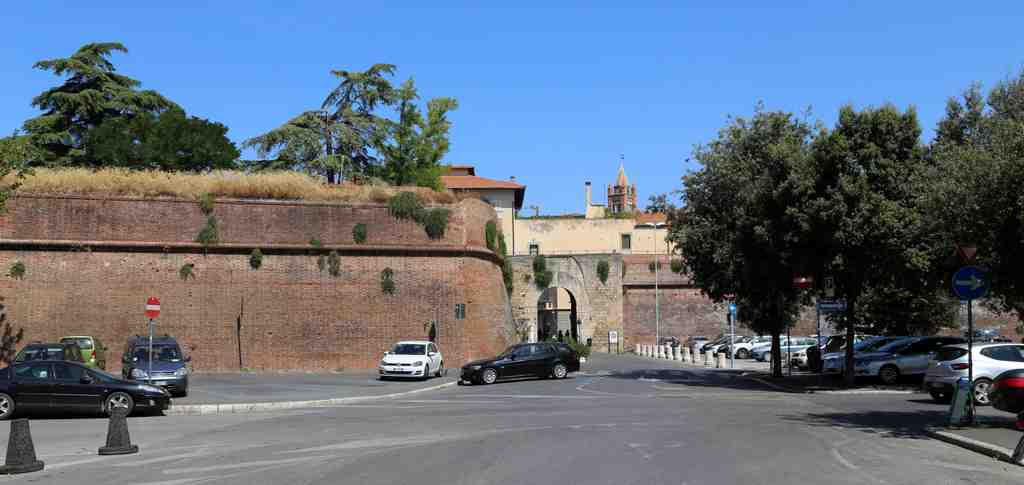
In front of you, rising solid and proud, you’ll spot a massive brick wall topped with wild grass and shaded by tall umbrella pines, its ancient curve broken only by a grand stone archway-just look for this imposing, fortress-like barrier across from the car park, and you’ve found the legendary Walls of Grosseto.
Ah, bella, take a deep breath-the scent of history is in the air, perhaps mixed with a bit of exhaust from these modern carriages, but never mind, we’re about to time-travel! Picture yourself centuries back, standing in the shadow of these walls, nervous whispers all around: pirates, foreign armies, and those grim Medici taxes-mamma mia, life wasn’t always so dolce! Now, these walls might look like just another pretty relic from Italy’s treasure chest, but believe me, they're rare gems: intact city fortifications are as rare as a polite scooter driver in Rome!
Grosseto was born out of misery and mud, when the ancient city of Roselle was finally abandoned (too many mosquitoes, they say, or maybe the Roman bathhouses just got too crowded). From day one, Grosseto threw up defenses-brick by brick, wall by wall. The first circle of these beauties was finished in the twelfth century-a time when everyone was either building walls or fighting about who should have built them first.
But, ah, the drama! Over the centuries these walls had more makeovers than a reality TV star-sieges, sieges, and more sieges, patch jobs, and finally a complete Renaissance facelift. When Cosimo I de’ Medici swept through in the sixteenth century, he looked at the old medieval walls and probably declared, “Che brutto!” He hired the brilliant Baldassarre Lanci to transform them into these geometric, hexagonal beauties you see today! Imagine-it took nineteen years (yes, nineteen, and you thought Italian roadwork was slow), and most of the labor came from prisoners leaping at the chance to trade chains for, well, more bricks.
Now try to picture hammering bricks under the Tuscan sun, knowing the city is relying on you to keep out bandits, invaders, and pushy salesmen hawking dodgy olive oil. As the walls grew, so did rumours-secret tunnels, hidden storerooms, mysterious footsteps at night. They even buried underground cisterns to capture every precious drop of rainwater, since the local rivers are more fashionably late than a Neapolitan wedding. Some say, on certain misty mornings, you can still hear the workers’ hammers echo through the walls.
Look closely: you can still see the original bastions, those angular “shoulders” at each corner, almost all of them pentagonal, crowned once upon a time with picturesque little guardhouses-called garitte or “casini.” The “Cassero Senese” inside was extra protected with smaller bastions, both for show and survival. If you squint, perhaps you’ll catch a ghostly sentry eyeing you warily from a missing garitta (don’t worry, friendly ghosts-they’re just here for the legends-and maybe a decent espresso).
For centuries, these mighty walls were circled by a deep moat, and at the gates-Porta Nuova to the north, Porta Vecchia to the south-life pulsed. Gossip, trade, secret lovers sneaking back after curfew (ehh, you think medieval teens were so different?), and even a few wild boar, legend has it! Over time, lesser gates “postierle” popped up for the more athletic or, shall we say, creatively sneaky citizens.
But then-eh, enter the age of romance! By the time Grand Duke Leopoldo II strolled in, he had a softer vision for Grosseto. In 1855, he ordered the demolition of nearly all the towers and most of the guardhouses, transforming these once-fearsome walls into a public promenade where sweethearts and grandmothers could stroll among leafy trees.
The march of time didn’t slow down: in World War II, a bombing raid destroyed the last “Casino delle Palle,” the wall’s final grand garitta-if only those walls could talk, eh? Today, the two that survived still perch like watchful owls atop the bastions of Santa Lucia and Vittoria.
The circle of Grosseto’s walls stretches for three kilometers. Today, instead of angry armies or restless peasants, you’ll find locals enjoying a walk, children playing, and lovers carving their initials in the ancient brick-a good-luck charm for eternal amore, they say. So linger a little, run your hands along the cool stone, and listen-if you’re lucky, the walls might just whisper an old secret or two to you. Or at least invite you for gelato, which, let’s be honest, is a pretty good consolation prize!


