
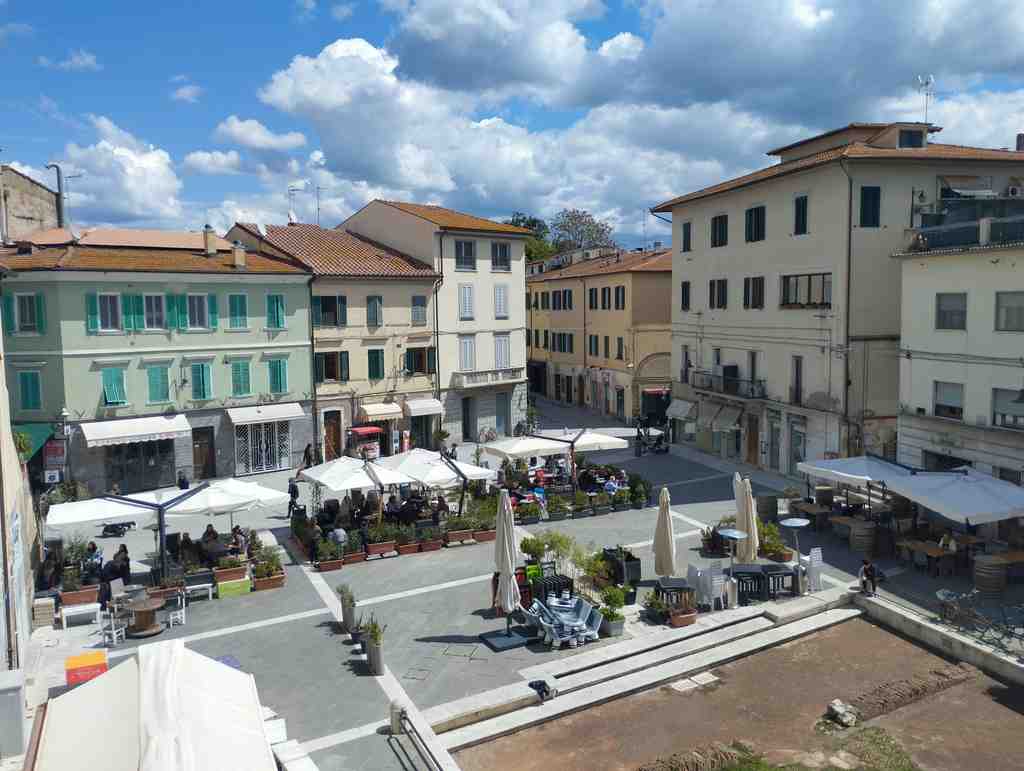
To spot Piazza del Sale, just look ahead for the open square lined with pastel buildings, café umbrellas, and a sun-drenched terrace bustling with people-right where history mingles with modern life!
Ah, you’ve found yourself in the heart of Grosseto’s secrets, right here in Piazza del Sale! Take a deep breath-do you smell the espresso from the cafés, the faint hint of salty sea air mixing with laughter and a hint of centuries-old mystery? This isn’t just a piazza, my friend, it’s a living, breathing slice of Tuscan storytelling, a place where every stone and every window shutter seems to whisper an anecdote!
Let’s start way, way back-remember, Italian history always has more layers than a lasagna. The story begins in 1291, when this very area was the heartbeat of what was called the Terzo di San Giorgio. Back then, the neighborhood borrowed its name from the ancient Church of San Giorgio, which itself already had centuries of history under its belt. Can you imagine? People have been gathering here for over 700 years! They gossiped, traded, argued, and maybe even flirted, right where your feet stand.
But the true star of the show here is salt-not the kind you sprinkle on your pasta, but pure, precious white gold, hauled in from the salt pans of Querciolo and Castiglioni. Grosseto was famous for its abundance of salt, so much so that even the poet Cecco Angiolieri wrote about it in his verses! Imagine wagon after wagon, laden with salt, clattering over these stones, destined for the imposing Cassero del Sale-a great warehouse built here in the 13th century, its walls echoing with the haggling of merchants and the clang of scales. It was the economic engine of the city.
But, ah, then came Siena-a city known for its appetite (and not just for panforte)! When Grosseto fell into Sienese hands, they didn’t just change the rules-they changed the square itself. The mighty new Cassero for the Dogana del Sale rose up, regulating every grain of salt, with magistrates eyeing the ledgers as closely as any modern taxman. All the hustle and bustle of Siena’s salt officials mixed with the daily drama of townsfolk-if you listen hard, maybe you’ll hear the echoes of a frustrated merchant or two, trying to sneak in an extra barrel of salt.
With time, the tides of power shifted. Florence and the Medici swept in, walls came tumbling down, and the Medici rebuilt their own ramparts-so solid you could almost bounce a coin off them. The Cassero was partly demolished, but a stubborn sliver was tucked inside the new walls, as if the past refused to be buried. In the 16th century, an elegant stairway was added, turning even humble salt storage into something worthy of a Medici flourish.
Fast forward to the 18th and 19th centuries and the piazza transformed again. The old towers were knocked down, leafy promenades replaced fortress ramparts, and instead of soldiers, you’d find a parade of locals enjoying a stroll, soldiers replaced by the bright chatter of children and cafés. The customs office moved in, regulating every person and cargo entering the city-imagine the drama when someone tried to smuggle a particularly fine wheel of pecorino cheese!
By the late 1800s, the sweet chaos of the Thursday market took over. Farmers, butchers, and bakers mingled with elegant ladies and wide-eyed children, and the square earned its new moniker: Piazza del Mercato. There was even a ghetto in this quarter for a time, and Ricasoli Street, right next to you, was once known as Via del Ghetto.
Look at the buildings around you. See that sturdy, slightly austere façade of the Cassero del Sale on the northern edge? That’s the old salt warehouse, rebuilt, added to, proudly harboring the memory of ages past. On the corner, Palazzo Carmignani-its Liberty-style decorations a little flamboyant, a little cheeky, a lot Italian! Don’t miss those original 1800s fittings inside the cobbler’s shop; the locals love a good pair of shoes and a story, and here you get both.
If you sneak a peek at the palazzetto Del Fa and palazzetto Cesaroni, you’ll see more hidden history-shop signs adorned with iron initials, the marks of families who have called these walls home for generations. There’s even a lingering spirit of the old liquors once made by the Torrefazione Onorato-so if you catch a whiff of something sweet, blame the ghosts of toasts past.
These days, the market may have moved, but Piazza del Sale stays lively. The cafés brim with laughter, students debate over tiny cups of coffee, and at night, the square transforms into a glowing, friendly hub. Under your feet, ruins from the medieval Cassero still peek out, bravely refusing to be forgotten.
So, as you stand here, take a moment to feel the pulse of history-centuries of trade, politics, love, rivalry, and, of course, a little bit of Tuscan mischief. This is Grosseto’s real soul, served up with a side of salt and a generous dash of charm. Now, which way to the next adventure, eh?
Intrigued by the description, buildings or the image gallery? Make your way to the chat section and I'll be happy to provide further details.


