
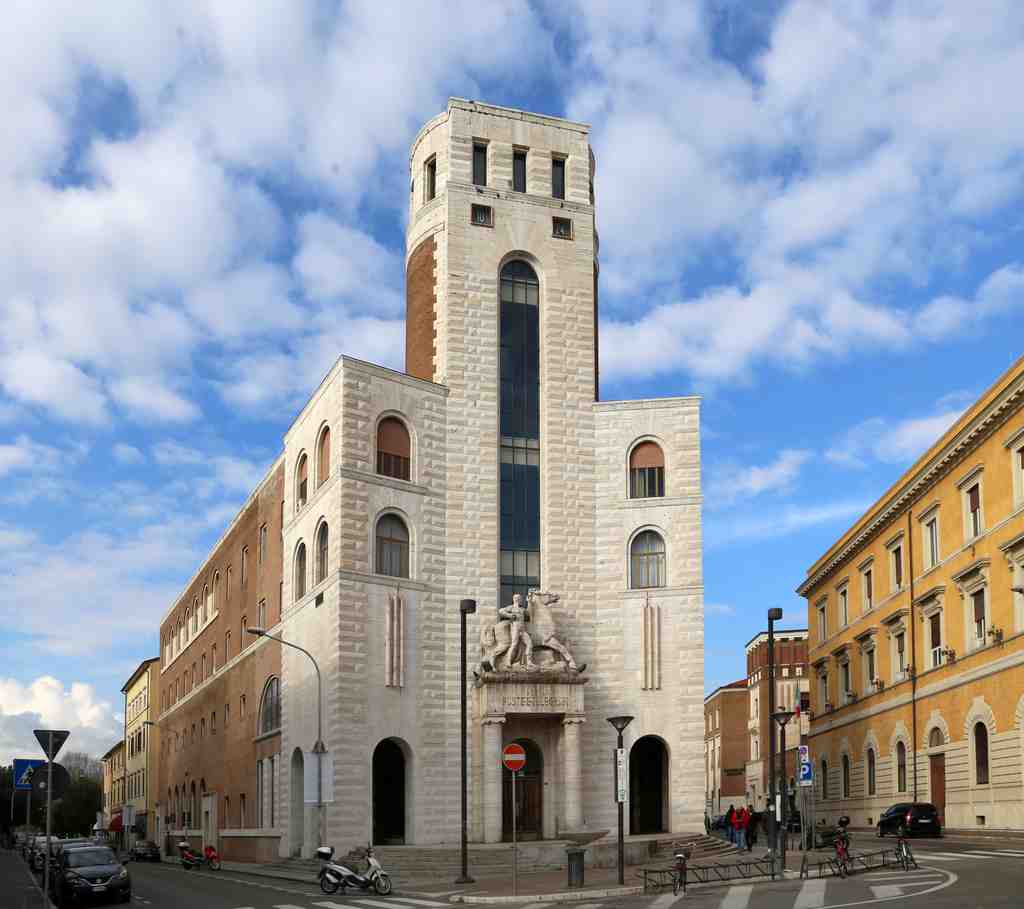
To spot the Post Office Building, just look for an impressive, fortress-like structure right ahead of you with gleaming pale stone cladding, tall arched windows, a powerful tower shooting skyward, and at its base, a spectacular marble sculpture above the entrance-believe me, this building isn’t shy!
Ah, welcome to the grand stage of Grosseto’s own “palazzo delle Poste e Telegrafi!” If this place doesn’t make you stand at attention, maybe the towering marble lions will! Right now, you’re staring at the beating heart of communication for the city-a civic temple erected at the very crossroads of history and ambition. This is no ordinary post office-this is a story in stone, marble, and a pinch of political drama.
Picture this: it’s the 1930s, and Italy is buzzing with grand plans to wriggle out of an economic crisis-unemployment was sky-high, and Mussolini was doling out jobs like confetti at a carnival. He signed a decree in 1930, making Grosseto the proud host of this monumental new post office, handpicking the daring Angiolo Mazzoni as the architect. Mazzoni was like the Michelangelo of bureaucracy-he didn’t just stick a stamp on a blueprint; he reimagined the very urban soul of Grosseto. Forget boring boxes-he dreamed up something that would knock the socks off anyone stepping out of the historic Porta Nuova.
The site? A busy circular piazza, now called piazza fratelli Rosselli, was chosen for its energy and connections-think of it as the crossroads where old meets new, where memories of the Risorgimento (look for the obelisk monument) brush up against the city’s future. And yet, in true Italian style, there was drama! The previous “palazzina liberty,” a lovely Art Nouveau beauty built just one year earlier, was ruthlessly demolished alongside some other buildings along then-viale Pisani. I imagine the demolition crews, taking a quick espresso break, shaking their heads-“Che peccato!” What a shame! But onward! Progress waits for no one.
In the early 1930s, the city was buzzing with more than just postal deliveries-picture the crush of 120 workers a day, the clatter of marble blocks from Garfagnana and the sparkle of travertine from Rapolano. The contracts zipped from Milan to Arcidosso to Pistoia, with one company even shaving 19.36% off the asking price! Now that's Italian bargaining for you-“What’s your final offer? And will you throw in a free panino?”
By 1932, the masterpiece was ready for its big unveiling-and who better to cut the ribbon than the king himself, Vittorio Emanuele III? Imagine the fanfare, the crowds, the sense of stepping bravely into a new era! The square was transformed, lined with bold new icons: Palazzo del Governo in Neoclassical pomp, Villa Panichi waving its whimsical Liberty touches, and this, the crescendo-Mazzoni’s monumental post office, standing on its own trapezoidal plinth, breaking from all traditional shapes. A visual anchor for the whole neighborhood, visible from every approach.
Take a closer look at the main facade-it’s nearly twenty meters high and split into three crisp sections. The core is crowned with a giant portal, flanked by beefy Ionic columns and topped with a heroic marble group by Napoleone Martinuzzi-the very image of the Maremma “tamed by man.” Above it all? A striking elliptical tower, with a ribbon of vertical windows leading the eye up, up-like a gigantic exclamation mark shouting, “Look at me!”
The curved granite staircase, made from island of Elba stone, sweeps out gracefully to the piazza-a bit like an opera diva making her grand entrance. At its feet sits the rationalist fountain-a circle of Portasanta marble and a diorite globe, a little pool where, on hot days, pigeons stop for a quick splash.
Those side wings? They hug the main plaza and reach out along via Roma and viale Matteotti, styled in warm bricks with flashes of elegant travertine. Each element-whether window, door, or column-was obsessively designed. The two smaller entrances on each side retain their original glass-and-brass lanterns, the floors and benches shimmer with precious stones, and if you peer through the side windows, you might even spot the twinkle of old neon lights from the 1930s!
Inside, the extravagance continues: the entrance hall is an ellipse of polished marble, with the echo of footsteps on violet “cipollino” stone, the glimmer of brass, and the cool touch of Carrara statuary. The postal hall is a cathedral to communication-concave walls, gleaming red Amiata marble, high arched ceilings with original glass chandeliers, and old brass clocks that once kept the city’s pulse in time. Behind the scenes: staircases spiraling skyward, hidden meeting rooms, and, if desks could talk, a million whispered secrets of love letters sent and bills paid.
Post-war, the building just kept reinventing itself: adding floors, stretching a bit here, getting a nip and tuck there-until, after a full restoration in 2008, it gleamed brighter than ever. Critics once sniffed at its “solemn, even gloomy monumentality,” but now it stands as an icon-equal parts history, ambition, and just a dash of Italian show-off.
So, take it all in. Maybe drop a postcard inside. And remember: in Grosseto, even sending a letter is a grand affair worthy of kings, duchesses, and the occasional nosy tourist! Shall we continue?


