
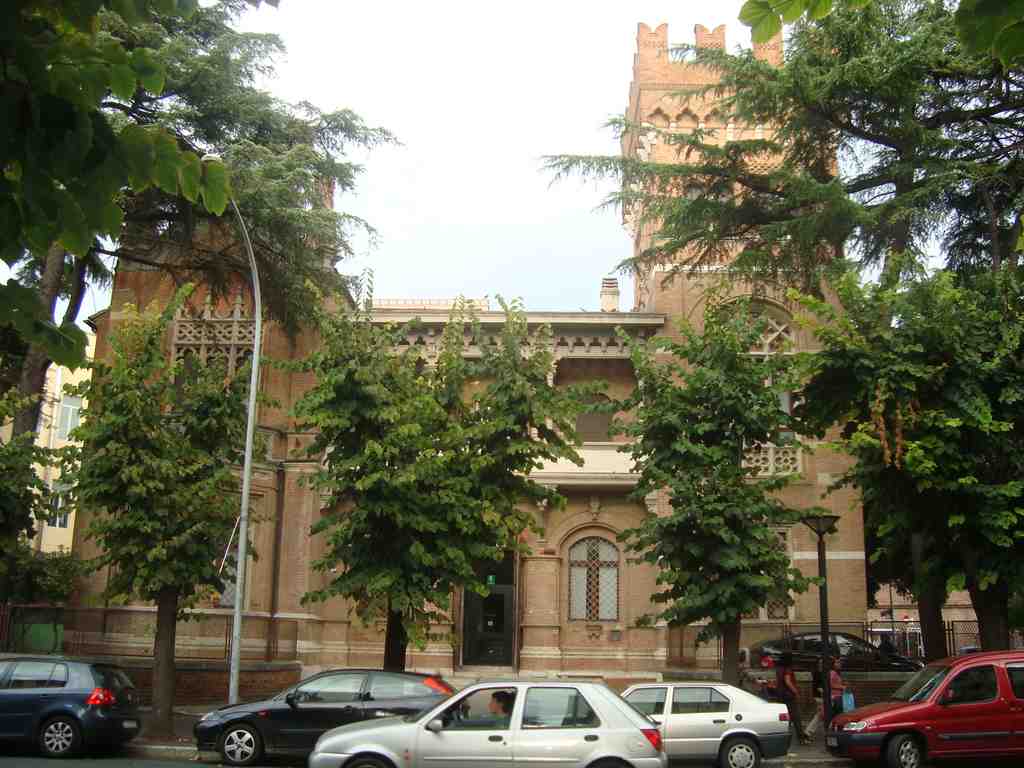
On your left, peeking mysteriously from behind a parade of leafy trees, you’ll spot the reddish-brick Villino Pastorelli, easy to find thanks to its fairy-tale tower with battlements and a whimsical blend of arches, loggias, and medieval details-just look past those branches!
Now, my friend, let’s take a moment here in the shade and imagine ourselves transported back to early 1900s Grosseto. Imagine the smell of fresh earth and kiln-fired brick drifting on the breeze-because those very bricks, which give the Villino Pastorelli its unique reddish warmth, traveled only a stone’s throw from the San Lorenzo furnace, owned by the family of Lorenzo Porciatti, the genius who designed this showstopper. Porciatti had a flair for the dramatic-if you’ve ever wondered what would happen if an English Gothic castle decided to go on holiday in Tuscany, well, this is it!
Back in its earliest days, this villa stood almost as a castle at the northern entrance to Grosseto’s historic core, just outside the ancient customs gate. Picture a classic Italian scene: a wrought-iron barrier, demolished only in 1924, separating the quietly dignified villa from the city bustle. The house was shielded by a protective line of trees, and further surrounded by a private yard-nowadays, that’s a parking lot, but let’s focus on the romance rather than the Renaults!
The villa was originally built between 1908 and 1913 for a wealthy farmer named Millanta, and trust me, he had taste. The place wasn’t just a home; it was practically a love letter to neo-Gothic style, with every detail carefully thought out. You see the lower arches, the elegant upstairs loggia with delicate twin columns, the square tower with crenellations ready for a miniature Juliet and Romeo drama, and a laterally attached hall that looks like a medieval chapel with spunky tumbling pinnacles. Even the windows-oh, don’t miss those!-are framed by fanciful stone tracery. It’s as if Porciatti saw an English “domestic architecture” magazine and said, “Yes, but let’s make it Tuscan!”
Now, the villa’s story is as twisty as its stunning design. After Millanta, it became the property of the Pastorelli family-hence the name-and in the dramatic war years of 1942 and 1943, it was transformed into the “Excelsior,” an inn, restaurant, and even a “dancing” venue where guests waltzed under the shade of those trees. Imagine the music floating over the garden as locals slipped away from the grim realities of wartime for a little bit of la dolce vita. The garden itself became a dance floor, rich with laughter-although I bet those who danced a bit too enthusiastically had to watch out for the roots!
After the Second World War, the villa’s life took on a more serious note. The Banca Nazionale dell’Agricoltura snapped it up and made some substantial changes-enlarging the rear of the building and considering even more grand expansions (plans for an entire new wing survive, like a “what could have been” of local daydreams). Later, until 2013, it housed the famous Banca Monte dei Paschi di Siena. Now, since 2019, it’s the stylish headquarters for an interior design firm-a fitting fate for a building that’s always been obsessed with beauty.
Inside, though much was changed for bank counters and offices, the villa once was a treasure box of Gothic flair: marble stairs wound up to apartments, ballrooms hosted lively receptions (imagine the swish of skirts and the clink of glasses), and even a “beautiful frescoed hall” for the most important gatherings. Upstairs, surprisingly, some original wooden fixtures and colorful hexagonal floors survive, especially in the turret’s attic and the side chapel-where geometric tiles and an intricately carved doorway evoke a medieval vibe more English than Tuscan.
Villino Pastorelli is considered one of Porciatti’s masterpieces-a playful, somewhat theatrical display of English-inspired Gothic transplanted into the heart of Maremma. Local critics have called it a “fairy-tale castle,” and who could disagree? All these years later, even behind its leafy camouflage and modern cars, it still whispers secrets of garden waltzes, aristocratic ambitions, and the dreams of architects who never saw a turret they didn’t want to add. If only these walls could talk-eh, maybe they’d sing! And if you find yourself tempted to twirl in the parking lot, just blame the Excelsior spirit. Off we go, on to our next adventure!
Interested in a deeper dive into the urban context, description or the criticism? Join me in the chat section for an insightful conversation.


