
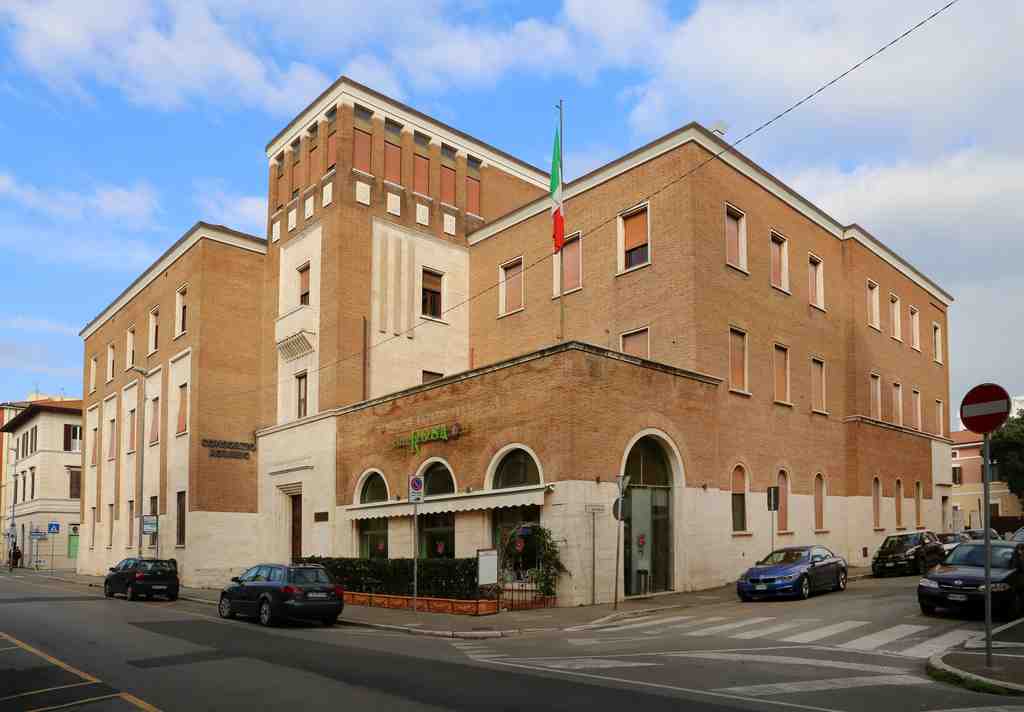
To spot the Palace of the Agricultural Consortium, look for a large, stately building on Via Roma with red bricks, grand travertine stone details, and a central tower-like section with a row of windows above the main entrance-plus, you’ll see the Italian flag proudly waving out front.
Ah, welcome, welcome! You’ve made it to a true chapter in the storybook of Grosseto-the Palace of the Agricultural Consortium, standing right here, where Via Roma stretches like fresh pasta from the rolling pin! Take in that imposing structure: strong lines, a bold tower poking into the sky, all dressed in red brick with accents of creamy travertine. It’s like the building is flexing its muscles, ready to show off Grosseto’s agricultural heart.
But wait, did you expect this place to have been here since the days of gladiators and togas? Ha! Not quite. Our story begins in the early 1900s, when farmers in this region were desperate for something more than the usual “good luck and a bit of rain.” In 1906, the first agricultural consortium opened nearby, not for fine dining, but to sell practical things-machinery and chemical fertilizers, the backbone of any ambitious local farmer! By 1908, they had a full branch working out deals, swapping gossip, and selling those bags of fertilizer with the same secrecy as a spy exchanging precious codes.
But business was booming-too booming for their first little shop. In 1909, the organization eyed this very plot, bought from the Carriaggi brothers, and dreamed big: imagine a grand palace, a real headquarters worthy of Grosseto’s rising ambitions. The plans came slow-first from an engineer Maconi in 1921, then another, Guido Bonci Casuccini, in 1931, and finally, after years of back and forth, the ultimate design was drawn by the determined (and probably slightly exhausted) Umberto Tombari in 1937. The construction? Well, that was another saga worthy of opera! After six hopeful companies competed for the job, victory went to the firm Alpiano-Castelli, who offered a nice discount-because, of course, every good Italian project starts with a bit of haggling!
Building kicked off in late 1938, and by November of the following year, locals watched this structure rise, the cost ballooning all the way to a cool one million lire. When the doors finally opened in February 1940, you can bet there was a lot of chest-puffing pride in Grosseto. The ground floor became the public’s playground-displaying everything from shiny tractors to the newest marvels in seed-planting. Upstairs? The brains of the empire: directors, office staff, and even the headquarters of the farmers’ fascist union, because even wheat and olives have a taste for politics, eh?
But life changes, and after the Consortium split by decree in 1939, this palace became the proud property of the Grosseto branch. It didn’t stop there! In 1942 the ambitious Tombari drew up an expansion on via Damiano Chiesa-a new home for the director, first built as one floor, later lifted up with another storey. Maybe the director just wanted a better view. Can you blame him?
From the outside, the building’s regular rank-and-file windows and bold corners mark it as authority’s home, while the grand stairs and travertine-clad tower seem to proclaim, “Here, we mean business…and business is agriculture!” The marble coats, heavy cornice, and the loggia that once displayed hulking machinery-oh, it must have been a traffic-stopper in its glory days! Don’t miss the marble coats-of-arms above: these are the crests of proud Tuscan cities, watching over every contract and handshake made inside.
Step in, and the drama continues: green and white marble stairs sweeping upwards, wood and ceramic finishes still whispering stories from the 1940s, and tucked away, a dramatic meeting room with Tolomeo Faccendi’s beautiful bas-relief-a tribute to the harvest, carved by hands that, I like to imagine, knew the joy of sinking fingers into rich Tuscan soil.
So take a breath, lift your eyes, and remember: this palace was, and remains, a monument to Grosseto’s grit and the eternal hope for a good harvest. And, as any local will tell you, you simply don’t mess with a farmer-especially one with a palace like this! Ready to explore more? Andiamo!


