
Akureyri Audio Tour: Cultural Gems
Beneath the shadow of the Arctic circle lies a town where colorful houses mask centuries of betrayal, burning ambition, and quiet defiance. Akureyri is not just a gateway to the north. It is a stage where the silence of the landscape conceals loud, forgotten histories. Unlock these secrets with a self-guided audio tour that navigates the hidden corners of the city. Walk beyond the postcard views of Akureyrarkirkja and the Botanical Garden to uncover the layers of rebellion and scandal buried in plain sight. Why did a local legend choose to bury his secrets beneath the church floorboards? What political collapse started with a single whisper in the garden? Who actually painted the mysterious symbol on the door of St. Peter's? Traverse the steep streets as history breathes through the crisp air. Transform your visit from simple sightseeing into a gripping pursuit of truth. Start your journey and uncover the scars of the north.
Tour preview
About this tour
- scheduleDuration 90–110 minsGo at your own pace
- straighten4.8 km walking routeFollow the guided path
- location_on
- wifi_offWorks offlineDownload once, use anywhere
- all_inclusiveLifetime accessReplay anytime, forever
- location_onStarts at Akureyrarvöllur
Stops on this tour
lock_open 3 free previews · 4 unlock with purchase
On your left is a polished metal bell form, upright and clean-lined, marked by engraved years that turn its smooth surface into a kind of public timeline. This is Iceland’s Bell,…Read moreShow less
Open dedicated page →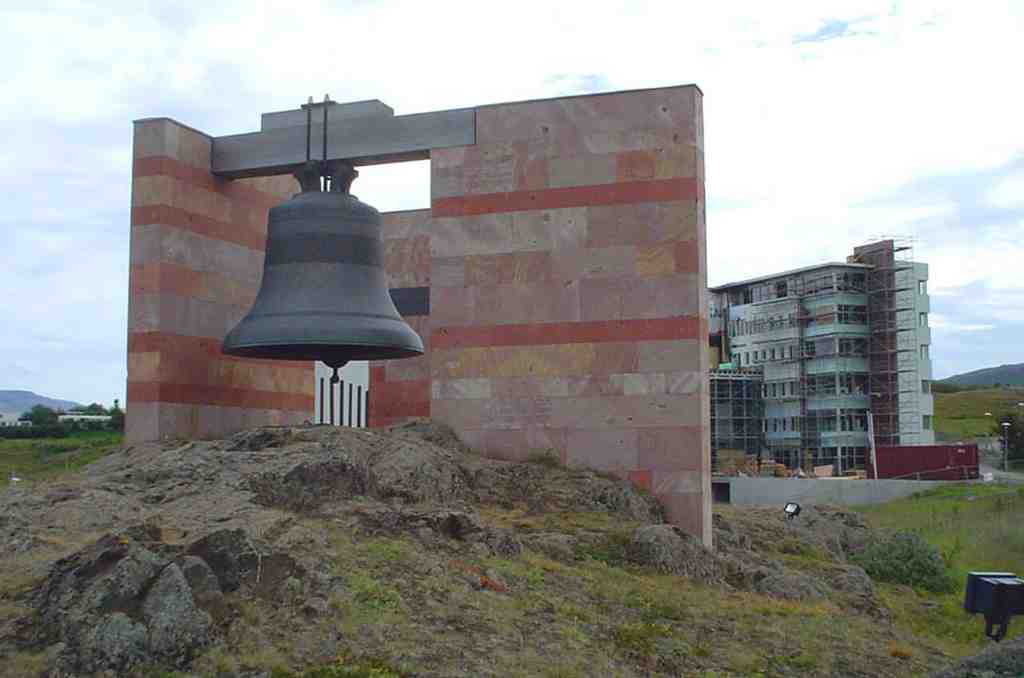
Iceland's BellPhoto: Bjarki Sigursveinsson, Wikimedia Commons, Public domain. Cropped & resized. On your left is a polished metal bell form, upright and clean-lined, marked by engraved years that turn its smooth surface into a kind of public timeline.
This is Iceland’s Bell, created by Kristinn E. Hrafnsson for the University of Akureyri. It looks simple at first... a bell, a title, job done. But this city likes places that carry more than one meaning. Here, time is inscribed in public space: those years are literally cut into the metal, so history becomes something counted, held, and walked past on an ordinary day.
Hrafnsson, born in Ólafsfjörður in nineteen sixty, trained first at the Art School of Akureyri, then at the Iceland University of the Arts, and later in Munich. You can feel that mix here: northern Icelandic roots, but with the finish of someone who knew exactly how civic art should stand its ground without shouting.
The city of Akureyri commissioned the piece in two thousand, when it held a competition to mark the thousand-year anniversary of Christianity in Iceland and Leif Erikson’s first North American venture. Hrafnsson said the bell points to the vigilance expected of a good university community... which is a very academic way of saying, stay awake and pay attention.
And here’s the detail locals tend to enjoy: even though the title echoes Halldór Laxness’s famous novel Iceland’s Bell, Hrafnsson said this sculpture is not a direct reference to the book. Same title, different argument. Akureyri leaves room for that sort of polite ambiguity.
The bell entered public life quickly. It went up on the first of December, two thousand, and a year later Mayor Kristján Þór Júlíusson formally handed it over to the university in a ceremony where it rang six times. Later, people rang it one hundred and fifty times for city and university anniversaries, and its shape even influenced the university logo.
So this is not just a sculpture. It is a marker, a ritual object, and a question left out in the open. From here, the Akureyri Art Museum is about a twenty-eight-minute walk away. And fittingly, this stop is always accessible, twenty-four hours a day.
Show 4 more stopsShow fewer stopsexpand_moreexpand_less
A pale concrete church with twin towers, a broad arched front, and a long stairway rising straight to its doors is Akureyrarkirkja. This is where Akureyri stops being modest.…Read moreShow less
Open dedicated page →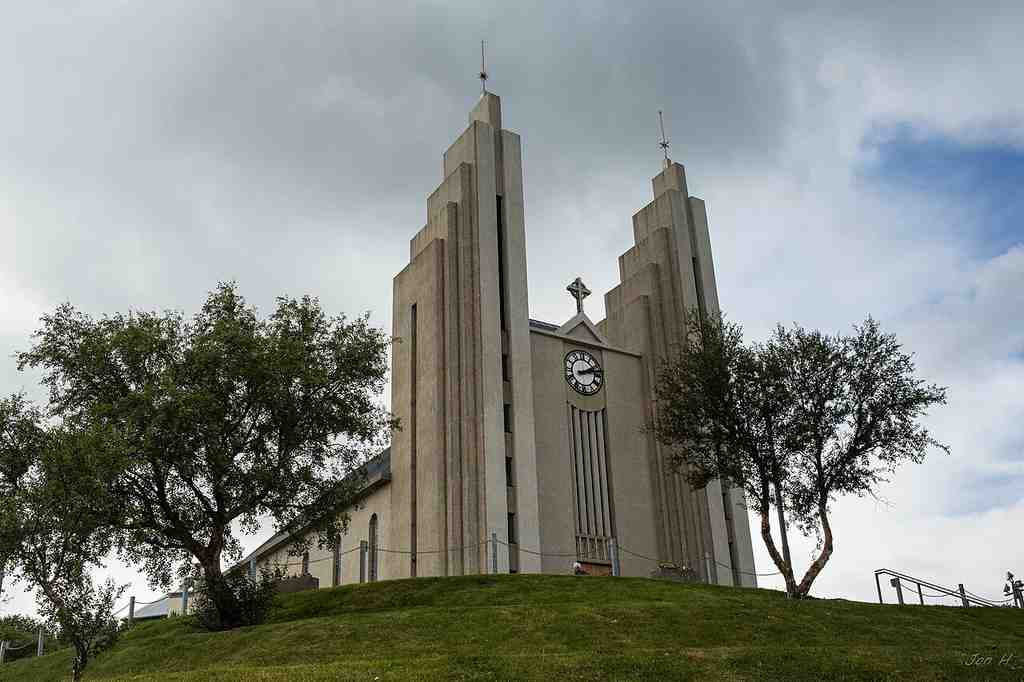
AkureyrarkirkjaPhoto: Jon Gretarsson, Wikimedia Commons, CC BY-SA 3.0. Cropped & resized. A pale concrete church with twin towers, a broad arched front, and a long stairway rising straight to its doors is Akureyrarkirkja.
This is where Akureyri stops being modest. Architect Guðjón Samúelsson finished the church in nineteen forty and treated it as a civic declaration, not just a parish church. He even described it as the most splendid and beautiful Lutheran church building in Iceland... which, is not exactly shy. The climb matters too: roughly one hundred steps lift you toward the nave, the main hall of the church, turning arrival into a small ceremony of its own. If you want a wider sense of that staged approach, take a look at the image on your screen.
Now pause for a moment and study how it holds itself above the street. Does it feel like a church... or a monument a town built to tell the world it had arrived?
Inside, the layers get richer: a three thousand two hundred-pipe organ, relief sculptures by Ásmundur Sveinsson, and historic windows that turn theology into something almost cinematic. The most famous piece came with a perfect story. Jakob Frímansson, a congregation leader, bought a stained-glass window after hearing it had once belonged to Coventry Cathedral, and one pane fit the altar opening almost exactly. Installed in the summer of nineteen forty-three, it became a beloved wartime legend.
Then the legend wobbled. In two thousand fourteen, BBC-linked research suggested the glass probably came from another London church, not Coventry at all. Coventry’s original Victorian windows had been destroyed in the air raids. So the romance faded a little... but the truth got more interesting. The window still mattered, just differently: not as a neat rescue tale, but as evidence of how towns build meaning from fragments.
And fragments can be costly. In two thousand seventeen, Svavar Alfreð Jónsson discovered the church vandalized on a day when a funeral was scheduled here. Repair estimates rose above twenty million Icelandic krona.
So yes, the story is less tidy than the legend. But maybe that is the point. In about five minutes, St. Peter’s Church offers another version of belief, memory, and belonging in this town.
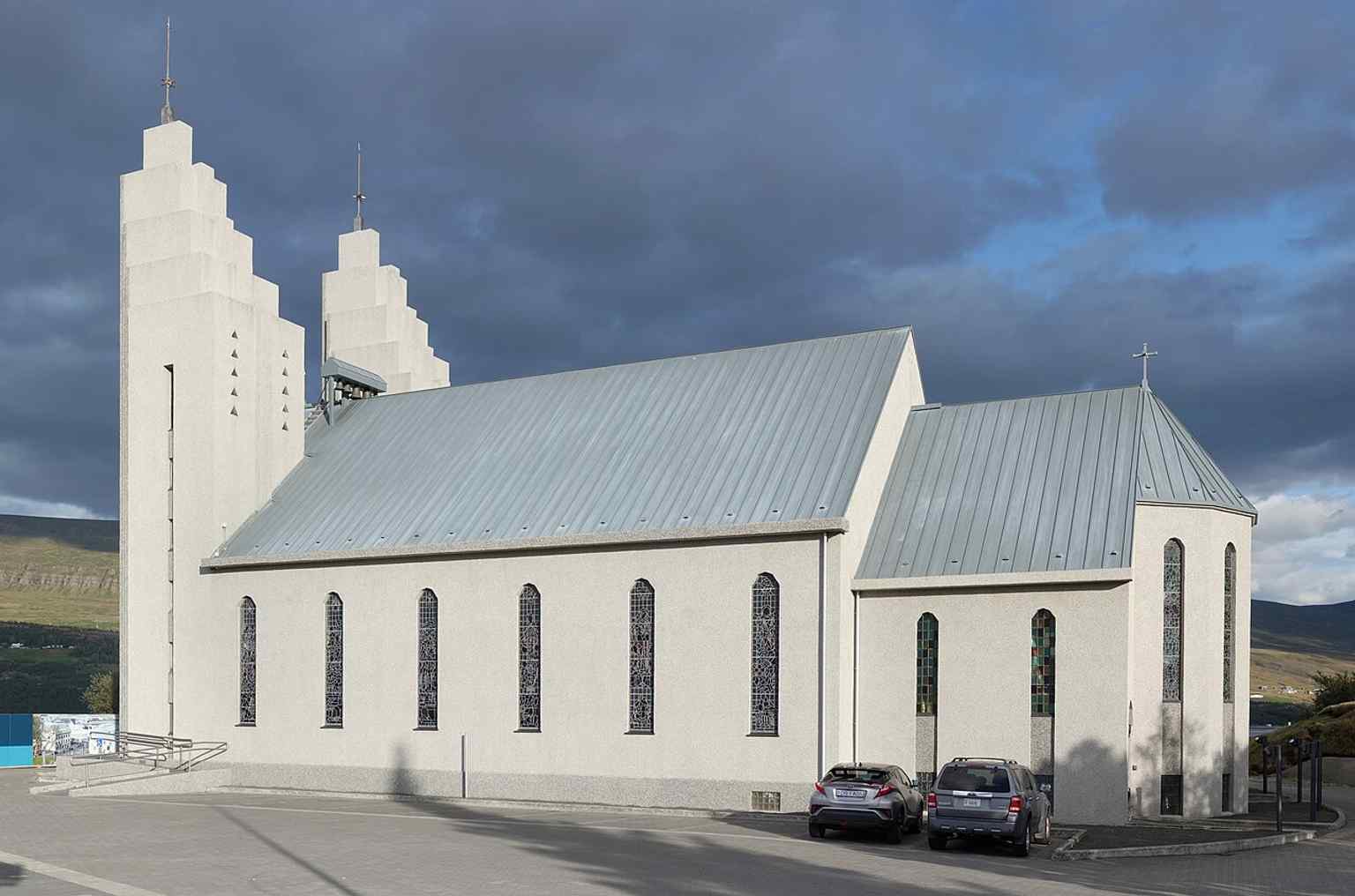
A crisp modern view of Akureyrarkirkja, the hilltop Lutheran church completed in 1940 and designed by Guðjón Samúelsson.Photo: Spike, Wikimedia Commons, CC BY-SA 4.0. Cropped & resized. 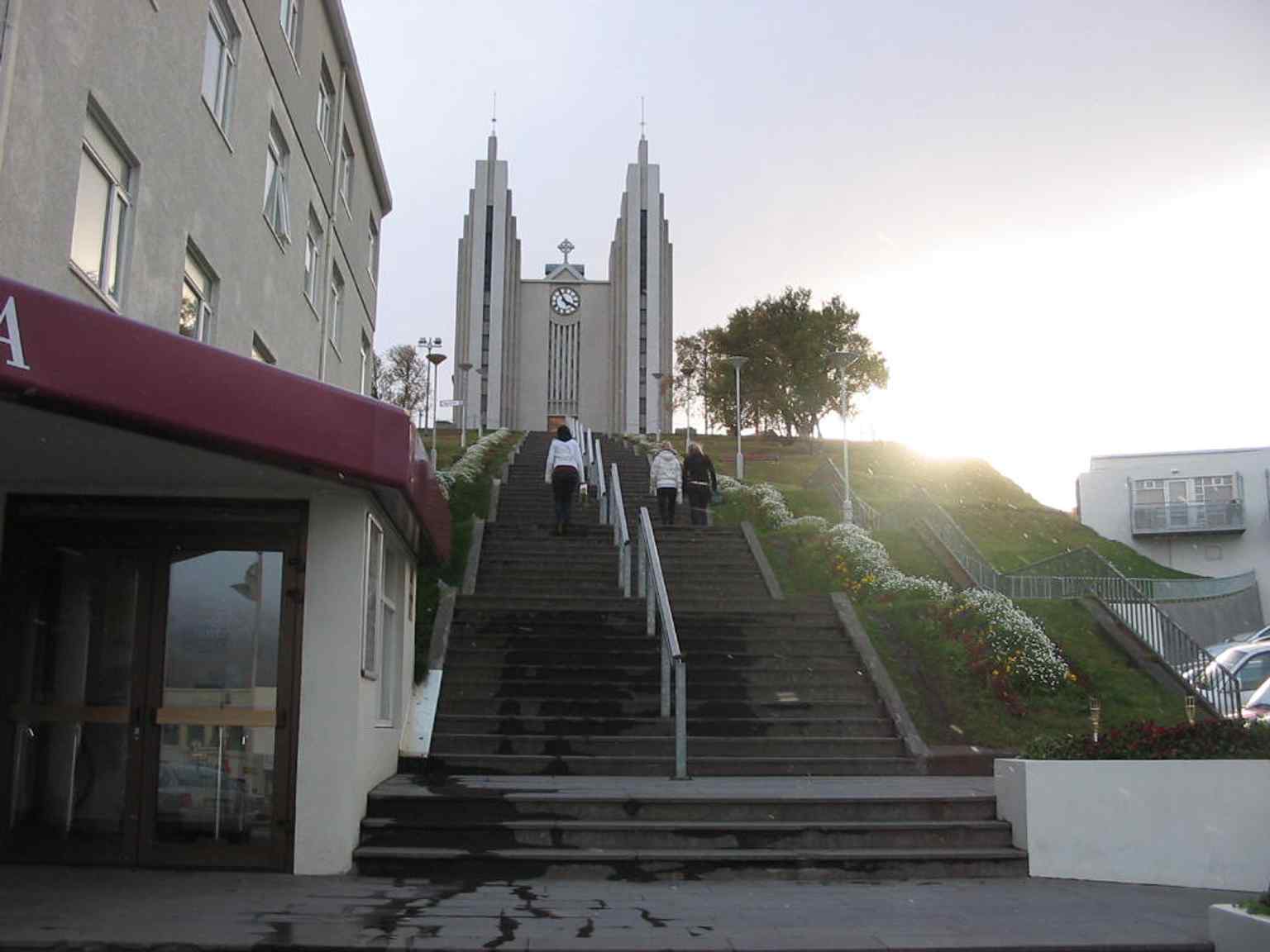
Downtown Akureyri with Akureyrarkirkja visible above the city, showing how centrally the church anchors the townscape.Photo: Roman Zacharij, Wikimedia Commons, Public domain. Cropped & resized. 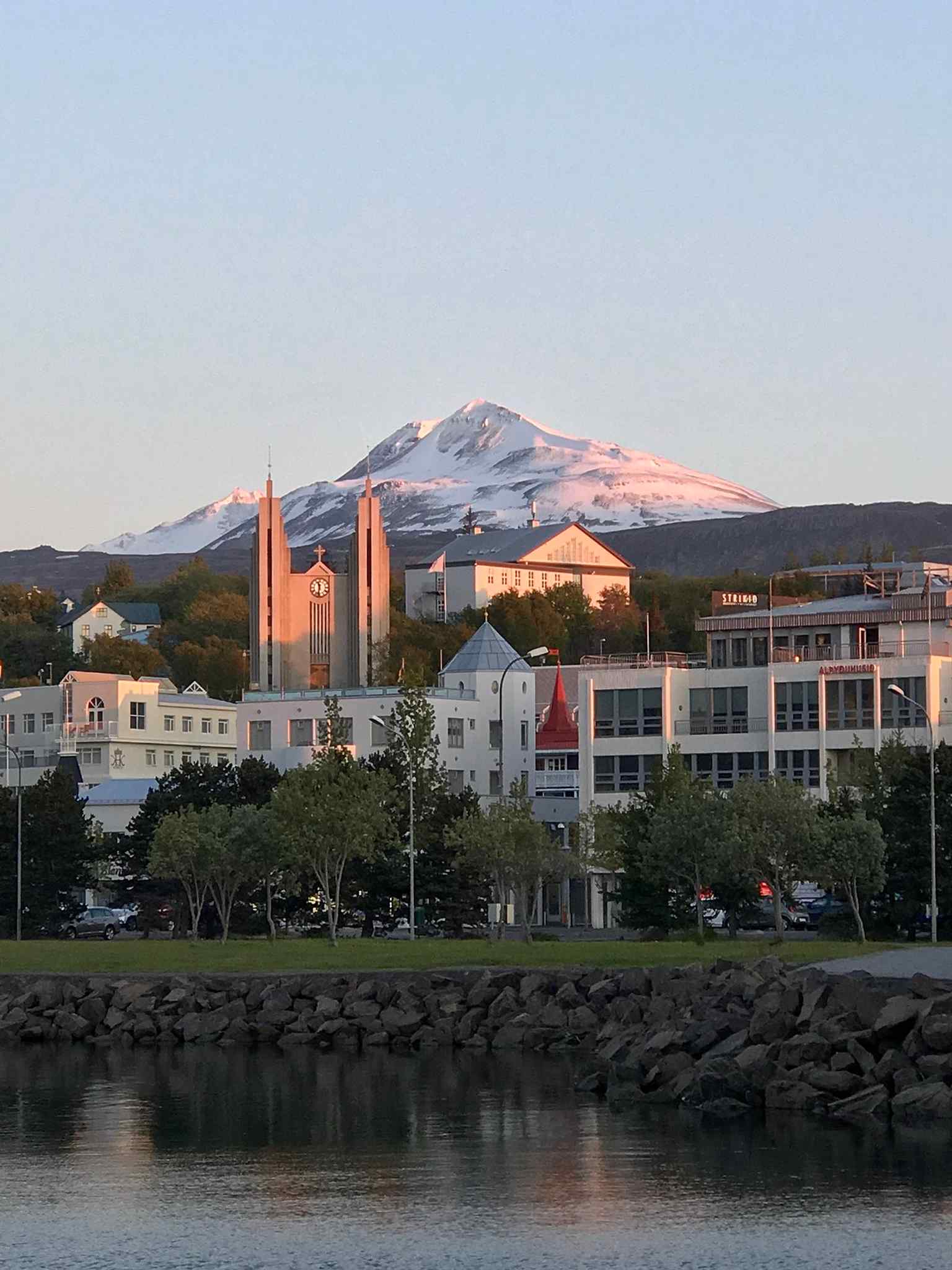
A broad city-and-church panorama with Mount Súlur in the background, placing Akureyrarkirkja in its dramatic northern Iceland setting.Photo: Andrii Gladii, Wikimedia Commons, CC BY-SA 4.0. Cropped & resized. Look for the compact red-and-white wooden building with a steep gabled roof and a simple cross that gives away its second life as a church. St. Peter’s is a good reminder that…Read moreShow less
Open dedicated page →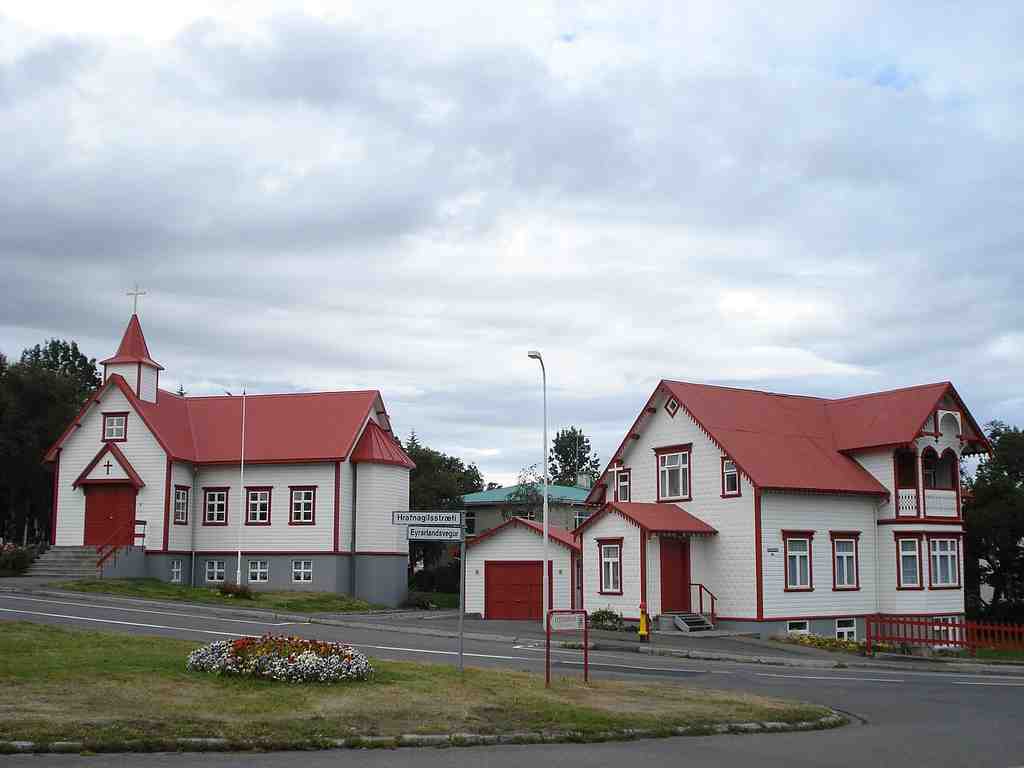
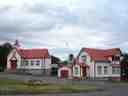
St. Peter's Church, AkureyriPhoto: TommyBee, Wikimedia Commons, Public domain. Cropped & resized. Look for the compact red-and-white wooden building with a steep gabled roof and a simple cross that gives away its second life as a church.
St. Peter’s is a good reminder that Akureyri’s small faith communities run on closeness, not grandeur. After the big Lutheran landmark up the hill, this place feels almost disarmingly personal... which is exactly the point.
What you see began as a house in nineteen twelve. The Diocese of Reykjavík bought it in nineteen fifty-two, and between nineteen ninety-eight and two thousand it turned the old home into a Catholic church for North Iceland. If you glance at the image on your screen, you can see that domestic scale still hanging on beneath the church colors.
The local names matter here. Father Jörgen Elí Jamin serves as parish priest, and Carmelite sisters like Sister M. Marselina and Sister Celestine help keep the place alive. Their work is steady, almost stubborn: Sunday confession before the eleven o’clock Mass, weekday Masses on Thursday and Friday, Saturday confession, rosary prayer, and Eucharistic adoration - quiet time set aside for prayer before the consecrated bread.
And here’s the detail locals notice: one of the parish’s biggest problems is not theology. It’s square footage. So many people want to stay and talk after Mass that the chapel can barely hold them, which is why the parish has asked for support for a proper gathering hall.
This church also anchors Catholics scattered across Húsavík, Dalvík, Sauðárkrókur, and beyond, with even more worship at the Carmelite chapel on Álfabyggð. In Akureyri, continuity often survives because small groups keep showing up and doing ordinary things with extraordinary persistence. From here, the Botanical Garden is about a five-minute walk.
Look for the black wrought-iron gate between stone posts, with curving gravel paths and the old timber house of Eyrarlandsstofa tucked inside. This garden makes a quiet but…Read moreShow less
Open dedicated page →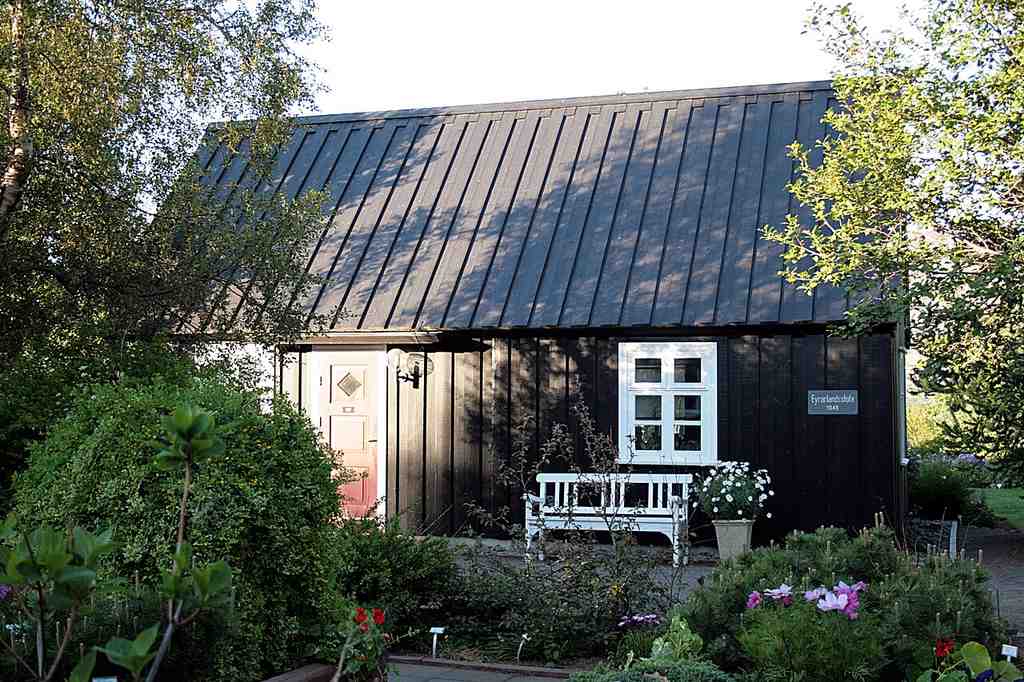
Akureyri Botanical GardenPhoto: Hedwig Storch, Wikimedia Commons, CC BY-SA 3.0. Cropped & resized. Look for the black wrought-iron gate between stone posts, with curving gravel paths and the old timber house of Eyrarlandsstofa tucked inside.
This garden makes a quiet but stubborn point: even this far north, about eighty-five kilometers south of the Arctic Circle, care can remake a place. Akureyri has relied on quiet caretakers of the city as much as on officials or builders. Patient people planted, weeded, protected, and waited... and over time that kind of work changed not just the land, but the town’s idea of itself.
That story starts with women. In nineteen ten, women in Akureyri formed the Park Association to make the town more beautiful, after the city granted them a hectare of land the year before. That made this the first public park in Iceland. Not a side project, either... more like a civic declaration with flowerbeds.
The person who came to embody that effort was Margrethe Schiöth. She moved here from Denmark in eighteen ninety-nine after marrying the baker Axel Schiöth, then took charge of the park and cared for it for the next thirty years. Her gardening turned into a public legacy. By nineteen twenty-six, when King Christian the Tenth and Queen Alexandrine visited Akureyri, people remembered this garden as one of the sights that impressed them most. Later, on her seventieth birthday, the city council proposed naming her an honorary citizen, saying she had done more than anyone to add lasting beauty to the town. That is a lovely civic compliment, and a fairly high achievement for someone armed mainly with patience.
If you glance at your screen, the aerial image shows how the grounds spread into a real landscape, not just a neat patch of municipal greenery. The park society managed it until nineteen fifty-three, and it grew to three point six hectares. Then, in nineteen fifty-seven, the city bought Jón Rögnvaldsson’s plant collection, helping formally turn the park into a botanical garden. Today it holds around seven thousand species, including about four hundred Icelandic plants, proving that the edge of the Arctic is not the edge of possibility.
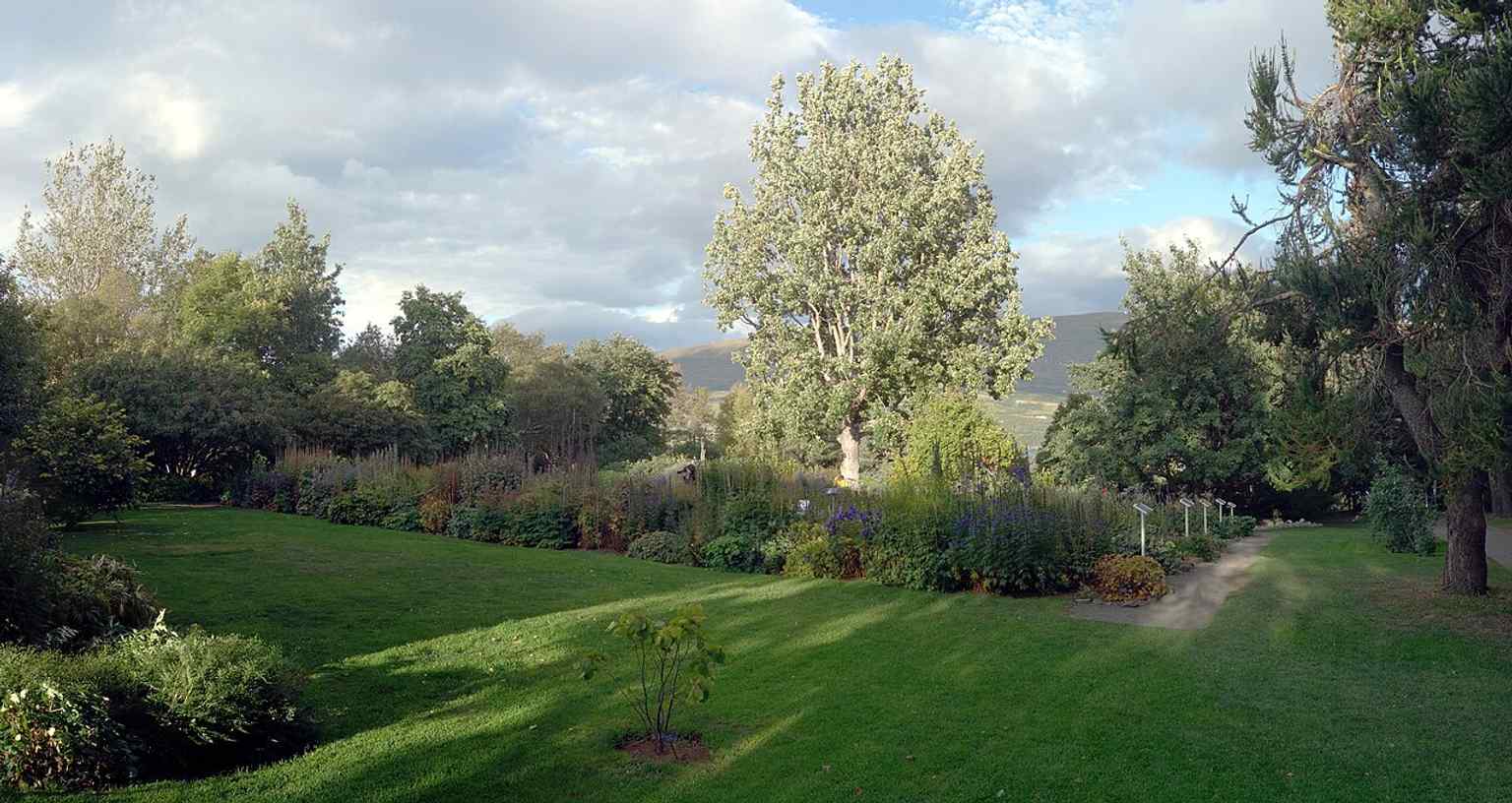
Wide panorama of Akureyri Botanical Garden, showing the green layout of one of the world’s northernmost botanical gardens.Photo: Spike, Wikimedia Commons, CC BY-SA 4.0. Cropped & resized. And if you check the app again, Eyrarlandsstofa, one of Akureyri’s oldest houses, sits inside these grounds too. So this place does double duty with quiet confidence: science, beauty, history, poetry, memorials, and everyday rest all share the same paths.
What leaves the deeper mark on a town: a dramatic building finished in one sweep, or years of careful tending that slowly change how people feel when they stand somewhere? This garden gives one clear answer. Akureyri did not shape itself through plans and monuments alone; it also grew because people kept tending it. The garden is open daily from eight in the morning until ten at night with free entry, and when you’re ready, Akureyri Hospital is about a three-minute walk from here.
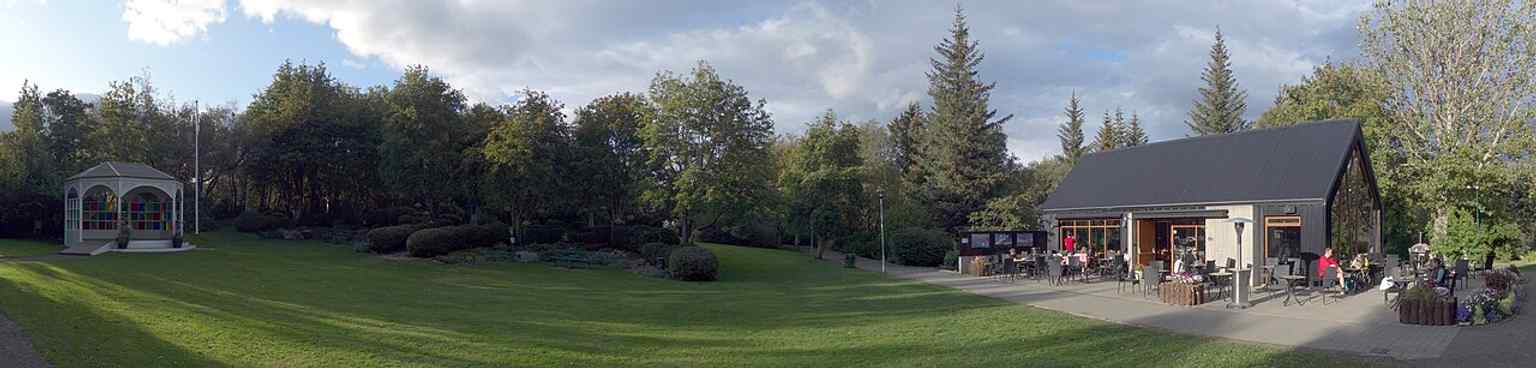
The garden café in summer, reflecting the botanic garden’s role as a welcoming public meeting place.Photo: Spike, Wikimedia Commons, CC BY-SA 4.0. Cropped & resized. 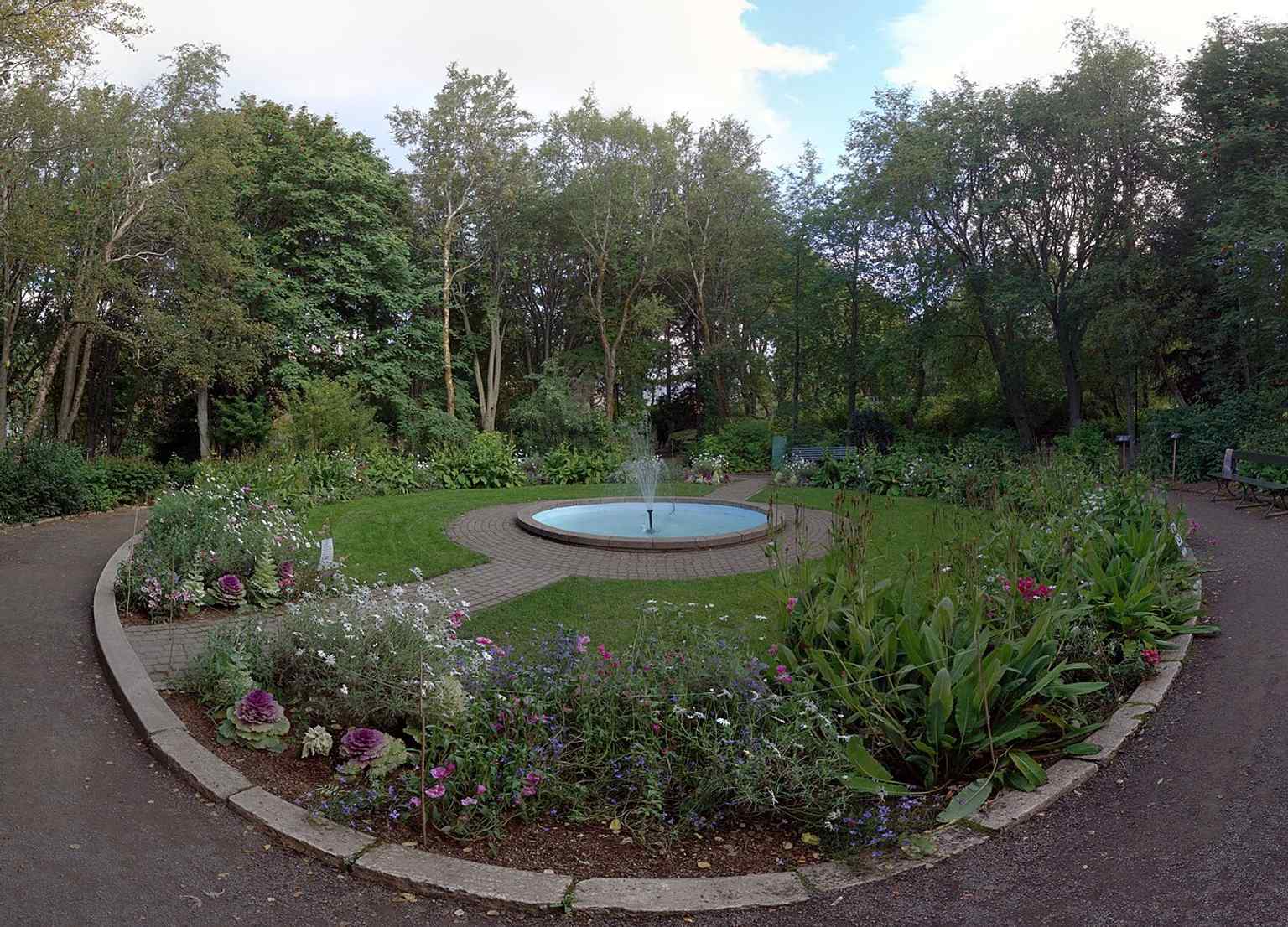
The garden fountain adds to the park-like atmosphere of Akureyri’s first public park, founded in 1910.Photo: Spike, Wikimedia Commons, CC BY-SA 4.0. Cropped & resized.
Frequently asked questions
How do I start the tour?
After purchase, download the AudaTours app and enter your redemption code. The tour will be ready to start immediately - just tap play and follow the GPS-guided route.
Do I need internet during the tour?
No! Download the tour before you start and enjoy it fully offline. Only the chat feature requires internet. We recommend downloading on WiFi to save mobile data.
Is this a guided group tour?
No - this is a self-guided audio tour. You explore independently at your own pace, with audio narration playing through your phone. No tour guide, no group, no schedule.
How long does the tour take?
Most tours take 60–90 minutes to complete, but you control the pace entirely. Pause, skip stops, or take breaks whenever you want.
What if I can't finish the tour today?
No problem! Tours have lifetime access. Pause and resume whenever you like - tomorrow, next week, or next year. Your progress is saved.
What languages are available?
All tours are available in 50+ languages. Select your preferred language when redeeming your code. Note: language cannot be changed after tour generation.
Where do I access the tour after purchase?
Download the free AudaTours app from the App Store or Google Play. Enter your redemption code (sent via email) and the tour will appear in your library, ready to download and start.
If you don't enjoy the tour, we'll refund your purchase. Contact us at [email protected]
Checkout securely with 






