
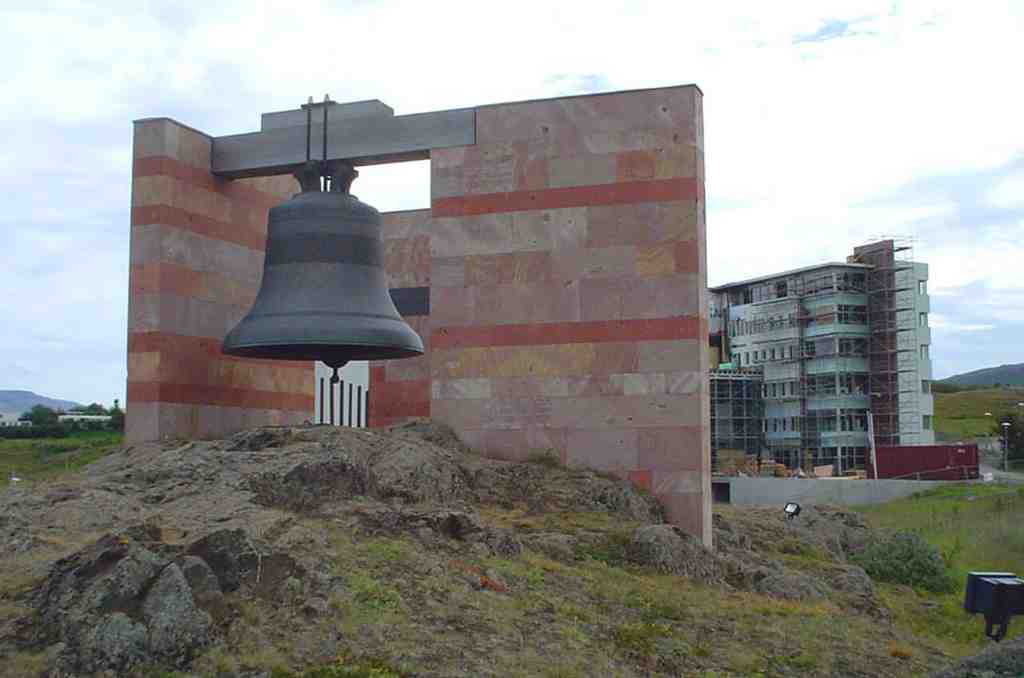
On your left is a polished metal bell form, upright and clean-lined, marked by engraved years that turn its smooth surface into a kind of public timeline.
This is Iceland’s Bell, created by Kristinn E. Hrafnsson for the University of Akureyri. It looks simple at first... a bell, a title, job done. But this city likes places that carry more than one meaning. Here, time is inscribed in public space: those years are literally cut into the metal, so history becomes something counted, held, and walked past on an ordinary day.
Hrafnsson, born in Ólafsfjörður in nineteen sixty, trained first at the Art School of Akureyri, then at the Iceland University of the Arts, and later in Munich. You can feel that mix here: northern Icelandic roots, but with the finish of someone who knew exactly how civic art should stand its ground without shouting.
The city of Akureyri commissioned the piece in two thousand, when it held a competition to mark the thousand-year anniversary of Christianity in Iceland and Leif Erikson’s first North American venture. Hrafnsson said the bell points to the vigilance expected of a good university community... which is a very academic way of saying, stay awake and pay attention.
And here’s the detail locals tend to enjoy: even though the title echoes Halldór Laxness’s famous novel Iceland’s Bell, Hrafnsson said this sculpture is not a direct reference to the book. Same title, different argument. Akureyri leaves room for that sort of polite ambiguity.
The bell entered public life quickly. It went up on the first of December, two thousand, and a year later Mayor Kristján Þór Júlíusson formally handed it over to the university in a ceremony where it rang six times. Later, people rang it one hundred and fifty times for city and university anniversaries, and its shape even influenced the university logo.
So this is not just a sculpture. It is a marker, a ritual object, and a question left out in the open. From here, the Akureyri Art Museum is about a twenty-eight-minute walk away. And fittingly, this stop is always accessible, twenty-four hours a day.




