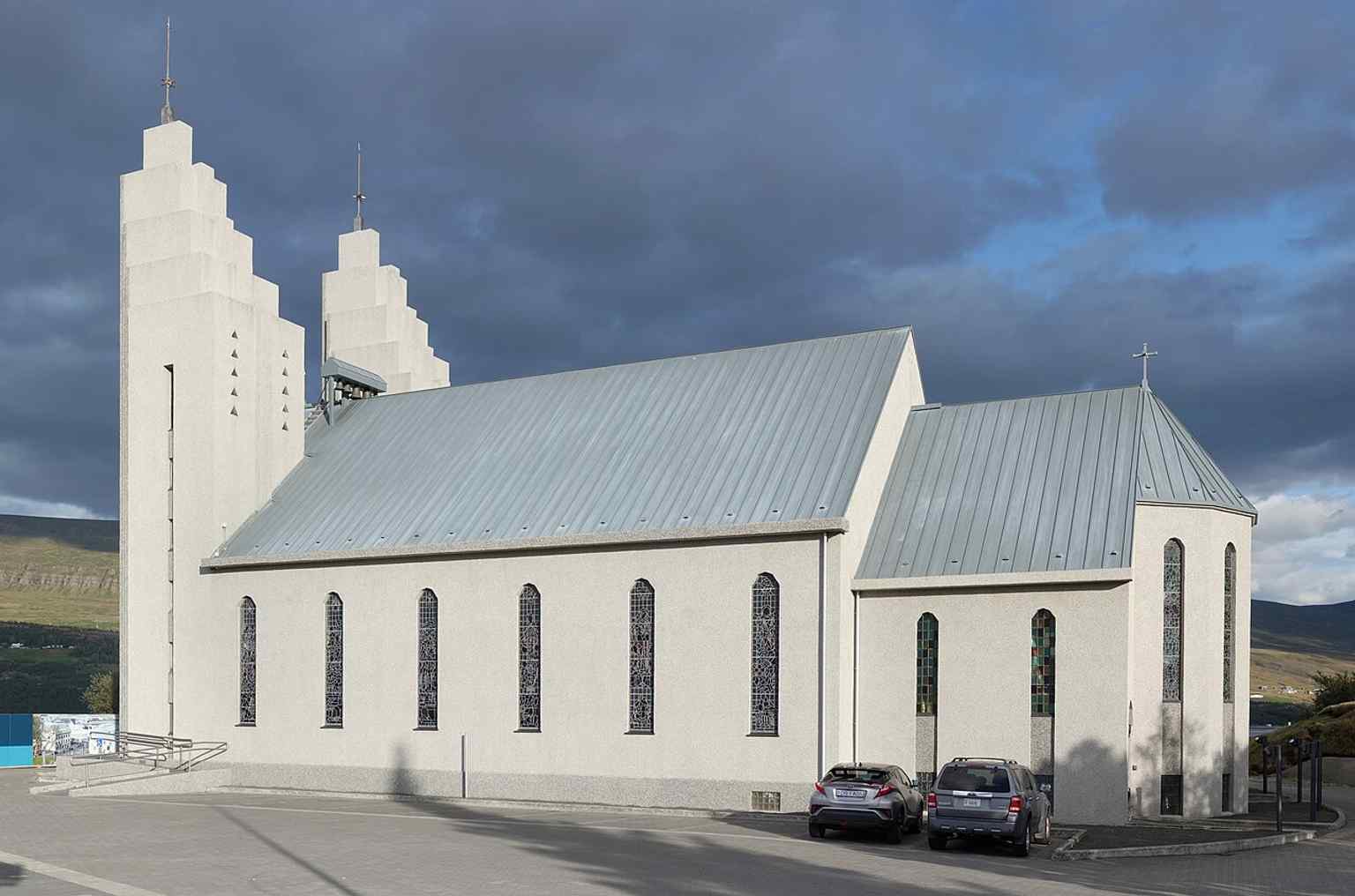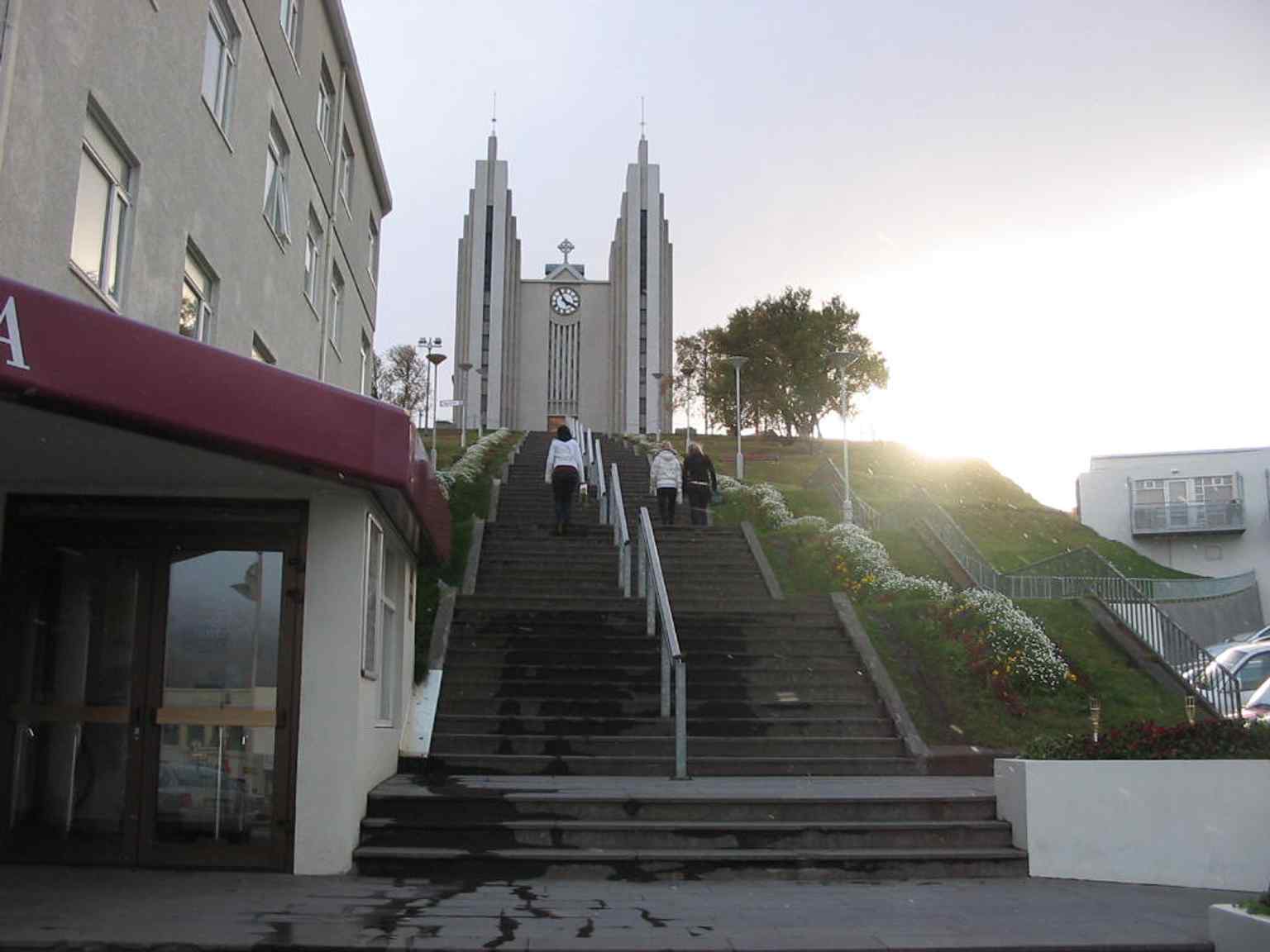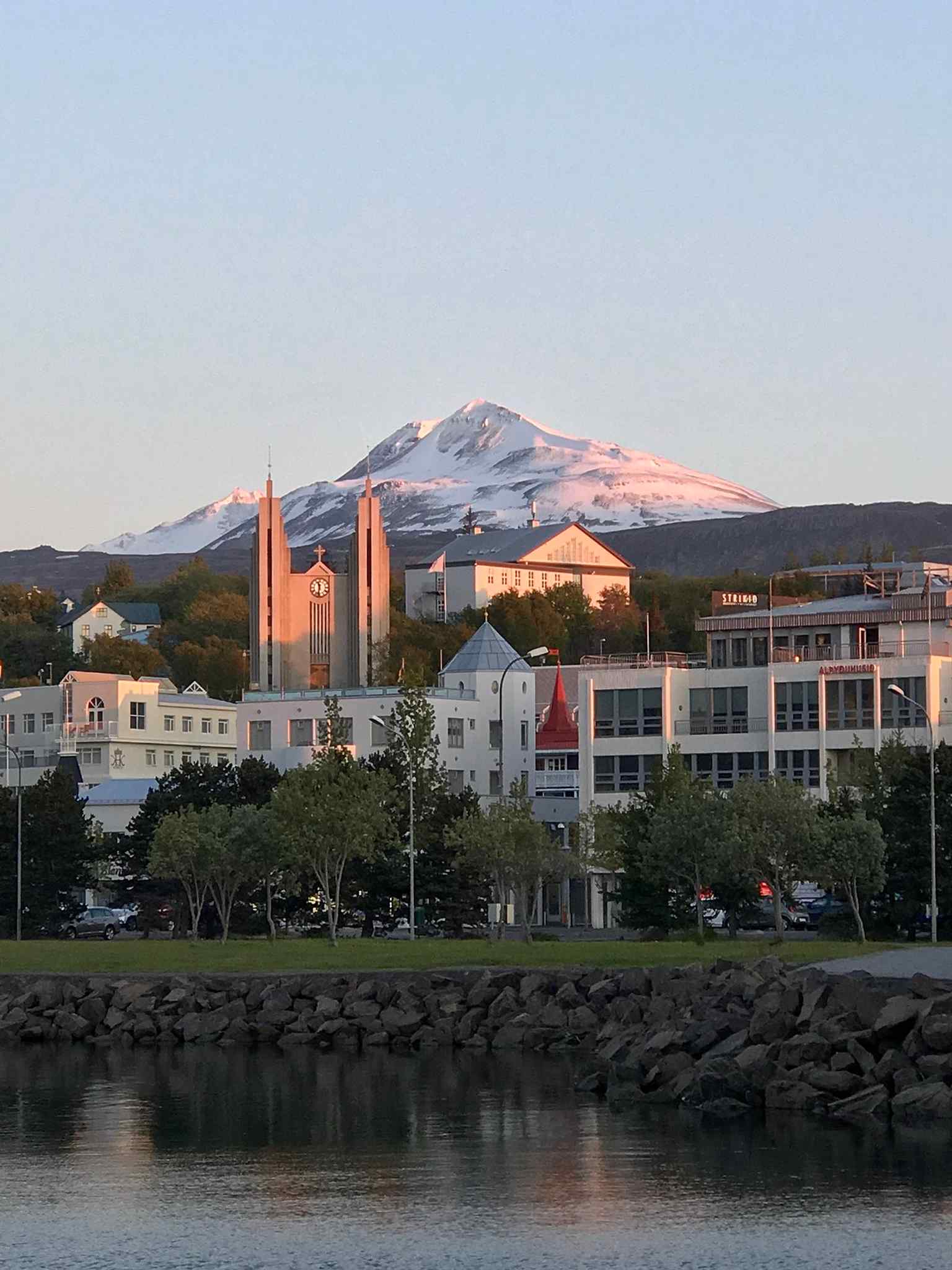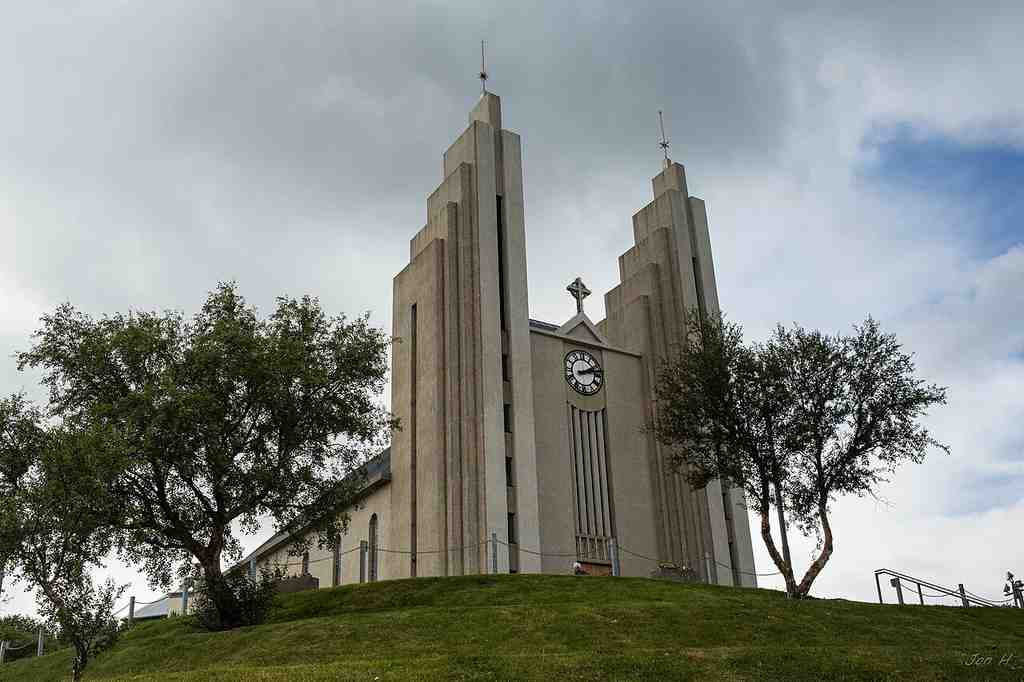
A pale concrete church with twin towers, a broad arched front, and a long stairway rising straight to its doors is Akureyrarkirkja.
This is where Akureyri stops being modest. Architect Guðjón Samúelsson finished the church in nineteen forty and treated it as a civic declaration, not just a parish church. He even described it as the most splendid and beautiful Lutheran church building in Iceland... which, is not exactly shy. The climb matters too: roughly one hundred steps lift you toward the nave, the main hall of the church, turning arrival into a small ceremony of its own. If you want a wider sense of that staged approach, take a look at the image on your screen.
Now pause for a moment and study how it holds itself above the street. Does it feel like a church... or a monument a town built to tell the world it had arrived?
Inside, the layers get richer: a three thousand two hundred-pipe organ, relief sculptures by Ásmundur Sveinsson, and historic windows that turn theology into something almost cinematic. The most famous piece came with a perfect story. Jakob Frímansson, a congregation leader, bought a stained-glass window after hearing it had once belonged to Coventry Cathedral, and one pane fit the altar opening almost exactly. Installed in the summer of nineteen forty-three, it became a beloved wartime legend.
Then the legend wobbled. In two thousand fourteen, BBC-linked research suggested the glass probably came from another London church, not Coventry at all. Coventry’s original Victorian windows had been destroyed in the air raids. So the romance faded a little... but the truth got more interesting. The window still mattered, just differently: not as a neat rescue tale, but as evidence of how towns build meaning from fragments.
And fragments can be costly. In two thousand seventeen, Svavar Alfreð Jónsson discovered the church vandalized on a day when a funeral was scheduled here. Repair estimates rose above twenty million Icelandic krona.
So yes, the story is less tidy than the legend. But maybe that is the point. In about five minutes, St. Peter’s Church offers another version of belief, memory, and belonging in this town.