Nîmes Audio Tour: Echoes of Empire and Sacred Stones
Nîmes glimmers with centuries-old secrets behind its sunlit stones, where Roman arenas cast colossal shadows beside futuristic glass togas. This self-guided audio tour is your invitation to wander through the city’s heart and uncover dramatic tales most travelers never hear—at your pace and on your own terms. Why did an entire medieval neighborhood spring up inside the ancient amphitheater’s blood-soaked walls? What hidden rivalries shaped the spectacular Museum of Romanness across from the arena? And who unearthed France’s most dazzling mosaics by accident while digging for something entirely mundane? Stride from breathtaking architecture to buried scandals, reliving moments when emperors ruled and rebels hid in plain sight. Each stop peels away Nîmes’ layers—echoes of sandals on mosaics, forgotten street feuds, and stories that swirl like the wind through marble arches. Set out now to follow the glint of glass and stone—discover Nîmes as you’ve never imagined.
Tour preview
About this tour
- scheduleDuration 60–80 minsGo at your own pace
- straighten2.0 km walking routeFollow the guided path
- location_on
- wifi_offWorks offlineDownload once, use anywhere
- all_inclusiveLifetime accessReplay anytime, forever
- location_onStarts at Museum of Romanness of Nîmes
Stops on this tour
lock_open 3 free previews · 6 unlock with purchase
Ah, welcome to the dazzling entrance of the Museum of Romanity! You’re standing here in the shadow of the great Roman arena, but across the street, the city’s most modern treasure…Read moreShow less
Ah, welcome to the dazzling entrance of the Museum of Romanity! You’re standing here in the shadow of the great Roman arena, but across the street, the city’s most modern treasure awaits you-and trust me, this place is as bright and shiny as the glass toga it wears. Yes, you heard that right. This contemporary building by Elizabeth de Portzamparc wraps itself in folds of glass designed to mimic the sway of a Roman toga in the breeze-because apparently, even buildings in Nîmes like to dress with a bit of flair. Open since June 2, 2018, the museum is an ode to the city’s long, enthralling relationship with Rome-a relationship that, at times, has been a bit like a soap opera, full of dramatic conquests, grand gestures, and the occasional neighborhood makeover. The Museum of Romanity is more than just a proud display case for old rocks. Step inside, and you’ll find yourself surrounded by 65 multimedia devices. Interactive screens, augmented reality, immersive movies-it might feel like the Romans left us their WiFi passwords! Each platform tells you about Nîmes’ origins, bringing history to life so vividly you might just start checking your pockets for a stray legionary’s denarius. The heart of the building is its spectacular central atrium, adorned with ancient fragments of a monumental pediment-a sort of ancient billboard advertising Nîmes’ epic past. Feel the cool, modern walls as you imagine the buzz of Roman sandals hurrying across mosaic floors almost two millennia ago. Speaking of mosaics, if you’re a fan of “before and after” stories, wait until you see the museum’s pride: the “Achilles” and “Pentheus” mosaics. Discovered during a routine construction dig in 2006-one can only imagine the surprise on those archaeologists’ faces!-these masterworks have been described as the most beautiful Roman mosaics in France after those in Pompeii. So if you think all archaeological finds are just broken pots, these will certainly change your mind. The museum itself is the result of a fierce creative rivalry. It all started when Mayor Jean-Paul Fournier was inspired to create a new, world-class showcase for Nîmes’ ancient treasures-he wanted to display these rarest works, long hidden in the old Jesuit cloister museum. So, in 2012, three famed architects competed for the honor: Rudy Ricciotti, Richard Meier, and Elizabeth de Portzamparc. Imagine the drama-three visionaries, three models, only one winner! Ultimately, Portzamparc’s glass toga won the day. The cornerstone was laid in 2015, and soon after, gigantic relics-like the majestic Bellerophon mosaic-arrived by crane, creating a buzz in the city. It’s not every day you see history airlifted down the street! But this isn’t just a museum stuck in ancient times. Here, you’ll time travel-from the world of the Gauls, with a reconstructed Gallic house filled with the sights and sounds of pre-Roman life, to the glory days of the Empire. You’ll peek into daily Roman routines, see what people wore (spoiler: togas are making a comeback in museum architecture), how they cooked, even how they decorated their homes. There are objects of all sorts-jars, jewelry, coins, even a restored Roman domus where you can almost hear the echoes of a long-lost dinner party. Travel further through time, and you’ll stumble into the medieval era. Nîmes shrinks as the centuries pass, and the city’s colossal Roman arena-instead of gladiators-bristles with medieval houses and a church smack dab in the middle. Over time, some of these medieval relics were buried, built over, or repurposed: history loves a good renovation! At the museum, you can see chunks of medieval sculpture-worn faces, mischievous stone creatures-which survived centuries of change. But don’t forget, the museum hosts ever-changing temporary exhibits, too. One year you might walk into the world of gladiators, the next, Pompeii, or even an emperor’s life among the gods. There’s always a surprise in store-perfect for those who suffer from chronic museum déjà vu. Let’s not forget the roof! Climb to the terrace and you’ll get a panoramic sweep of the city’s most iconic landmarks-a moment to catch your breath and imagine all the centuries you’ve just traveled in a few footsteps. So, are you ready to step inside a city’s living memory, where Romans, Gauls, medieval knights, and modern art lovers all bump shoulders-sometimes literally, if there’s a big crowd? The Museum of Romanity is calling you in; after all, Nîmes has always been a city with a taste for the spectacular. And if you get lost, just follow the trail of glittering glass. Now, onward to our next stop-history’s got a lot more in store, and I promise, the best is yet to come! Intrigued by the history of the musée de la romanité project, the permanent exhibition or the temporary exhibitions? Explore further by joining me in the chat section below.
Open dedicated page →Now, imagine stepping into a time machine as you walk through its doors. First stop: the world before the Romans, when the people of Nîmes lived in rustic Gallic houses. Picture…Read moreShow less
Now, imagine stepping into a time machine as you walk through its doors. First stop: the world before the Romans, when the people of Nîmes lived in rustic Gallic houses. Picture smoke from hearths curling up into the sky, and the air filled with chattering in ancient Celtic dialects. Keep moving and suddenly, you’re in the glittering age of Rome. The museum holds some truly dazzling mosaics, like the mosaic of Pentheus-each tiny tile carefully placed by hands over 2,000 years ago. Can you imagine the patience? I barely have enough to finish a jigsaw puzzle! Some dark corridors transport you further into the medieval era-a time of knights, monks, and a little less indoor plumbing. Every wall here holds a secret, every artifact has a tale. So take a deep breath and let your imagination roam. Each step in this museum is a leap across centuries, right here in sunny Nîmes! And who knows-maybe you’ll be inspired to start your own collection. Just don’t take any Roman bricks as souvenirs, okay?
Open dedicated page →To spot the Nîmes Arena, just look straight ahead for a massive, oval-shaped stone monument with two tiers of grand arches, looking like an ancient Roman crown glowing in the…Read moreShow less
To spot the Nîmes Arena, just look straight ahead for a massive, oval-shaped stone monument with two tiers of grand arches, looking like an ancient Roman crown glowing in the sunlight-it’s impossible to miss with all those arches and the striking bronze statue of a matador in front. Welcome to the Nîmes Arena! Standing before you is not just any old pile of rocks-this is one of the best-preserved Roman amphitheaters in the whole world, a place where echoes of gladiators, roaring crowds, and the dusty scent of history swirl in the air. Imagine yourself here around the year 90 AD: the sun is blazing, togas are all the rage, and 24,000 excited spectators are flowing into the oval seats by the thousands, not unlike people squeezing in for a rock concert-except their headline act is, well, a bit more dramatic. This amphitheater was the Roman answer to “how big and fancy can we make our sports venue?” Built for the people of the ancient colony of Nemausus, its design is like clockwork: 60 arches on two levels wrap around, while columns and pilasters give it that famous Roman flair. Vitruvius, the ancient architect, would have been proud-there are separate passageways so the richest citizens rub only their own elbows, and vomitoriums (don’t worry, they’re passageways, not what you’re thinking) for the crowds to empty out quickly instead of getting trapped like herded sheep after a perilous lion show. The seating? The well-to-do upfront, the not-so-rich up high, and if you dared to mix, well, that just wasn’t done. But this mighty stadium has lived many lives. After the gladiator battles ended (let’s be honest, Netflix just isn’t as thrilling), the arena became a fortress. The Wisigoths showed up, blocked the arches, added towers and extra defenses, and, as if out of a medieval fantasy, an entire village popped up inside: two churches, 220 houses, streets, even a tiny castle. Imagine hanging your laundry across the same stones that once saw battles to the death! The arena transformed into a neighborhood so bustling, even medieval real estate agents would have had a field day. By the 19th century, though, those houses and churches were evicted, leaving the ancient bones of the amphitheater exposed once again. It was restored to become an arena for bullfights, concerts, and festivals. If these walls could talk, they’d have stories of everything from Roman chariot races to guitar solos from Elton John and Tina Turner. Fancy a duel? There are recreations of ancient games every spring, complete with costumes, clashing swords, and maybe a Roman or two who missed their cue. Below the main arena lies a mysterious crisscross of galleries-a “cruciform room”-that you wouldn’t see unless you could slip into the subterranean world beneath your feet. For years, people thought they hid secret ceremonies there, but in reality, these were backstage tunnels where gladiators and animals waited, probably overheating in full armor and wishing someone would invent deodorant. Look up at the top, and you still find the holes where mighty poles once held up the velum, a vast canopy that sheltered spectators from the blazing southern sun-because nothing spoils the fight-to-the-finish mood like a sunburn. Sculpted decorations remain too: a she-wolf nursing Romulus and Remus, fierce gladiators fighting, and, over the gates, proud bull heads gazing over the crowds. The Nîmes Arena has kept busy over the centuries: tennis finals, handball matches, sword duels, legendary rock and jazz concerts, and even TV shows, all unfolding on its ancient stage. In spring, the “Roman Days” festival takes you back in time, with 500 reenactors, roaring crowds, and the pulse of history racing through the stone. Today, the arena is open all year. It welcomes everyone and offers special guides, tactile models, and wheelchair access so that no one misses out-unless, of course, you try to come in alone, because after a few daredevil jumps, they put a stop to solo visits. So, as you’re standing here, let the mystery, the echoes, and perhaps the distant sound of a crowd make you wonder: could you have faced the lions, the gladiators, or perhaps, just the smell in the air on festival day? Either way, you’re standing where empires rose, fell, and-luckily for us-left behind a building that’s still the main event in Nîmes. Ready to delve deeper into the characteristics of the monument, historical or the contemporary arenas? Join me in the chat section for an enriching discussion.
Open dedicated page →
Show 6 more stopsShow fewer stopsexpand_moreexpand_less
Let’s rewind the clock to the year 737, when the story of Nîmes was about as calm as a cat in a room full of rocking chairs. Our tale actually begins a little before that, in 719,…Read moreShow less
Let’s rewind the clock to the year 737, when the story of Nîmes was about as calm as a cat in a room full of rocking chairs. Our tale actually begins a little before that, in 719, when the Omeyyads-also called the “Saracens” by the locals back then-crossed the mighty Pyrenees and swept into the present-day Languedoc region. They weren’t here for a vacation; instead, they took over the whole territory, from Narbonne to good ol’ Nîmes, making themselves quite at home for about a dozen years. Picture the scene: the local defenders trying desperately to hold the bridge over the Vidourle, but being overwhelmed. Soon, the Omeyyads, led by Ambiza ibn Suhaym al-Kalbi-try saying that three times fast-took over Nîmes around 724 or 725. Things got dramatic: many monks managed a daring escape, running off to the countryside, while those who stayed were thrown out as the new rulers turned churches into mosques and outlawed Christianity right here for twelve long years. Imagine the blending smells of exotic spices newly brought by the Omeyyads, echoing prayers at sunrise unfamiliar to local ears, and the tension as two cultures lived side by side, eyeing one another warily-but living together nonetheless. Now, let’s throw one of history’s wildcards into the mix: Charles Martel. The “Hammer,” as his nickname suggests, was not a man who handled things gently. He had his own problems up north-battling Saxons and others-but as soon as he had the time, he turned his attention south, to the hotly contested lands of Septimania, which, yes, included Nîmes. Remember the Battle of Poitiers in 732, when Charles Martel threw back Omeyyad forces? After that, the Omeyyad army beat a retreat down the Rhône, pillaging as they went. The instability gave another player-Mauronte, the rebellious Duke of Provence-a chance to stir the pot. He joined forces with the Omeyyads, plundering local cities including Avignon and Nîmes, while Charles dealt with threats elsewhere. Fast forward to 736 and 737: Charles Martel returned with an army big enough to worry absolutely everyone. He cut through Aquitaine, camping in fields, routing the Omeyyad forces near Sernhac (about halfway to Avignon), then crushing them again near the Pont du Gard-you might visit the remains of his commemorative chapel at Montfrin if you fancy a detour. The Duke Mauronte, realizing Charles wasn’t stopping for croissants or sight-seeing, ducked into the Alps to hide. Charles’s army stormed through the Rhône valley, setting fire to major cities. They didn’t pull punches-Avignon was burned, the Omeyyad fleet destroyed, even the civilian population was caught in the maelstrom. At this point, Nîmes, in Omeyyad hands, was right in Charles’s sights. And so, the siege began. The fear and chaos must have been unimaginable: smoke rising, stone walls trembling as battering rams hammered away, shouts piercing the winter air. According to older chronicles, Charles’s wrath spared very little. "He burned the city gates, tore down every house the fire had missed, shrines, basilicas, towers, walls, aqueducts, even the bridges-nothing escaped his hammer," to paraphrase a chronicler from the day. Nîmes was left smoldering, a city gutted but with one memorable exception-the massive Roman amphitheater and a few sturdy stone wonders like the Maison Carrée survived. Not even Charles Martel could out-hammer stone that thick! Did this bring a peaceful ending? Well, not quite. Charles never quite managed to conquer Narbonne, the big target, as a king’s death up north forced him to cut the campaign short. On his way home, Charles continued his fiery brand of negotiation, sacking and burning towns-Nîmes included-to make sure the Omeyyads couldn’t turn them into fortresses again. Yet, the cycle wasn’t over: in 738, with Charles off busy in Saxony, the Saracens crept back, reoccupying cities like Nîmes and provoking yet more showdowns. It would take Charles’s son, Pepin, many more years to finally drive them out for good, while the resilient stones of Nîmes watched in stoic silence as history’s tides washed back and forth. So the next time you pass a centuries-old building in Nîmes, remember: it’s not just an old wall. It’s a survivor, a silent witness to war, faith, fire, and the wild comedy of history-where sometimes, the only thing tougher than an army is a Roman stone. Onward to our next stop!
Open dedicated page →Directly ahead, you’ll spot a striking, gleaming Roman temple with tall columns and sturdy steps, set dramatically in the heart of the city square-no, you’re not in ancient Rome,…Read moreShow less
Directly ahead, you’ll spot a striking, gleaming Roman temple with tall columns and sturdy steps, set dramatically in the heart of the city square-no, you’re not in ancient Rome, you’re in the living, breathing city of Nîmes! Welcome to Nîmes, the heart of southern France, and what a lively heart it is! Imagine yourself standing here not only as a visitor but as a time traveler: beneath your feet, layers and layers of history stretch back to the days when togas were all the rage, sandals were in fashion for everyone, and the sound of Latin filled the bustling streets. Today, Nîmes is known as the “French Rome”-and that’s not just a clever nickname. It was founded in Antiquity, long before designer denim jeans were invented, and it still holds onto its ancient roots like a kid clutching their favorite comic book. Let’s set the scene: Nîmes is a modern commune, bursting with nearly 150,000 inhabitants-Nîmois, as they proudly call themselves. But don’t let those numbers fool you; the city swells in the summer like bread in a warm oven, as tourists come flooding in for its legendary monuments, sizzling festivals, and sun-drenched ambiance. Seriously, with 300 days of sunshine each year, it’s hard not to feel like the city is constantly winking at you. But the story of Nîmes isn’t just sunshine and picnics. The city sits at a crossroads: the Mediterranean Sea just a quick drive south, and the rugged Cévennes mountains rising nearby. Whether you’re dreaming of splashing in the surf or hiking rugged trails, Nîmes is perfectly placed. In fact, its convenient position means that in ancient Roman times, the city was a stop along the famed Via Domitia, which once connected Italy to Spain-and maybe a few lost sandals along the way, too. Now, don’t be surprised if you spot some incredible Roman landmarks as you wander: those grand arenas you saw earlier, the Maison Carrée right in front of you (so perfectly preserved it looks like Augustus could stroll out at any moment!), and don’t forget the mysterious Tour Magne looming above the gardens. Legend has it that, back in Roman days, the great emperor himself might have paused here, squinting in the same sunshine, perhaps also trying to avoid a stray chariot or two. Why is Nîmes called “French Rome?” Well, from its days as the Roman stronghold “Nemausus,” the city grew into a melting pot: part Gallic, part Roman, a dash of Camargue, provençal spice, and even a side of protestant spirit since the 1500s. In the 18th century, Nîmes wrapped itself in fabric fame-denim, in fact, gets its name from “de Nîmes.” Yes, next time you put on your favorite jeans, give a little salute to this city! Through the centuries, Nîmes saw floods, fires, and the roar of the mistral wind (hold on to your hat!-those gusts can reach over 100 kilometers per hour). The streets circle around the ancient Écusson, the medieval heart of Nîmes, once protected by thick stone walls and now by rows of ancient trees shading elegant boulevards. Today, you’ll find vibrant squares, chic shops, and the laughter of families drifting from hidden courtyards. Modern Nîmes is more than its ancient bones-it’s a city that loves to celebrate. Every summer, the squares echo with music and cheers as the ferias come alive, and every night, new urban projects light up the avenues and refresh the landscape. You might notice stunning new museums popping up, art centers like the Carré d’art, or even the shimmering glass of the train station, which whisks people off to Marseille, Paris, or even Barcelona if they miss that Mediterranean breeze. But like any city with a rich life story, Nîmes has faced its share of challenges: dramatic floods, scorching summers (fun fact, the city hit a sweltering 44.4°C-France’s hottest big city record!), and the regular threat of wild weather. Still, the people of Nîmes (and their crocodile mascot, no less!) just keep on going, modernizing older neighborhoods, opening eco-friendly districts, and finding ways to blend old magic with new possibilities. So, as you stand here in the center of it all, take a deep breath and listen-imagine a Roman marching band, a burst of festival music, or maybe just the sound of your own footsteps echoing through two thousand years of history. Welcome to Nîmes, city of sun, stories…and denim. Ready to delve deeper into the geography, town planning or the toponymy? Join me in the chat section for an enriching discussion.
Open dedicated page →To spot the Notre-Dame-et-Saint-Castor Cathedral of Nîmes, just look for the tall, pale stone tower with arched windows rising above the square and the church’s sturdy,…Read moreShow less
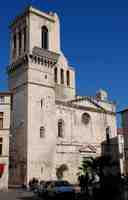
To spot the Notre-Dame-et-Saint-Castor Cathedral of Nîmes, just look for the tall, pale stone tower with arched windows rising above the square and the church’s sturdy, rectangular body topped with a triangular pediment and a large rose window right above the entrance. You’re standing right at the heart of history, and maybe-just maybe-if you listen closely you’ll hear the echoes of more than a thousand years packed into these ancient stones! This is the Notre-Dame-et-Saint-Castor Cathedral, and its tale is one of survival, transformation, and, dare I say, a pinch of medieval drama. Let’s wind the clock back. Once upon a time, long before the cathedral was here, people thought it had been built on some mysterious Roman monument, thanks to the recycled Roman columns and stone blocks scattered around. But a dig in 1920 revealed an even older surprise: beneath your feet, the remains of a church from the 7th century, once used constantly as a burial place-imagine the hush and the solemn footsteps of mourners passing through, year after year. Over time, more churches sprang up here. Imagine a bustling complex: chapels, an open atrium, and later even a cloister, with the scent of incense and the low murmur of chanting clergy. Some fragments from these times now rest quietly in the city’s archaeological museum. A leap forward, and we’re in the age of the Romans-well, at least their recycled stones are! In 1096, Pope Urban II himself consecrated the Romanesque church rising on these ancient layers. At first glance, the cathedral’s walls might look plain, but look closer! Along the façade, you see a row of little arches and, to the left, a series of stone carvings from the Old Testament-like a medieval comic strip for believers who couldn’t read. It’s said the original bells once rang out from a wall right above you. But life wasn’t always peaceful. Two major attacks during the Wars of Religion nearly brought the cathedral to ruins. In 1567 and again in 1621, Reformers stormed through, causing so much destruction that one of its grand towers, once taller than even the famous tower of Uzès, was lost forever. Only the northwest tower survived, standing guard like a stone-silent sentinel and, believe it or not, serving as an observation post. After such turmoil, the seventeenth century brought a breath of fresh, classical air. Under Bishop Cohon, the cathedral was rebuilt in a style more graceful: one grand, vaulted nave with side chapels, where sunlight dances on baroque details. The most dazzling spot is the Chapel of the Rosary, topped with a little lantern; it was magnificently restored just a decade or so ago. Skip ahead to the 19th century and, well, some people thought the old Romanesque doorway was too tiny for visiting royalty-so, in 1822, it was demolished for the grander, neoclassical entrance you see today, just so a princess’s fancy canopy could fit through! Priorities, right? In the late 1800s, architect Henri Antoine Révoil went wild inside, draping the interior in a blend of Romanesque and Byzantine styles. He didn’t get to touch the weathered, noble façade, though-you can almost hear the architects bickering about style behind closed doors. Now, if you listen carefully, you might even hear the deep, warm sound of the cathedral’s mighty organ, whose pipes date back to the seventeenth century. Over centuries, it’s been rebuilt many times, and its beautifully carved wooden case is itself protected as a national treasure. The current organ, finished in 1983, has four manuals, 51 stops, and the power to shake the floor during a concert-or let loose a blast on the brilliant trumpet stop! Imagine the clamor as nine bells ring from the soaring northwest tower, some still in service, each carrying their voice across the old city rooftops. So as you stand here, picture all those centuries-the prayers, processions, quarrels, and celebrations, all wrapped up in stone and tradition-and know you’re standing in a place where yesterday still whispers, if you care to listen. Interested in a deeper dive into the historical, description or the the organ? Join me in the chat section for an insightful conversation.
Open dedicated page →To spot St. Paul's Church, look straight ahead for a grand, cream-colored stone building with round arches, three large red doors, and a towering spire rising high into the…Read moreShow less
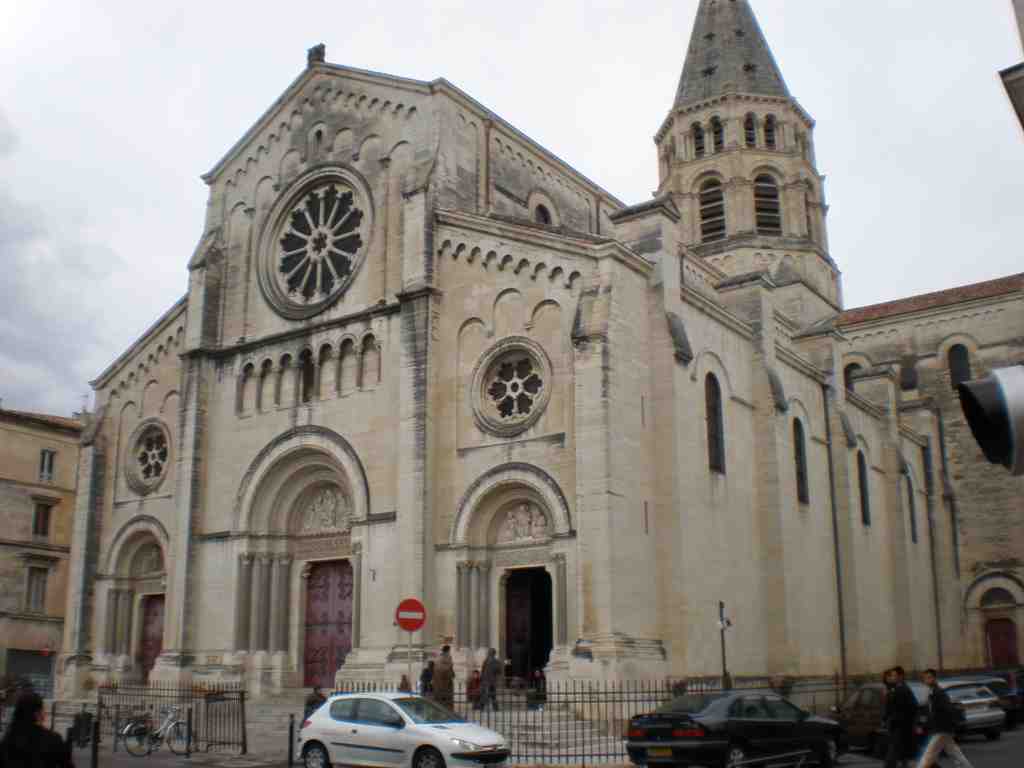
To spot St. Paul's Church, look straight ahead for a grand, cream-colored stone building with round arches, three large red doors, and a towering spire rising high into the sky. Now, take a breath and imagine the year is 1849-the streets are filled with the clatter of horse hooves as Charles-Auguste Questel, the architect, unveils his brand-new masterpiece in Nîmes: St. Paul’s Church, a neo-Romanesque wonder. The bell tower soars to 62 meters above you, making even the bravest pigeons reconsider their flight path! These heavy doors aren't just doors; in 1845, famed ironworker Pierre Boulanger crafted their intricate hinges and locks, the same man behind the legendary doors of Notre-Dame in Paris. If you could step inside, you’d find delicate painted friezes and murals by Hippolyte Flandrin-though today, these treasures are sadly a bit faded, as if the walls themselves have gotten shy over the years. Look up and picture sunlight glowing through stained glass windows by Laurent Charles Maréchal, coloring the pews in dazzling reds and blues. And back in 1848, you’d hear the mighty organ crafted by Aristide Cavaillé-Coll filling every corner with music. Oh, and for a touch of modern fame, St. Paul’s Church once set the scene for the wedding of Yves Mourousi in 1985, causing quite the media circus-imagine trying to get a selfie back then! So, as you stand here, let the echoes of past ceremonies, artistic hands, and grand celebrations surround you.
Open dedicated page →To spot the Square House, or Maison Carrée, look straight ahead for a stunning, creamy stone rectangle rising above the square on a high podium, ringed with tall Corinthian…Read moreShow less
To spot the Square House, or Maison Carrée, look straight ahead for a stunning, creamy stone rectangle rising above the square on a high podium, ringed with tall Corinthian columns and fronted by an impressive staircase. Welcome to one of the world's best-preserved Roman temples-though if you’d asked a Frenchman in the 16th century, they’d have said it was a “square house.” Bit of a misnomer, considering it’s clearly a rectangle! Back in those days, anything with four right angles, even a long rectangle, was simply called “square.” So here it stands, Maison Carrée, a name that stuck through the ages despite its true shape-now that’s what I call a lasting identity crisis. Travel back with me to the dawn of the 1st century AD, when Roman Nîmes was alive with the clang of hammers and the shouts of builders. This temple was a gift to the city from Emperor Augustus, who dedicated it to the glory (and memory) of his two grandsons, Lucius and Gaius Caesar, his chosen heirs and the young stars of the imperial family. Imagine the scene-priests in flowing robes climbing that grand staircase, a hush falling as a sharp Roman trumpet sounds, and crowds gathering to catch a glimpse of statues and sacred ceremonies held on the forum, just outside these mighty columns. The Maison Carrée was the beating heart of the Roman forum, an embodiment of imperial power and the promise of “Pax Romana”-two centuries of hard-earned peace. Built between 10 BCE and 4 CE, its design followed the grandest tastes of Rome: the harmony of thirty Corinthian columns (each rising a dizzying nine meters high), floral friezes bursting with acanthus leaves, and a soaring portico inspired by the Temple of Apollo itself. The inner sanctuary, or “cella,” once guarded statues of Lucius and Gaius, but only priests could set foot inside. Ordinary folks peeked in awe from the steps, while all around, ceremonies and festivals echoed through the square. But history had different plans in store. As centuries marched on and cracks appeared in Rome’s mighty empire, new owners arrived. In the Middle Ages, the temple was reimagined as a council house-essentially City Hall for Nîmes’ local rulers. The ancient stone walls echoed with heated debate, paperwork rustling and councilors walking in clacking boots. Later, it even became a charming-albeit unorthodox-family home, then a stable (imagine Roman columns brushing horse manes), and finally an Augustinian church, echoing with the sound of hymns where prayers to Roman emperors once rose. The Revolution rolled into town, tossing out kings and priests alike. Suddenly, the Maison Carrée found itself a prefecture, then a gathering place for political meetings. Each new regime left its mark, installing staircases, windows, and walls-thankfully, the ancient structure refused to give in, still standing when so many Roman wonders crumbled away. In the 19th century, local citizens joined forces (and wallets!) to restore it. As a reward for all its endurance, the Maison Carrée even hosted a cabinet of ancient treasures and curiosities, dazzling the city anew. Modern architects tipped their hats to the past too. In the late ‘90s, Norman Foster built the elegant Carré d’Art on the opposite side of the square, a sleek glass twin for the temple’s stone grandeur, uniting old and new in one beautiful embrace. And finally, in September 2023, after more than 2,000 years of drama, disaster, restoration and revival, the temple won its crown jewel-UNESCO World Heritage recognition. Now, as you stand on a warm evening under the glow of streetlamps, gaze at the temple’s white limestone façade, see the light and shadow play across its intricate friezes, and imagine every footstep that’s echoed on these stones since the time of Augustus. Inside, the walls keep their secrets-lost decorations, vanished bronze inscriptions, the stories of emperors and families, of devotion, power, ruin, and rebirth. Even though the inner grandeur is gone, the Maison Carrée remains a monument to memory itself: resilient, mysterious, and occasionally, just a little confused about its own shape. But hey, who among us isn’t?
Open dedicated page →Just ahead of you, you’ll spot an elegant stone terrace surrounded by sculpted marble vases and statues, flanked by balustrades, with lush trees rising behind-look for the grand…Read moreShow less
Just ahead of you, you’ll spot an elegant stone terrace surrounded by sculpted marble vases and statues, flanked by balustrades, with lush trees rising behind-look for the grand staircases and ornate fountains at the center, and you’ll know you’ve found the Gardens of La Fontaine. Now, take a moment to soak in the view, because you’re standing at the entrance of one of Europe’s very first public parks! Picture this: more than two thousand years ago, right beneath your feet, an ancient spring bubbled up from deep inside the earth. Before Romans ever dreamed of togas or amphitheaters, Iron Age tribes gathered right here, treating the spring almost like magic-imagine the hiss of water echoing out from hidden caves in the hillside, a mysterious and vital lifeline. When the Romans arrived, they wasted no time turning this spot into the heart of their new city, and the bustling neighborhood around you started to grow up centuries before gladiators strutted into the arena. Their most ambitious trick? Building a massive, sacred complex called the “Augusteum” right on top of the spring. The Romans were nothing if not dramatic in their architecture-temples, courtyards, statues, all perfectly placed to channel the life-giving waters in style. Of those grand monuments, the Temple of Diana and the mighty Tour Magne still stand nearby, a little older, a little wiser, but still impressive. Fast forward to the Middle Ages and beyond, and the spring was both a blessing and a battleground. Imagine feisty Nîmes residents arguing over their right to the water-millers building their mills, washerwomen scrubbing laundry in the main fountain basin, and city officials tearing their hair out over water shortages! In fact, in the 1600s, things got so splashy that the town had to post a guard just to stop people from turning the fountain into a giant medieval laundromat. You could say things got a bit “soaked and stirred” around here. Now, picture a crowd gathering for fireworks in 1701, when two royal grandsons of King Louis XIV visited Nîmes. The barrels of powder and bursts of color in the night sky must have been dazzling-until, oops, someone’s house caught fire from a stray rocket! Never a dull moment at the Fontaine. As the centuries rolled on, drought struck, wells dried up, and everyone from merchants to mathematicians wracked their brains to fix the city’s water woes. Ingenious engineers dreamed up plans for new canals, with one even proposing they gather all the water in a giant stone channel nearly a meter wide-imagine the splashy debates! But it was in the 1700s that the site was destined to become a masterpiece of landscape design. When workers started digging to expand and beautify the gardens, their shovels hit Roman ruins at every turn-grand arches, ancient porticoes, forgotten theaters buried in the earth. The excitement must have buzzed through the city like a modern treasure hunt. And so, from 1745 to 1755, under the expert eye of engineer Jacques Philippe Mareschal, these stately French gardens took shape. He knew that beauty and utility could work together: sculpted staircases, elegant terraces, clever canals, and a burst of Mediterranean trees-pines, chestnuts, plane trees, cedars-woven among statues and the rich history beneath your feet. Look around and you’ll spot those enormous marble vases and proud statues, their stories starting elsewhere but brought here in the 1700s from a château near Montpellier. Don’t forget the rustle of tree branches overhead, the gentle croak of frogs, the gurgle of water over stone. Modern visitors may take it all for granted, but each sound and sight is an echo of ages past. Today, the Gardens of La Fontaine are not just beautiful; they are officially a “remarkable garden” of France, watched over by history and open to everyone-no fancy ticket required. The grand iron gates with golden crests welcome you every day, just as they have visitors for centuries, so take a stroll, snap a selfie, and let your imagination flow as freely as the spring itself.
Open dedicated page →
Frequently asked questions
How do I start the tour?
After purchase, download the AudaTours app and enter your redemption code. The tour will be ready to start immediately - just tap play and follow the GPS-guided route.
Do I need internet during the tour?
No! Download the tour before you start and enjoy it fully offline. Only the chat feature requires internet. We recommend downloading on WiFi to save mobile data.
Is this a guided group tour?
No - this is a self-guided audio tour. You explore independently at your own pace, with audio narration playing through your phone. No tour guide, no group, no schedule.
How long does the tour take?
Most tours take 60–90 minutes to complete, but you control the pace entirely. Pause, skip stops, or take breaks whenever you want.
What if I can't finish the tour today?
No problem! Tours have lifetime access. Pause and resume whenever you like - tomorrow, next week, or next year. Your progress is saved.
What languages are available?
All tours are available in 50+ languages. Select your preferred language when redeeming your code. Note: language cannot be changed after tour generation.
Where do I access the tour after purchase?
Download the free AudaTours app from the App Store or Google Play. Enter your redemption code (sent via email) and the tour will appear in your library, ready to download and start.
If you don't enjoy the tour, we'll refund your purchase. Contact us at [email protected]
Checkout securely with