
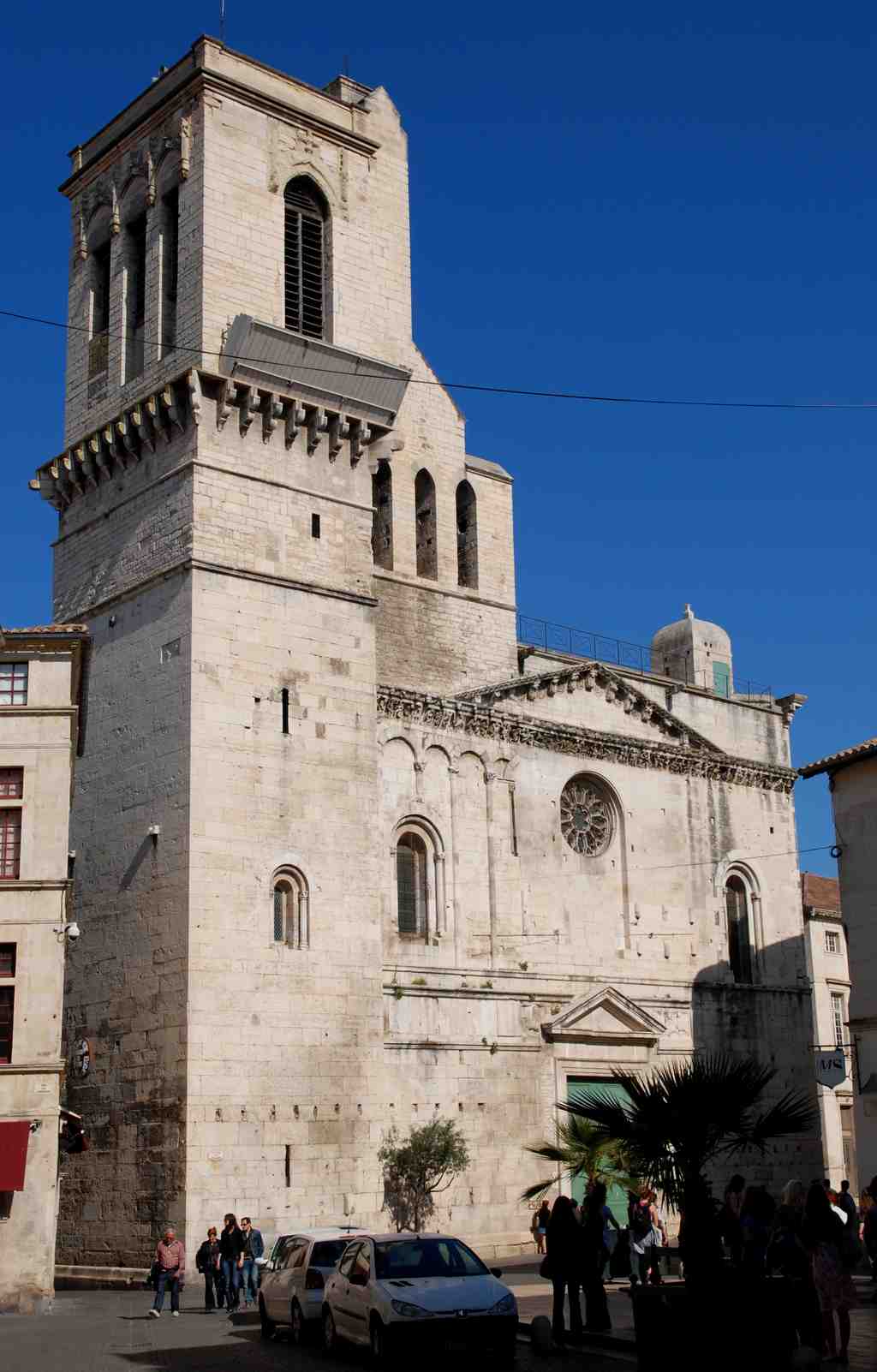
To spot the Notre-Dame-et-Saint-Castor Cathedral of Nîmes, just look for the tall, pale stone tower with arched windows rising above the square and the church’s sturdy, rectangular body topped with a triangular pediment and a large rose window right above the entrance.
You’re standing right at the heart of history, and maybe-just maybe-if you listen closely you’ll hear the echoes of more than a thousand years packed into these ancient stones! This is the Notre-Dame-et-Saint-Castor Cathedral, and its tale is one of survival, transformation, and, dare I say, a pinch of medieval drama.
Let’s wind the clock back. Once upon a time, long before the cathedral was here, people thought it had been built on some mysterious Roman monument, thanks to the recycled Roman columns and stone blocks scattered around. But a dig in 1920 revealed an even older surprise: beneath your feet, the remains of a church from the 7th century, once used constantly as a burial place-imagine the hush and the solemn footsteps of mourners passing through, year after year. Over time, more churches sprang up here. Imagine a bustling complex: chapels, an open atrium, and later even a cloister, with the scent of incense and the low murmur of chanting clergy. Some fragments from these times now rest quietly in the city’s archaeological museum.
A leap forward, and we’re in the age of the Romans-well, at least their recycled stones are! In 1096, Pope Urban II himself consecrated the Romanesque church rising on these ancient layers. At first glance, the cathedral’s walls might look plain, but look closer! Along the façade, you see a row of little arches and, to the left, a series of stone carvings from the Old Testament-like a medieval comic strip for believers who couldn’t read. It’s said the original bells once rang out from a wall right above you.
But life wasn’t always peaceful. Two major attacks during the Wars of Religion nearly brought the cathedral to ruins. In 1567 and again in 1621, Reformers stormed through, causing so much destruction that one of its grand towers, once taller than even the famous tower of Uzès, was lost forever. Only the northwest tower survived, standing guard like a stone-silent sentinel and, believe it or not, serving as an observation post.
After such turmoil, the seventeenth century brought a breath of fresh, classical air. Under Bishop Cohon, the cathedral was rebuilt in a style more graceful: one grand, vaulted nave with side chapels, where sunlight dances on baroque details. The most dazzling spot is the Chapel of the Rosary, topped with a little lantern; it was magnificently restored just a decade or so ago.
Skip ahead to the 19th century and, well, some people thought the old Romanesque doorway was too tiny for visiting royalty-so, in 1822, it was demolished for the grander, neoclassical entrance you see today, just so a princess’s fancy canopy could fit through! Priorities, right?
In the late 1800s, architect Henri Antoine Révoil went wild inside, draping the interior in a blend of Romanesque and Byzantine styles. He didn’t get to touch the weathered, noble façade, though-you can almost hear the architects bickering about style behind closed doors.
Now, if you listen carefully, you might even hear the deep, warm sound of the cathedral’s mighty organ, whose pipes date back to the seventeenth century. Over centuries, it’s been rebuilt many times, and its beautifully carved wooden case is itself protected as a national treasure. The current organ, finished in 1983, has four manuals, 51 stops, and the power to shake the floor during a concert-or let loose a blast on the brilliant trumpet stop!
Imagine the clamor as nine bells ring from the soaring northwest tower, some still in service, each carrying their voice across the old city rooftops.
So as you stand here, picture all those centuries-the prayers, processions, quarrels, and celebrations, all wrapped up in stone and tradition-and know you’re standing in a place where yesterday still whispers, if you care to listen.
Interested in a deeper dive into the historical, description or the the organ? Join me in the chat section for an insightful conversation.




