
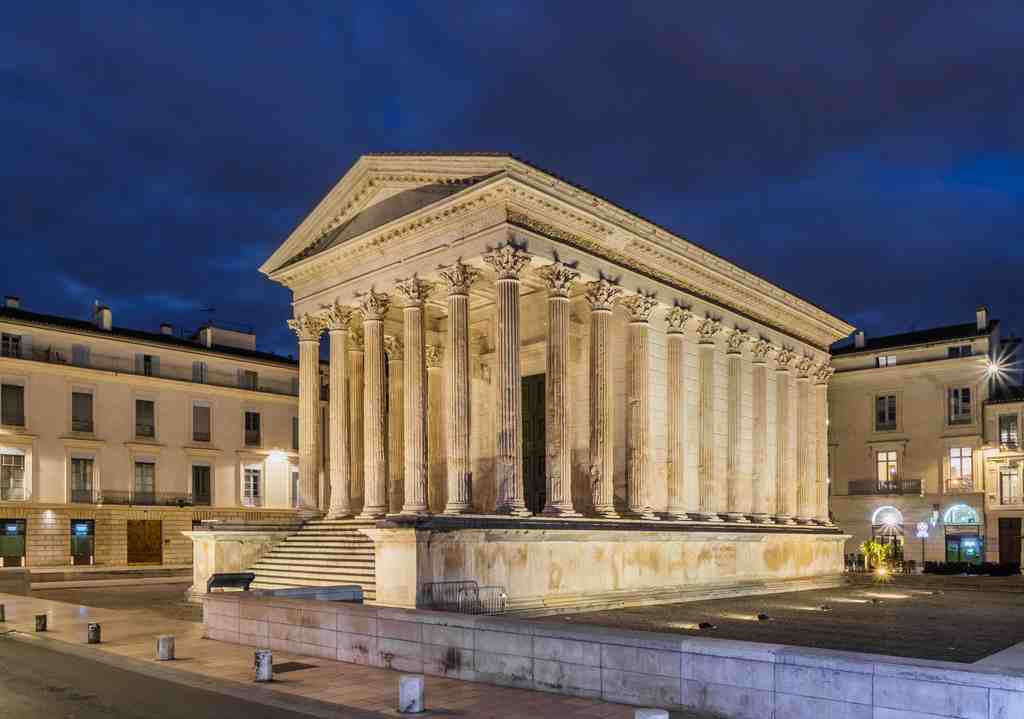
To spot the Square House, or Maison Carrée, look straight ahead for a stunning, creamy stone rectangle rising above the square on a high podium, ringed with tall Corinthian columns and fronted by an impressive staircase.
Welcome to one of the world's best-preserved Roman temples-though if you’d asked a Frenchman in the 16th century, they’d have said it was a “square house.” Bit of a misnomer, considering it’s clearly a rectangle! Back in those days, anything with four right angles, even a long rectangle, was simply called “square.” So here it stands, Maison Carrée, a name that stuck through the ages despite its true shape-now that’s what I call a lasting identity crisis.
Travel back with me to the dawn of the 1st century AD, when Roman Nîmes was alive with the clang of hammers and the shouts of builders. This temple was a gift to the city from Emperor Augustus, who dedicated it to the glory (and memory) of his two grandsons, Lucius and Gaius Caesar, his chosen heirs and the young stars of the imperial family. Imagine the scene-priests in flowing robes climbing that grand staircase, a hush falling as a sharp Roman trumpet sounds, and crowds gathering to catch a glimpse of statues and sacred ceremonies held on the forum, just outside these mighty columns.
The Maison Carrée was the beating heart of the Roman forum, an embodiment of imperial power and the promise of “Pax Romana”-two centuries of hard-earned peace. Built between 10 BCE and 4 CE, its design followed the grandest tastes of Rome: the harmony of thirty Corinthian columns (each rising a dizzying nine meters high), floral friezes bursting with acanthus leaves, and a soaring portico inspired by the Temple of Apollo itself. The inner sanctuary, or “cella,” once guarded statues of Lucius and Gaius, but only priests could set foot inside. Ordinary folks peeked in awe from the steps, while all around, ceremonies and festivals echoed through the square.
But history had different plans in store. As centuries marched on and cracks appeared in Rome’s mighty empire, new owners arrived. In the Middle Ages, the temple was reimagined as a council house-essentially City Hall for Nîmes’ local rulers. The ancient stone walls echoed with heated debate, paperwork rustling and councilors walking in clacking boots. Later, it even became a charming-albeit unorthodox-family home, then a stable (imagine Roman columns brushing horse manes), and finally an Augustinian church, echoing with the sound of hymns where prayers to Roman emperors once rose.
The Revolution rolled into town, tossing out kings and priests alike. Suddenly, the Maison Carrée found itself a prefecture, then a gathering place for political meetings. Each new regime left its mark, installing staircases, windows, and walls-thankfully, the ancient structure refused to give in, still standing when so many Roman wonders crumbled away. In the 19th century, local citizens joined forces (and wallets!) to restore it. As a reward for all its endurance, the Maison Carrée even hosted a cabinet of ancient treasures and curiosities, dazzling the city anew.
Modern architects tipped their hats to the past too. In the late ‘90s, Norman Foster built the elegant Carré d’Art on the opposite side of the square, a sleek glass twin for the temple’s stone grandeur, uniting old and new in one beautiful embrace.
And finally, in September 2023, after more than 2,000 years of drama, disaster, restoration and revival, the temple won its crown jewel-UNESCO World Heritage recognition. Now, as you stand on a warm evening under the glow of streetlamps, gaze at the temple’s white limestone façade, see the light and shadow play across its intricate friezes, and imagine every footstep that’s echoed on these stones since the time of Augustus.
Inside, the walls keep their secrets-lost decorations, vanished bronze inscriptions, the stories of emperors and families, of devotion, power, ruin, and rebirth. Even though the inner grandeur is gone, the Maison Carrée remains a monument to memory itself: resilient, mysterious, and occasionally, just a little confused about its own shape. But hey, who among us isn’t?




