
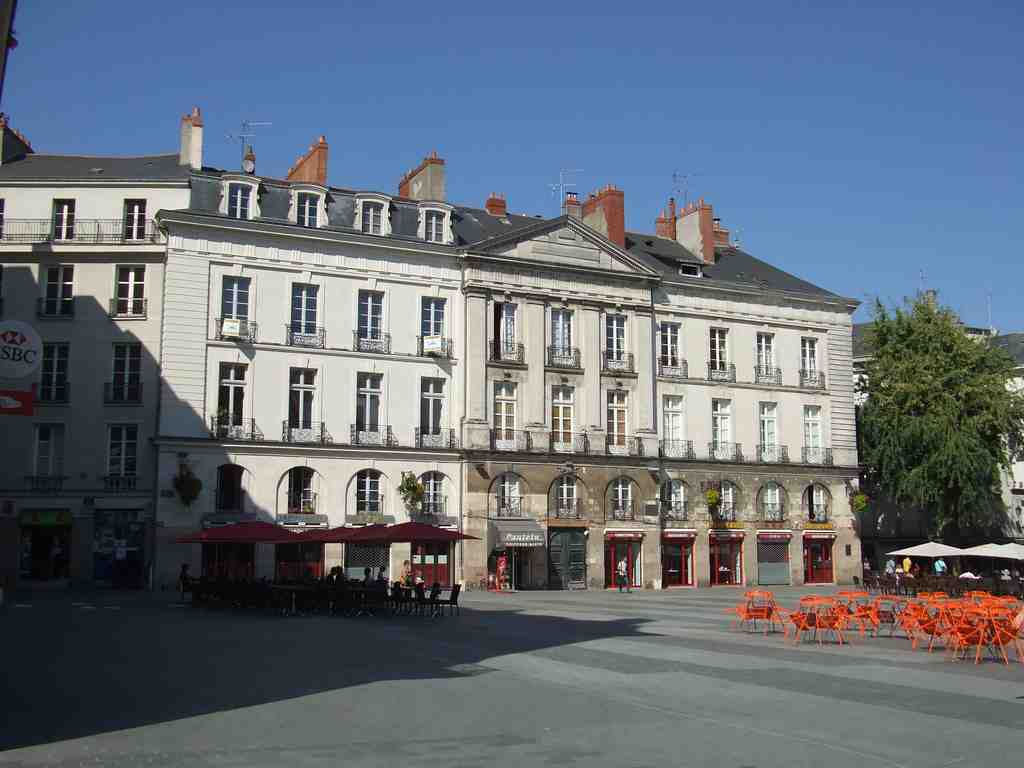
This is a broad paved square, almost rectangular, framed by pale stone facades with neat rows of windows and dark slate roofs, a calm classical shell around a much older center.
The memory of the Château du Bouffay still holds this place together. The fortress once stood on the west side, and this square began as its court. Even after the dukes raised their newer castle, the old Bouffay kept its grip on Nantes through law, prison, and city government, so its disappearance hides just how much power once radiated from right here.
By the Middle Ages, this was the city’s main square. The south side leaned against the old medieval wall above the Loire, and people reached the river by a quay where the allée de la Tremperie lies now. In fifteen fifty-two, the old château became a presidial, a royal court: prisoners waited on the ground floor, judges sat above, and small shops traded under the staircase that opened onto the square. Justice, punishment, and everyday buying and selling all shared one address.
Standing in a lively square like this, what happens to a city when the center of life is not a church or a market alone, but a fortress yard turned public stage?
That stage could turn brutal. Here, executions took place until the Revolution. In sixteen twenty-six, Henri de Talleyrand-Périgord died here by beheading. In seventeen twenty, the crown made an example of four Breton noblemen linked to the Pontcallec conspiracy: Pontcallec, Montlouis, Talhouet, and du Couëdic. Their deaths warned Brittany’s nobility that royal power could reach the very heart of Nantes. Then, during the Revolution, the guillotine stood here almost continuously from March of seventeen ninety-three to September of seventeen ninety-four.
And still, life pressed in. A major fire scarred the square in the early seventeen twenties. Market traffic clogged the approaches long before automobiles; by seventeen twenty-five, city officials were already complaining that wine, brandy, hay, straw, horses, and pedestrians jammed the route to Bouffay.
One child here would grow into a healer. At number five, René Laennec lived from seventeen eighty-eight to seventeen ninety-three. The boy who later invented the stethoscope spent part of his childhood in a square where verdicts, commerce, fear, and argument all met face to face.
The facades you see now came later. Jean-Baptiste Ceineray redrew the place in the eighteen hundreds’ approach, clearing crooked buildings and imposing the elegant order around you. The old castle finally vanished in the nineteenth century, and its civic bell tower did not die with it; workers moved it to Sainte-Croix in eighteen sixty, a reminder that Nantes often keeps memory by moving it. Like the vanished Collégiale Notre-Dame, this old center survives more in traces than in stone.
If Bouffay was the political heart, the port was the bloodstream. Walk on to Allée du Port-Maillard, where that pulse reached the river.




