
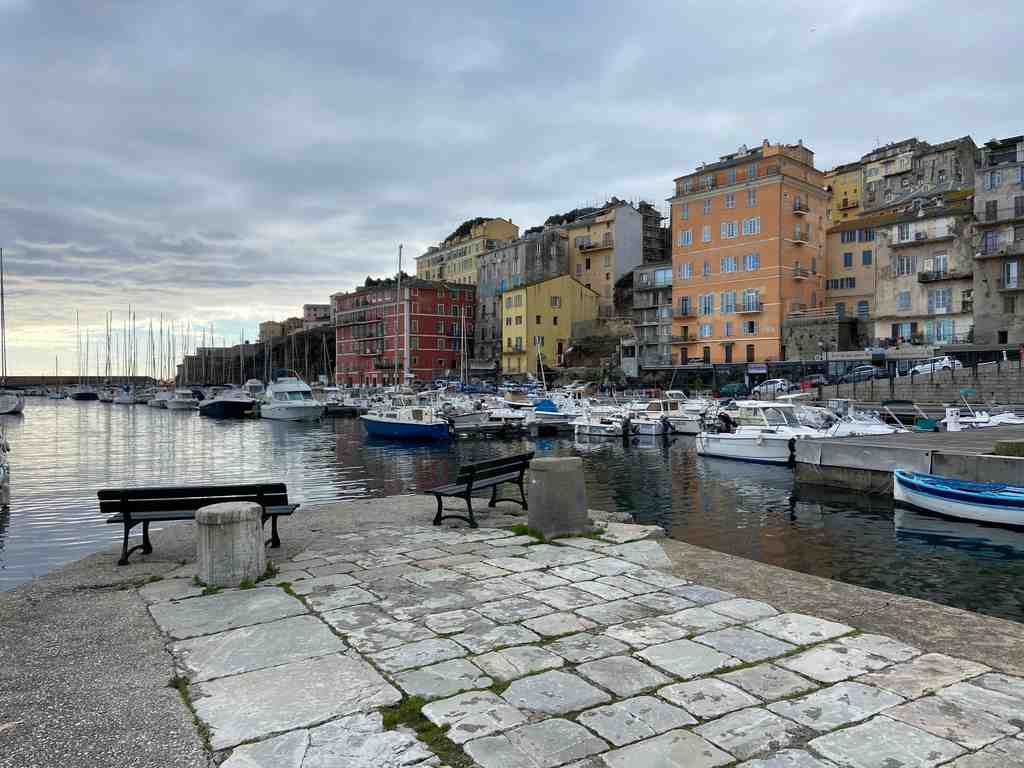
Look for a tight cluster of tall stone-and-plaster houses packed into a wedge of narrow lanes, with the sweeping Romieu staircase as its unmistakable marker.
This is U Puntettu, the “little bridge,” a name borrowed from a small bridge that once crossed the Guadellu River before the waterway was channelled into the Old Port. The quarter sits in a narrow seam between the harbour and the Citadel, and that position explains everything about it. When the Genoese secured Terra Nova, the fortified upper town, in the fourteenth century, the lower district of Terra Vechja grew below it, and U Puntettu became one of its most intimate pieces.
No one can say exactly when the first houses appeared here, which only adds to its quiet allure. What we do know is that wealthy Bastia families left their mark. The imposing Palazzu Rinesi-Romieu rose here in the nineteenth century for the Rinesi, an important merchant family; later, a Rinesi daughter married Romieu, a master cutler from Langres, and the name changed with the marriage. Nearby stood the Casa Montesoro, another merchant family residence, and the Casa Bonavita, linked to descendants of Joseph Bonavita, who became a general under Louis the Fifteenth.
Then there is the Romieu staircase itself, designed in the nineteenth century by the Bastia architect Paul-Augustin Viale. Its ramp, stairway, and garden gained historic monument protection in two thousand and seventeen. Writers noticed this quarter too: Sebastianu Dalzeto made U Puntettu famous in Pesciu Anguilla, the first novel ever written in the Corsican language.
Small in scale, U Puntettu carries an astonishing weight of memory.
When you are ready, continue upward toward the Governors’ Palace, where Bastia’s story grows even more commanding.




