
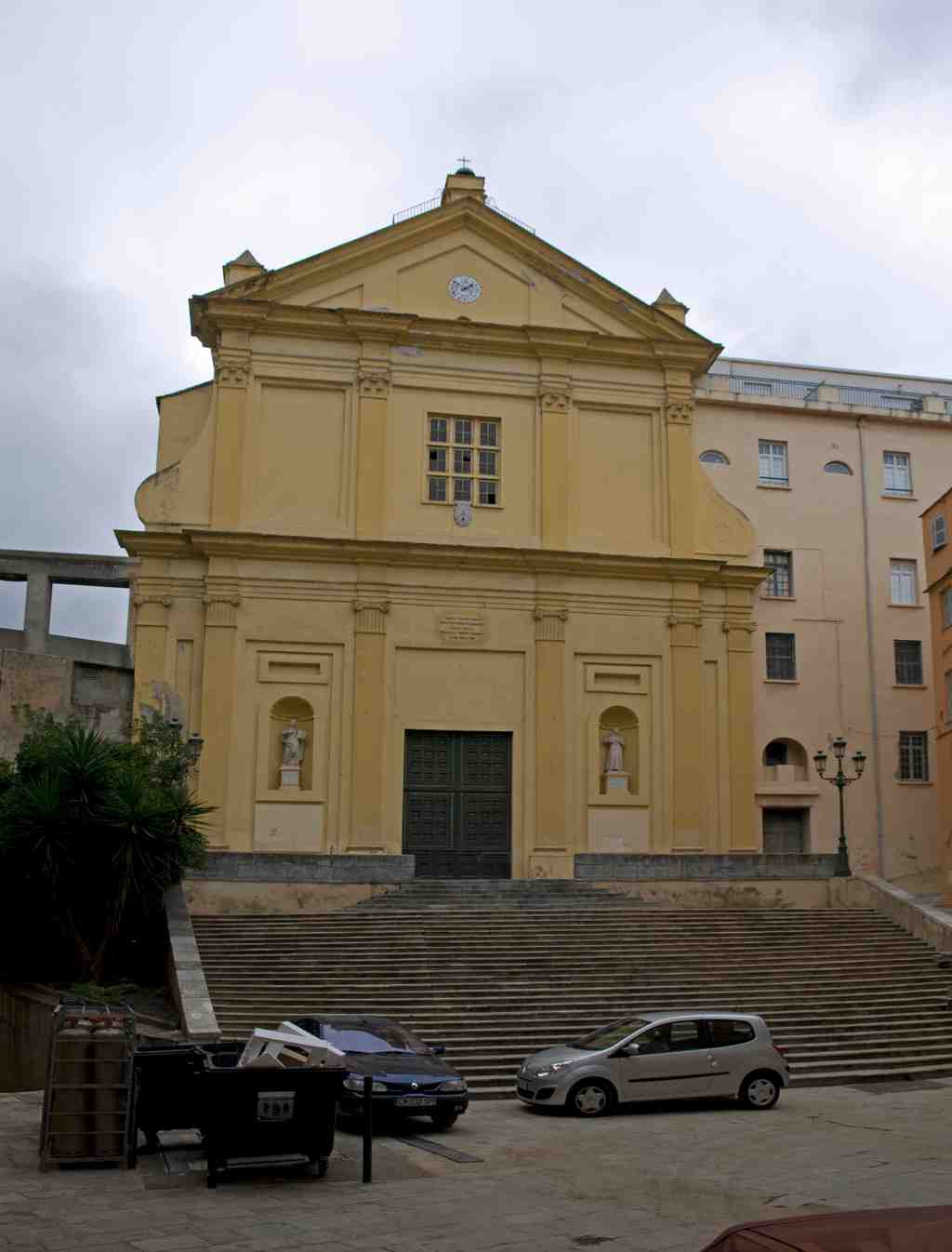
Ahead of you rises a pale stone Baroque façade in two stacked tiers, set above a broad monumental stair and crowned by a triangular pediment with great curling volutes.
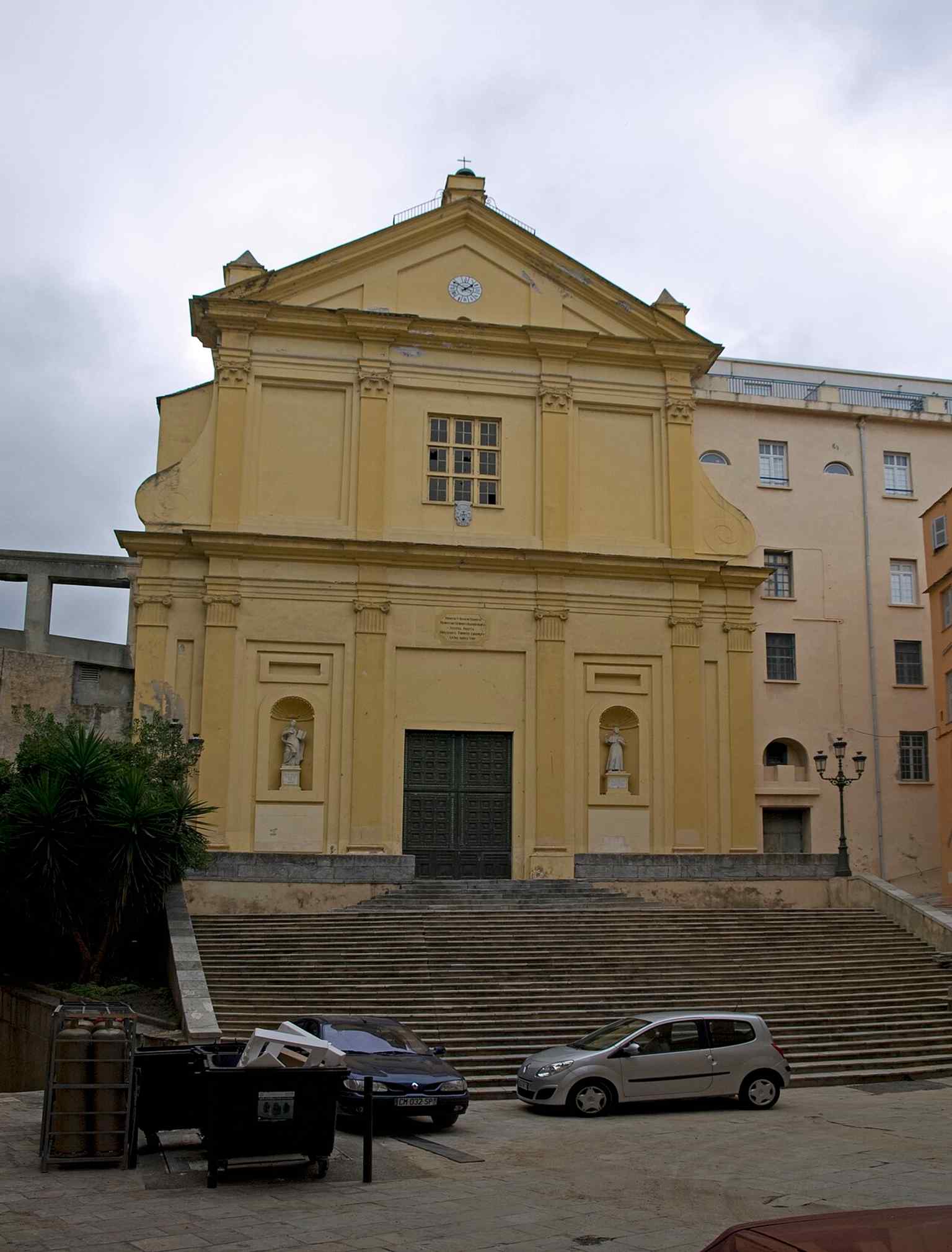
This is San Carlu, the Church of Saint-Charles-Borromée, and in Bastia it carries a quiet distinction: many consider it the first Baroque church in all Corsica. Its face follows the Jesuit style made famous by the Church of the Gesù in Rome. Notice the strong vertical pilasters, the narrower upper level, and, beside the entrance, the statues of Saint Francis Xavier and Saint Ignatius of Loyola. If you want to take in the full composition, have a glance at the image on your screen. The story begins with the Jesuits, the Society of Jesus, founded by Ignatius of Loyola in fifteen forty. He wanted priests who could teach as well as preach, so he insisted on a long education, ten years of study, before they were fully formed. In fifteen fifty-two and fifteen fifty-three, he sent two Jesuits to Bastia, Father Silvestro Landini and Father Emanuel Gomes. They came to spread the faith, certainly, but also to educate poorer families. By sixteen oh one, the first lessons had begun near this very site.
Then the place grew into a full Jesuit complex. Builders started the college and church in sixteen twelve and finished in sixteen thirty-five. At first, the church honoured Saint Ignatius himself. The adjoining college never lost its educational purpose; today it survives as the Simon Vinciguerra school, often described as one of the oldest colleges in Corsica.
Its name changed because politics changed. After the Jesuits were expelled in seventeen sixty-nine, the building passed to the confraternity of San Carlu, a religious brotherhood, and the church took the name of Saint Charles Borromeo. Inside, the seventeenth-century stucco decoration still survives. There is even a deliciously telling detail: a ceiling medallion once showed Saint Ignatius in black, but after the Jesuits were forced out, the confraternity altered the clothing so the figure could pass as Saint Charles instead.
This church has also heard the harder sounds of history. In eighteen fourteen, enemies of Napoleon gathered here under Frédien Vidau and Salvatore Viale. A Committee of Public Safety met inside and proclaimed Corsica’s break with France, calling for the return of the Anglo-Corsican kingdom. Later, in nineteen seventy-one, the church opened another chapter: the first Mass in the Corsican language was celebrated here, sung in paghjella, the island’s rich traditional polyphonic chant.
If you hope to go inside, the church is usually open only on Sunday mornings, from nine until noon. San Carlu keeps Bastia’s faith, learning, and rebellion folded into one splendid façade. When you are ready, continue on toward U Puntettu, where the city opens itself in another way.





