
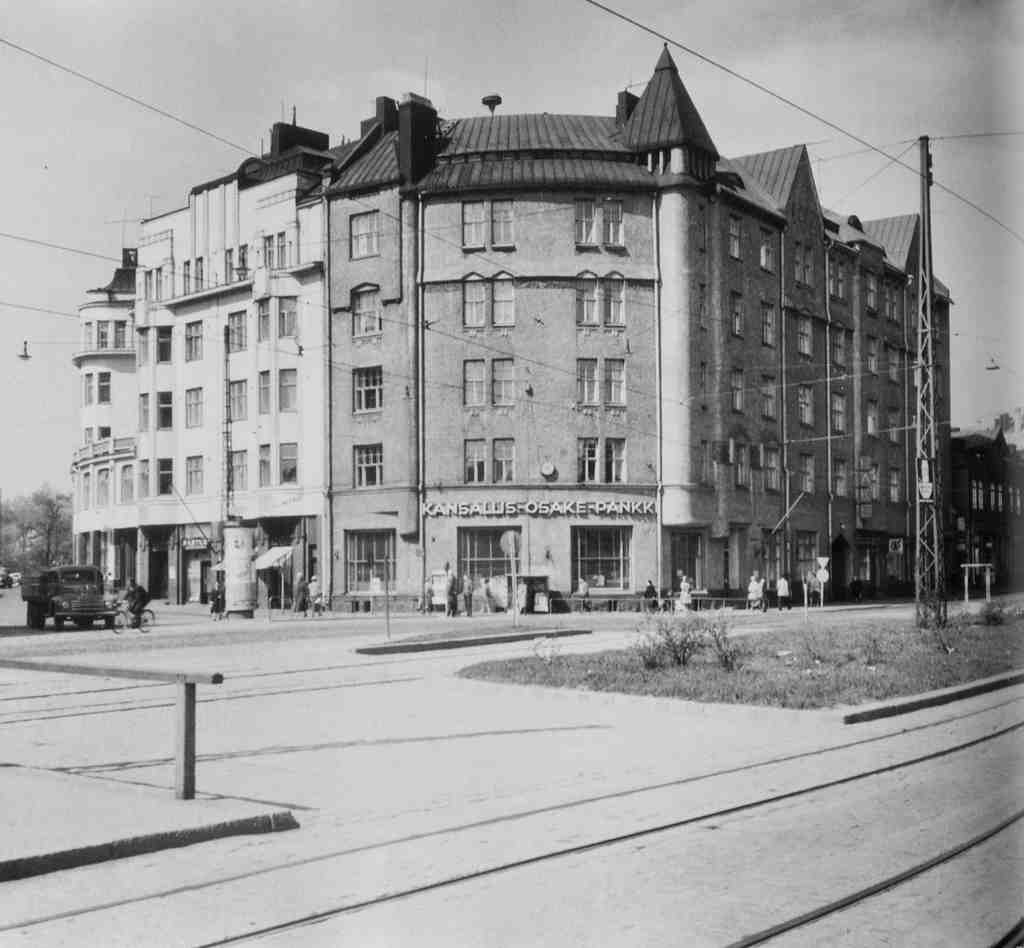
In old photographs, Wendt House appears as a hefty pale stone corner block, tall and rectangular, with long rows of windows and a dark, steep roofline.
Gustaf Estlander drew this house in nineteen oh three. He was an intriguing man: a sought-after Art Nouveau architect, a European speed-skating champion in eighteen ninety-three, and later one of the world’s great yacht designers. Here, though, his hand produced not elegance at sea but a solid urban stronghold.
Its name came from Carl von Wendt, the building manager, and that is where the story turns cold. He and his brother Georg lived here with their families and servants, a pocket of wealth set inside a workers’ district beyond Pitkäsilta. From these windows, the market square and the labour movement’s strongholds lay almost at hand. Yet Carl von Wendt later became one of the darkest figures in Helsinki’s memory. After the civil war of nineteen eighteen, he served as civilian commandant at the Suomenlinna prison camp. Prisoners remembered him for extreme cruelty: executions without trial, and food parcels refused to starving inmates.
That is the unsettling truth of this corner. Class did not live far apart here; it lived face to face. How should a city carry a name like Wendt’s when the building recalls privilege, but the man himself disturbs any easy pride?
In the early nineteen sixties, Kansallis-Osake-Pankki bought the whole block, cleared away the old houses, and prepared the ground for a sleeker future. In a moment, we meet that future at Ympyrätalo.




