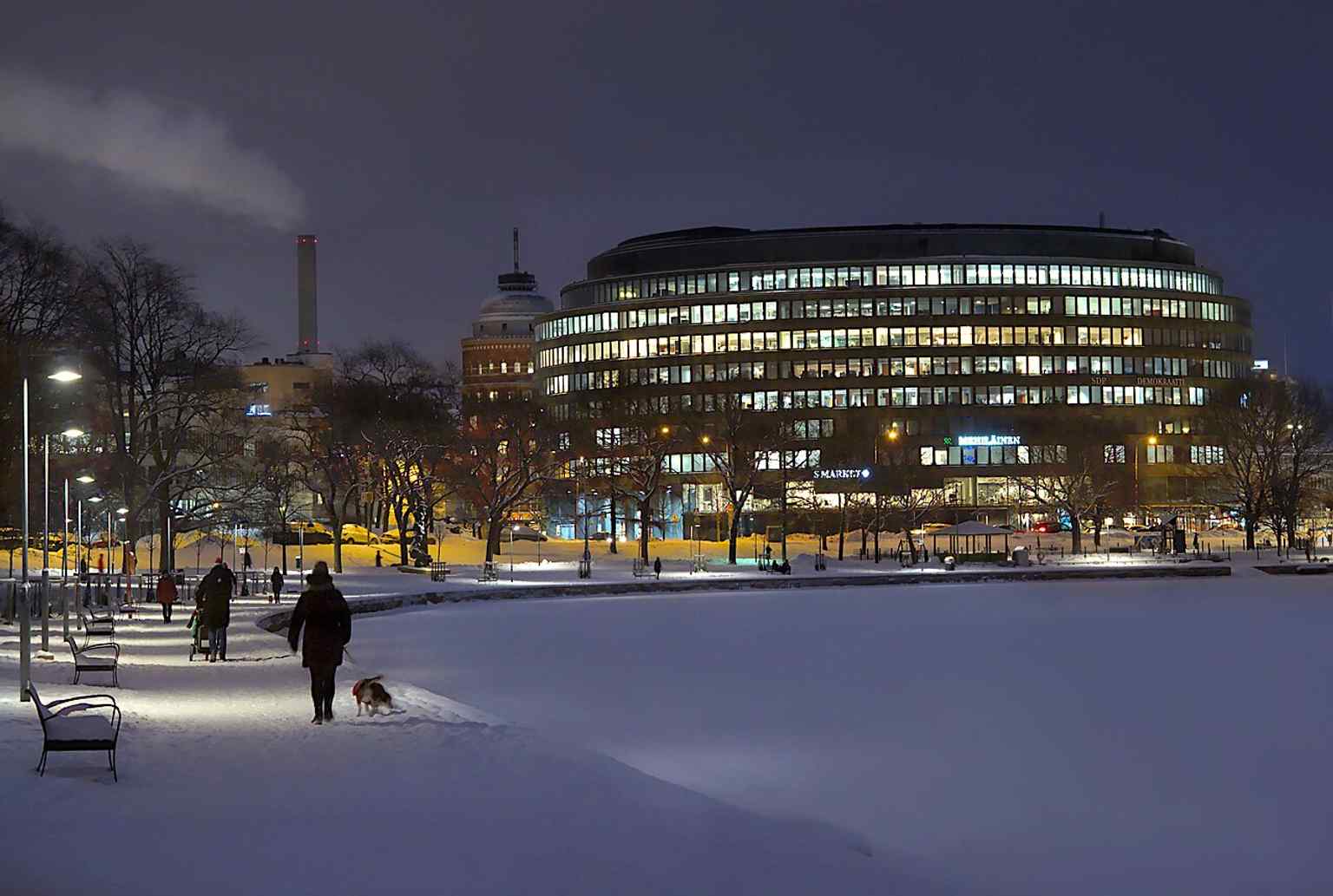
On your right, look for a pale concrete cylinder wrapped in dark horizontal window bands, a drum-shaped building that fills the whole block with one unbroken curve.
This is Ympyrätalo, the Circle House: modernist confidence made visible. Heikki and Kaija Siren drew it as a bold answer to a newly mobile Helsinki, a city learning to admire speed, clarity, and buildings that could be recognised in an instant.
Yet the curve stands on a place that once looked nothing like this. In nineteen oh seven, the photographer Signe Brander pointed her camera across the old shoreline and caught a scatter of wooden houses and a few stone buildings here, with open water still shaping the view. One of those lost houses was Wendt House, which we met moments ago. That is the quiet trick of Hakaniemi: it reinvents itself, but never quite severs the thread.
The bank Kansallis-Osake-Pankki opened this building in nineteen sixty-eight as its headquarters, and even the ground around it tried to anticipate the future. Those little kiosks outside were not just kiosks. They formed Finland’s largest drive-in bank, built for motorists who could bank without leaving the car. It sounded almost science fiction; demand faded within a few years, and the idea slipped into local memory like a stylish experiment.
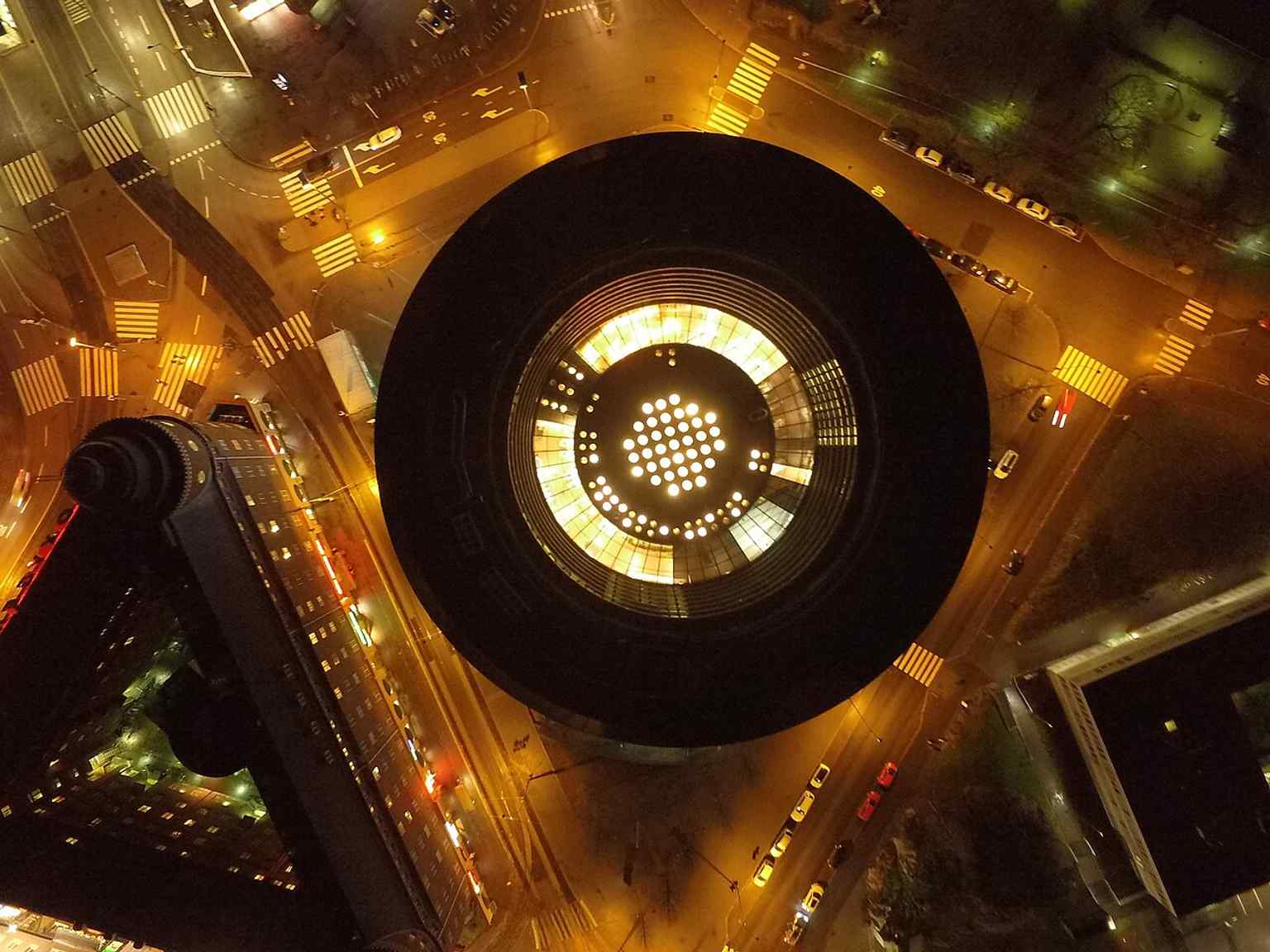
If you glance at the image on your screen, the aerial view reveals another secret: from the street, Ympyrätalo can seem oddly compact, but its volume is actually greater than Parliament House. That sleight of hand is part of its charm.
The Siren family left more than one signature here. By the main entrance stands Hannu Siren’s steel sphere, Symboli, and during the major renovation from two thousand and two to two thousand and four, the architects included Jukka Siren, son of the original designers. Most of the interior changed; one office suite kept its nineteen sixties character at the city museum’s request, like a single preserved note in a rewritten score.
Carry that appetite for bold urban image with you now. In a few minutes, Arena House takes that confidence and turns it outward, into signage, commerce, and the theatre of the street.