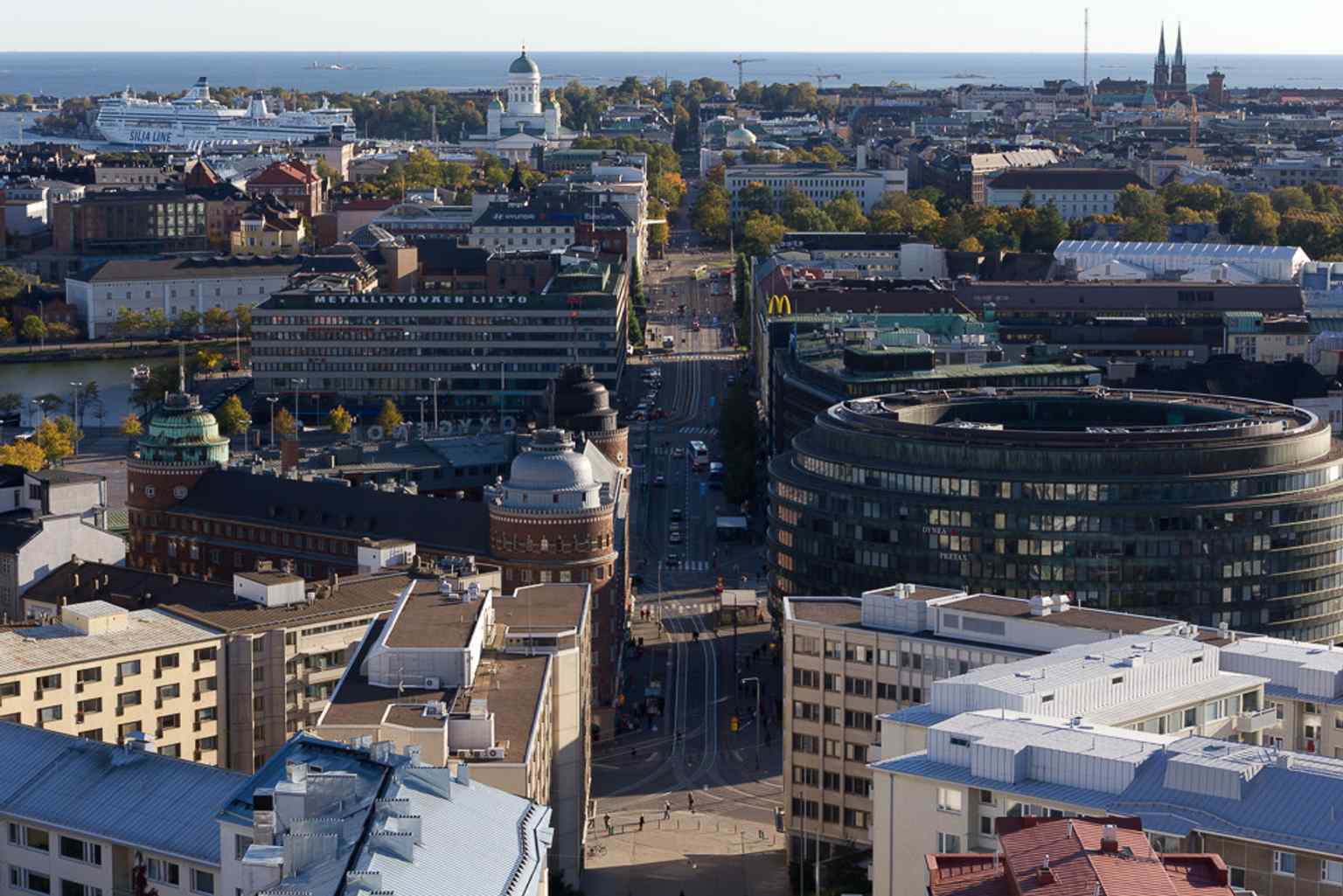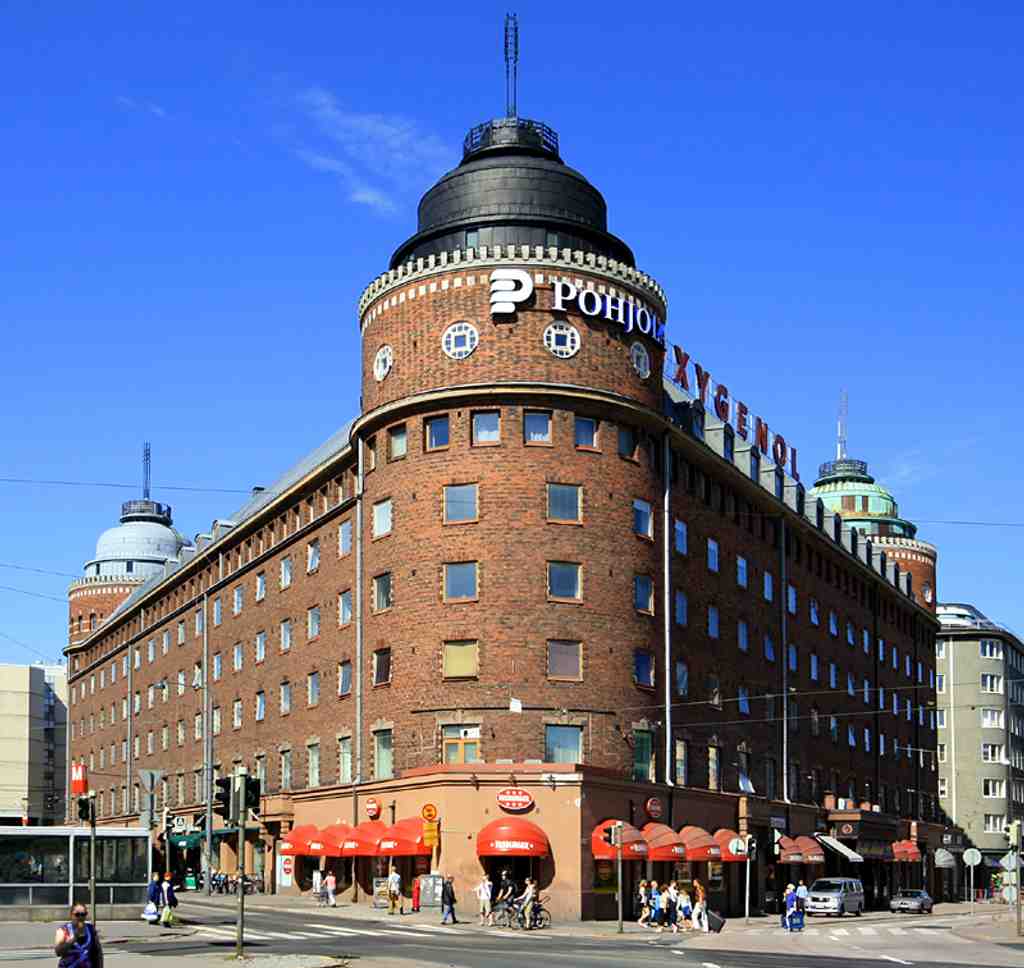
On your right stands a red-brick wedge of a building, wrapping a triangular block with sharp street-facing corners and a towered edge, all crowned by the famous Oxygenol rooftop sign.
Arena House understands something subtle about cities: people remember silhouettes as keenly as they remember monuments. Architect Lars Sonck gave Hakaniemi this Danish-influenced brick giant in two stages, first in nineteen twenty-four, then in nineteen twenty-nine, until it filled the whole triangle between Hämeentie, Siltasaarenkatu, and Toinen linja. It does not merely occupy the junction. It stages it.
And the sign matters. That glowing Oxygenol name began as advertising for toothpaste, yet it grew into something far stranger and more powerful: part of Helsinki’s own self-portrait. The Architecture and Design Museum has pointed out that without it, both this building and the Hakaniemi skyline would feel somehow incomplete. That is a delicious thought, is it not? A sales message becoming civic memory.
If you look at the image in the app, the aerial view shows the block’s triangular trick especially well, and how tightly the streets press around it. For years, trams seemed to draw a frame around the whole building. Until twenty twenty, the old “Arena loop” track still curved around it for exceptional service, making the house feel almost pinned in place by rails.
Yet this address has reinvented itself again and again. Before Arena House, a customs gate stood here when Siltasaari really was an island, and the little bridge called Pikkusilta sent traffic out along what became Hämeentie. Then came a power station. Then, in the summer of nineteen twenty-four, Saija and John Bertil Sarlin turned their tower apartment into Radiola, Helsinki’s first radio station, sending experimental broadcasts out from an ordinary home. Later, filmgoers came for Roxy and Tuulensuu; theatre audiences followed.
Now let your eyes travel from the roof sign to the shape of the block itself and ask yourself: how much of a city’s identity comes from architecture, and how much from the names it learns to love? In a moment, we leave image-making behind for an older transaction altogether: the buying and selling of food at Hakaniemi Market Hall.