
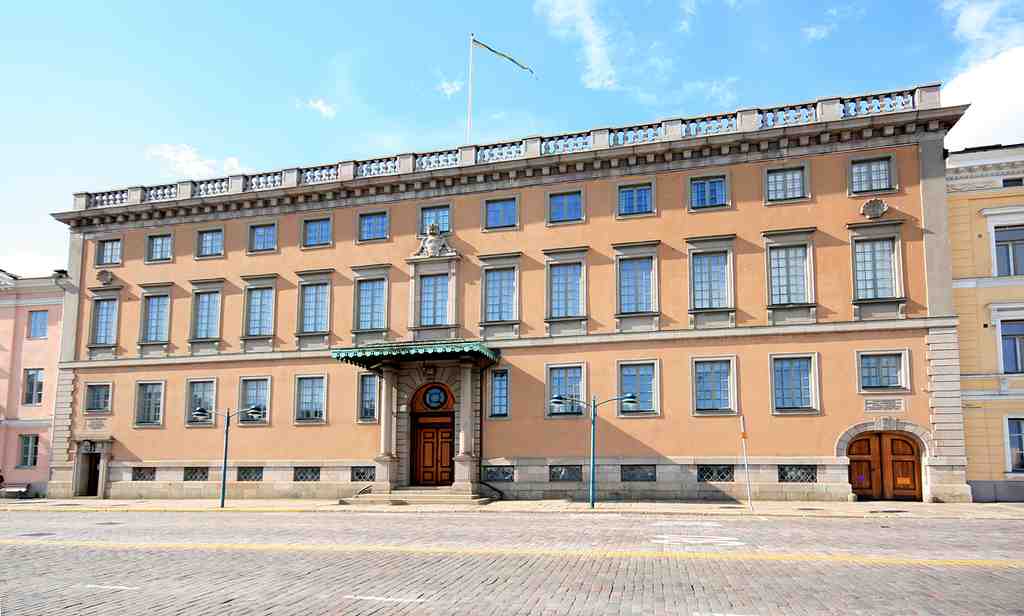
Look for the pale stone facade, the tall rectangular windows set in a strict row, and the formal entrance marked by embassy insignia on this stately building at Pohjois-Esplanadi seven.
Today it carries the calm face of diplomacy, but in February of nineteen oh six, this address held the Helsinki branch of the State Bank of Russia... and it became the scene of one of the city’s most shocking acts of political violence. The nineteen oh six Helsinki bank robbery was not a daredevil caper. It was a revolutionary operation, planned by professionals who believed ideas needed cash, and that cash could be taken at gunpoint.
The plot grew out of the unrest that followed the Russian Revolution of nineteen oh five and Finland’s general strike. A Latvian revolutionary named Jānis Luters, who used the alias Bobis, organized it from behind the scenes. He was experienced in prison escapes and arms deals. On the day itself, he stayed away. Instead, Jan Tshokke led a group of fifteen Latvian Bolsheviks - Bolsheviks being the hardline revolutionary wing of the Russian socialist movement - with help from Finnish activists, including Karl Gustaf Konrad Nyman, Walter Sjöberg, and the sculptor Alpo Sailo.
Inside this building, the violence came fast. The bank’s porter, Palandin, refused to raise his hands. The robbers shot him three times - in the ear, chest, and stomach - and stabbed him with a dagger. He died trying to resist. Staff and customers were forced into a side room. One customer, Elsa Zilliacus, an employee from another bank, lost the cash case she had brought in with her. In a matter of moments, the attackers seized a mixed haul of Russian rubles and Finnish marks worth one hundred and seventy thousand rubles... roughly two million euros in today’s money.
And here is the hard question this building leaves behind: when a political movement pays for its future with murder and robbery, does the cause excuse the act... or stain it forever?
The money did not vanish into local criminal circles. It fed a much larger struggle across the empire. Lenin had secretly visited Helsinki earlier that month, and later accounts suggest he likely approved the plan. Another conspirator, Nikolai Burenin - the son of a wealthy Saint Petersburg merchant and also a concert pianist - arranged to receive part of the loot in Tampere that same evening, while appearing in public at a concert. That contrast tells you everything: polished culture in one room, revolutionary finance in another.
Then the city’s neat lines broke apart. Some robbers fled toward Kerava, where a gendarme named Mihailov tried to arrest them and was shot dead. Others reached Tampere. There, Jan Tshokke’s arrest turned into a siege inside the police station. He pulled a hidden dagger during a body search, stabbed officers, fired a Browning pistol, shouted from the window for help, and held off police and volunteers for hours. By the end, two policemen and one civilian were dead, and seven others were wounded before firefighters and volunteers brought him down with a high-pressure water hose. Tshokke later received multiple life sentences and died in prison in nineteen ten.
So standing here, in front of this elegant facade, it becomes clear that money was never just money in this district. It was authority, obedience, rebellion... and blood. Once gunfire entered the center of Helsinki, every official building nearby felt less secure, less untouchable. In a moment, we’ll walk about two minutes to the Presidential Palace, where power tried to look composed even as the ground beneath it shook.
If you’re noting practical details, this site generally keeps longer hours on weekdays and shorter opening hours on weekends.




