
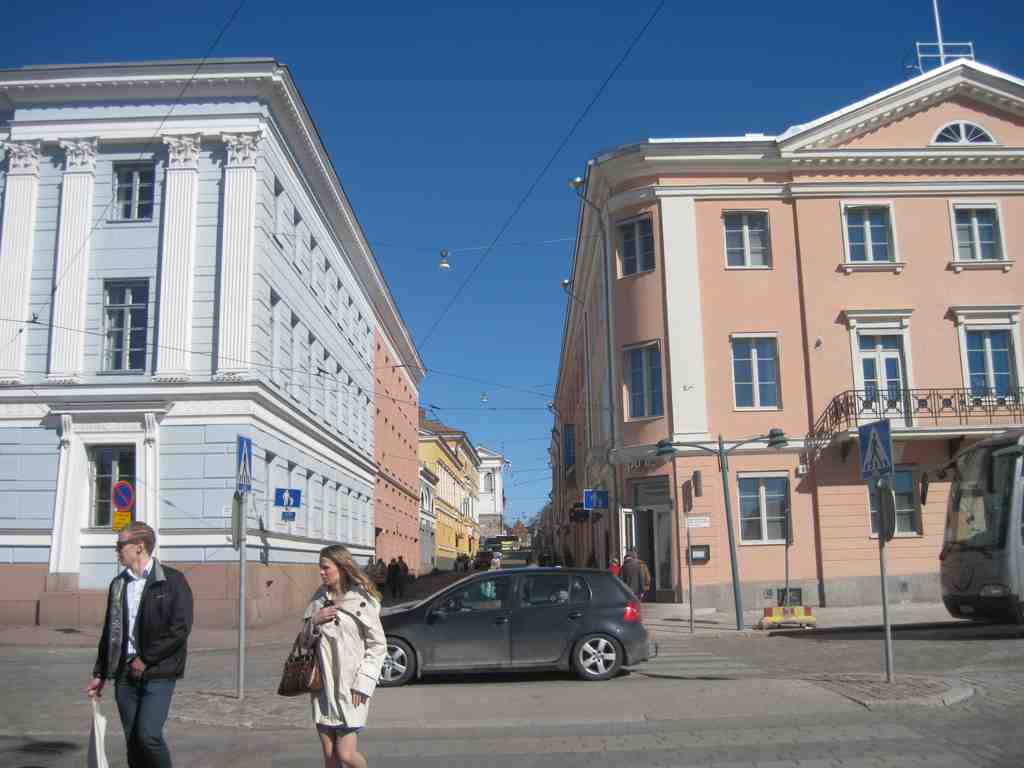
On your left, Tori Quarters looks like a linked cluster of pale plaster-and-stone empire buildings, laid out in crisp rectangular street blocks, with archways and gateways leading into hidden inner courtyards.
This is one of the places where Helsinki feels most human to me... not a single monument, but a whole weave of streets and rooms. Tori Quarters stretches between Senate Square and Market Square, bounded by Aleksanterinkatu to the north and Pohjoisesplanadi to the south. These four blocks - Elephant, Lion, Rhino, and Dromedary - formed the connective tissue of the city, where a merchant town slowly learned to live as a capital. Trade and government did not stand apart here. They shared walls, staircases, kitchens, and counting rooms.
That is why these blocks matter so much. The square nearby shows power in broad daylight. Here, power moved through errands, deliveries, rent books, hotel registers, and whispered deals. Rich and poor crossed paths constantly. A clerk might step out of an office and pass a porter, a diplomat, a cook, or a sailor on the same pavement.
If you want one building that captures that layered life, look toward Goviniuksen talo, on the corner by Katariinankatu. Most people pass its façade without a second glance. But behind it, for more than eighty years, Hotel Kleineh welcomed the city’s elite. Louis Kleineh, the restaurateur people called the restaurant king, turned it into a place where officials and cultural figures met over dinners, celebrations, and private conversations that never entered any archive. Fredrik Cygnaeus celebrated his fiftieth birthday there in style, and in eighteen sixty-one the sailing club Nyländska Jaktklubben began there. After Louis died, his widow kept the hotel’s refined reputation alive. A lot of Helsinki’s respectable surface was polished in rooms like those.
Elsewhere in these quarters, the stories get stranger. In the Lion block, Bock House served as the official residence of Finland’s governor-general from eighteen sixteen to eighteen thirty-eight, and later its grand Empire Hall hosted Helsinki’s first city council in eighteen seventy-five. One building, two kinds of authority: imperial rule first, local democracy after.
Then there was Kiseleff House in the Rhino block. Before shops and offices, it held a sugar factory. Sugar refining sounds sweet enough... but the process used cattle blood, stored on site, and the smell became so awful that it drifted over the new administrative center. Fire risk and stench finally drove the factory away to Töölönlahti in eighteen twenty-three. That is Helsinki in miniature: elegant plans, messy realities.
The city later moved office spaces out of these blocks, restored the old buildings, and reopened them for restaurants, cafés, shops, and courtyards. The work finished in twenty seventeen, and people began calling this Helsinki’s new old city. It is a fitting name. The façades look orderly, but the lives inside them were crowded with ambition.
And when money, empire, and unrest pressed this tightly together, the strain could turn violent.
In about two minutes, we’ll follow that pressure to the robbery of the Helsinki branch of the State Bank of Russia, where the city’s polished civic heart met revolution face to face.




