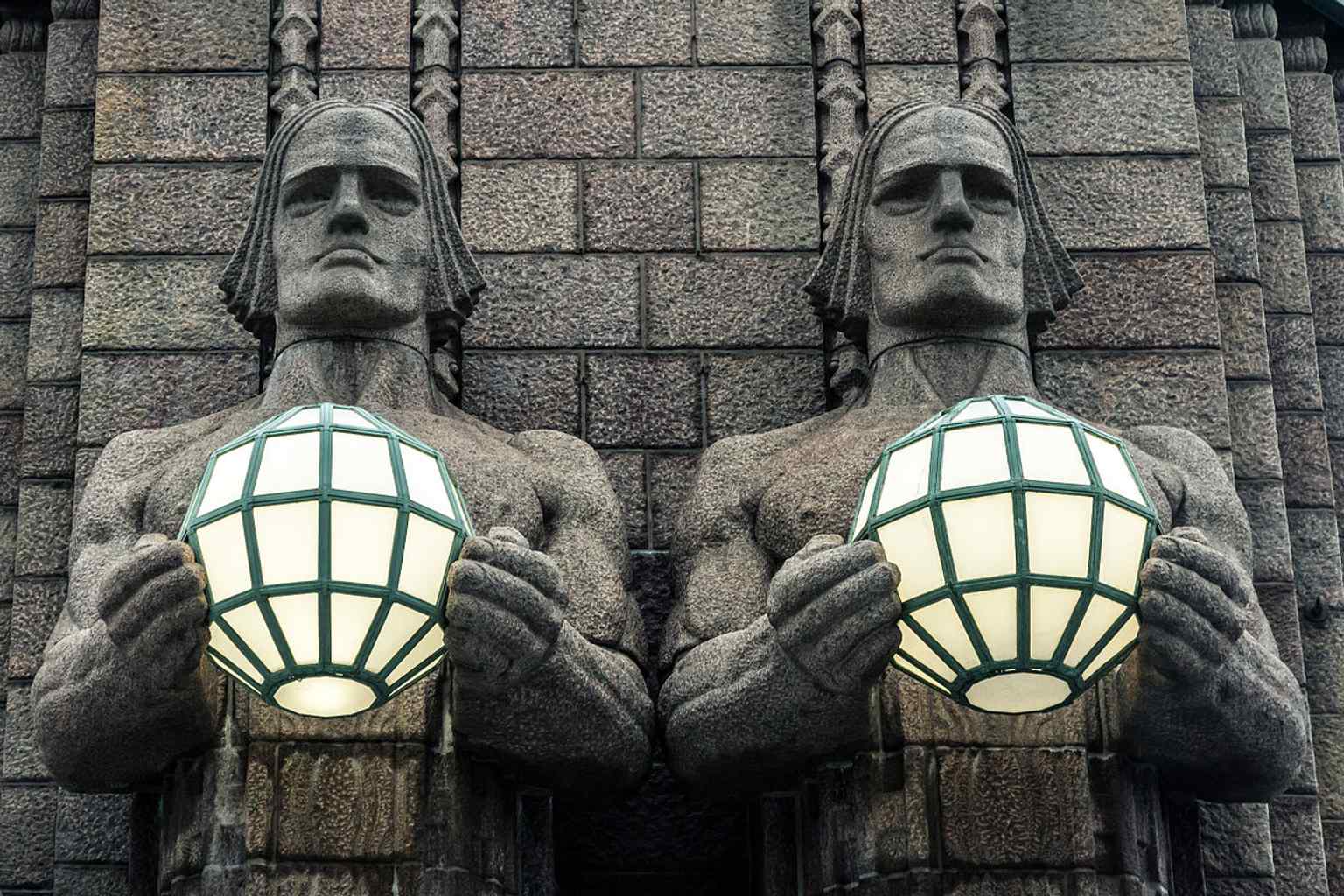
On your right, look for four colossal granite men built into the station entrance, each holding a round lamp, their square faces and cropped hair making the façade impossible to mistake.
These are the Lantern Bearers, completed in nineteen fourteen by the sculptor Emil Wikström, five years before the railway station itself opened. For a curious stretch of time, they stood here guarding a threshold that had not yet begun its full public life, as if Helsinki had placed its actors on stage before the audience arrived.
Eliel Saarinen, who designed this station, understood that a great arrival point should do more than function well. He gave Helsinki a granite drama in the flowing Jugend style, the northern version of art nouveau, where architecture turns symbolic and a doorway becomes a declaration. In his earliest ideas, bears flanked the entrance, but he abandoned them and asked for these giant men instead. It was a shrewd choice: bears would have decorated the station, but these figures almost become part of its structure, like ancient guardians holding the building’s meaning in their hands.
And they are ancient in spirit. Their upper bodies are muscular and unmistakably human, yet below the waist they taper into patterned pillar forms. That shape comes from the herm, a classical architectural figure that is part person, part column. So what you see is not quite statue and not quite support. It is something stranger: a human presence turned into civic stone.
Look at the faces. The story goes that Wikström gave them the features of a real man, Jalmari Lehtinen, known as Kappion Jalmari, a crofter and gardener from the sculptor’s Visavuori estate. Suddenly these stern giants become more intimate. A working man’s face, enlarged into myth, now watches generations arrive and depart.
If you glance at the close-up image in the app, the nearby people make the scale of these figures wonderfully clear. And if you fancy it, compare the historic view with today’s brighter forecourt; the composition has held its nerve across decades of travellers.
Later, the railway company, VR, gave them a second life in advertisements from two thousand and two onward. There, the Kivimiehet, the Stone Men, wandered Finland, holidayed in Lapland, even attended a statue conference in Verona. That campaign made them famous, but Helsinki already knew them well; in a two thousand and eight poll, they ranked among the city’s most loved outdoor sculptures.
They even left their posts briefly in two thousand and thirteen, when restorers dismantled them, cleaned the granite, and fitted new L-E-D lamps. The entrance looked oddly bereft without them.
Before you move on, study those jaws and lamp-bearing arms. Do they feel purely heroic, or do you sense the gardener still hiding in the stone? Helsinki announces itself here like a performance: monumental, slightly theatrical, and very sure of its entrance. Postitalo is about a minute away, and these guardians keep watch here around the clock.