
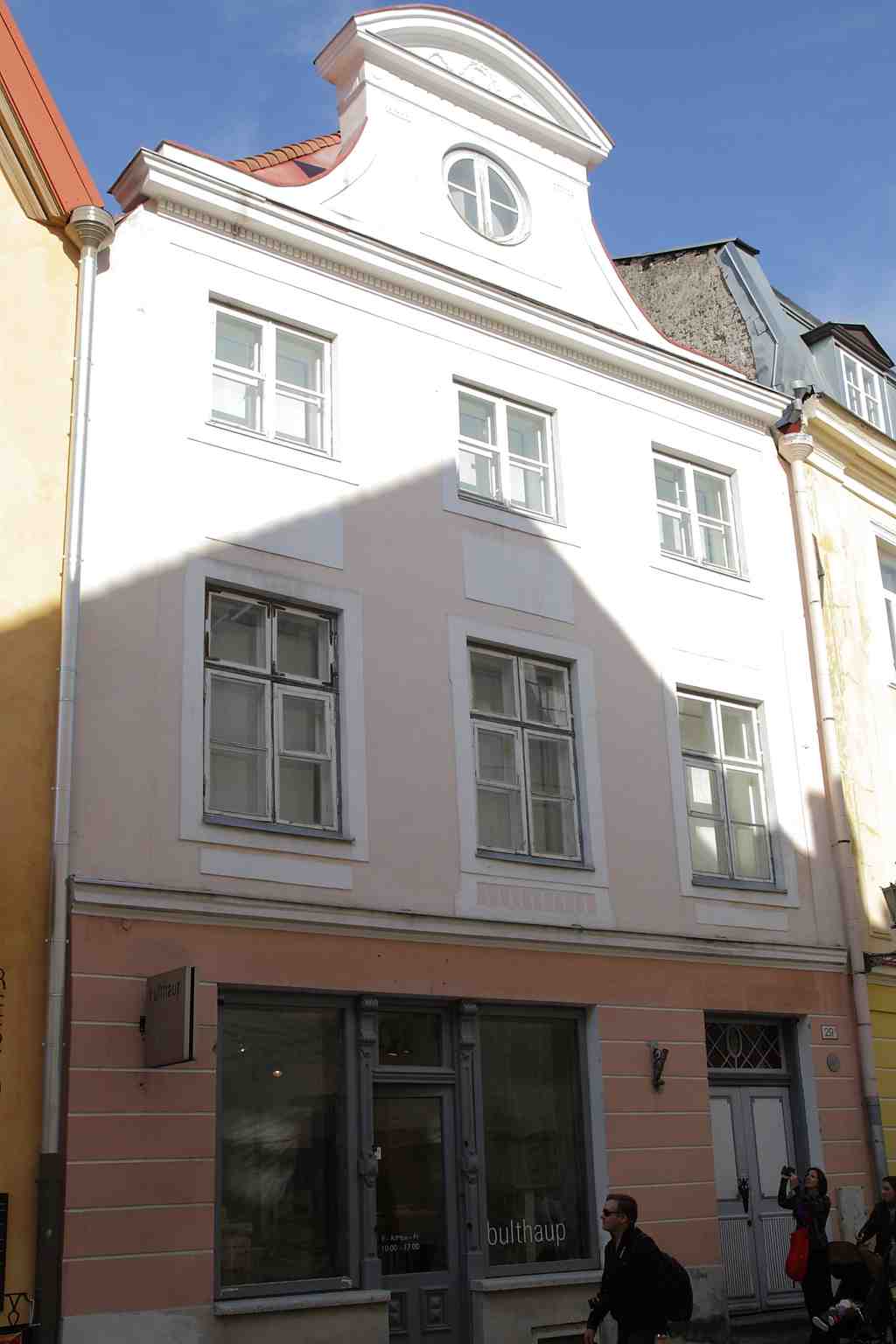
Look for the tall, narrow plaster-and-stone townhouse with a steep gable and an arched gateway cut into the façade.
This house on Pikk Street holds one of Tallinn’s most delicate arguments: how a city names the people who belong to it. Until the sixth of September, twenty twenty-four, this was the Tallinn Russian Museum. Then the city renamed it the Museum of the Peoples of Tallinn, part of a broader move to remove the word “Russian” from public institutions. That might sound abrupt, but Tallinn has long survived by revising its labels after political breaks, occupations, and new beginnings. Here, reinvention does not wipe the slate clean. It rearranges the shelves, rewrites the caption, and asks again who gets represented in public memory.
The museum opened in twenty sixteen to preserve and present the heritage of Tallinn’s Russian community. Yet its own staff later argued that the exhibitions had already grown beyond a single story, reflecting the traditions of many peoples living in Tallinn and their contribution to the city’s culture. So the new name did not invent a wider mission from nothing; it made official a shift that had been gathering for years.
That question stretches back much further. In nineteen thirty-one, inside the Great Guild building nearby, organisers staged the first Russian Exhibition. It was a deliberate act of communal self-preservation through display: icons, church silver, theatre designs by the stage artist Yepinatyev, and paintings by local artists such as Anatoly Kaigorodov, Alexander Grinyov, and Viktor Alekseyev. The exhibition drew prominent visitors, including Colonel Jakobsen, Bishop Ioann of Pechory, and later President Konstantin Päts. Encouraged by the response, the organisers asked the government for a permanent museum. Economic hardship stopped them.
The idea returned, and returned again. In the two thousands, politicians such as Sergei Ivanov and Stanislav Cherepanov pushed for it. Then came a bruising legal struggle sometimes called the “war of two museums”: the city had the building, while Ivanov’s non-profit held on to the collection and told the court the objects were stored in a safe place known only to the Ministry of Culture. Even memory, it seems, can be contested property.
And then there is the house itself, number twenty-nine-a, the Nottbeck House, protected as an architectural monument. People often call it medieval, but that is only part of the truth. Its present face is a collage of rebuildings. In the early twentieth century, the Estonian painter Ants Laikmaa worked here. He opened what became Estonia’s first art school in this very building, and his studio mixed Estonians, Russians, and Baltic Germans in one creative room. One surviving photograph shows Laikmaa posing in the courtyard with Roma companions, an image bold enough to unsettle respectable old Reval society. He understood something this museum still wrestles with: identity is never still, and culture refuses neat borders.
Inside, there is no fixed permanent display yet, only temporary exhibitions, which somehow suits the place. This is a museum that keeps admitting the story is still being edited.
Now, just ahead, we meet a brotherhood that protected its place in the city far more physically, locking status and treasure behind its own walls: the House of the Blackheads. If you plan to return, the museum is usually open Wednesday to Sunday from eleven in the morning until six in the evening, and closed on Mondays and Tuesdays.




